Thank you for visiting SNEWPapers!
Sign up free
Literary
October 23, 1823
The Rhode Island Republican
Newport, Newport County, Rhode Island
What is this article about?
In Greenwich Hospital, sailors Joe Jennings and Tom Pipes banter and share stories. Joe recounts his injuries, then they narrate the tragic tale of Bill Neville: after shipwreck and impressment, he reunites with wife Nancy and infant son, only for both to die together in a naval battle against the French.
Clipping
OCR Quality
88%
Good
Full Text
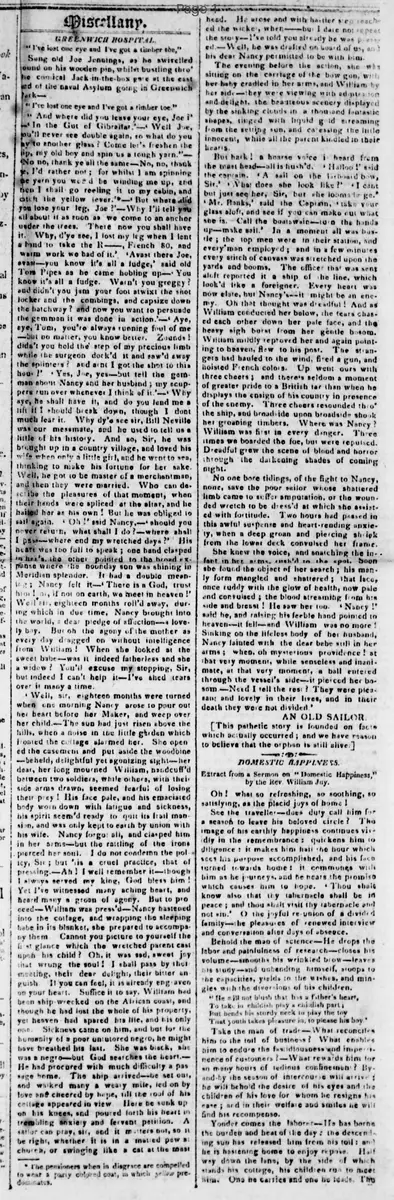
Miscellany.
GREENWICH HOSPITAL
"I've lost one eye and I've got a timber toe,"
Sung old Joe Jennings, as he swiveled
round on his wooden pin, whilst bustling thro'
the comical Jack-in-the-box gait at the east
end of the naval Asylum going in Greenwich
park --
"I've lost one eye and I've got a timber toe."
"And where did you leave your eye, Joe?"
"In the Gut of Gibraltar," -- "Well Joe,
but never see double again, to what do you
have to another glass? Come let's freshen the
lip, my old boy and spin us a tough yarn." --
No no, thank ye all the same -- No, no, thank
I'd rather not; for whilst I am spinning
the yarn you would be winding me up, and
then I shall go rolling it to my cabin, and
catch the yellow fever." -- "But where did
you lose your leg, Joe?" -- Why I'll tell you
all about it as soon as we come to an anchor
under the trees. There now you shall have
it. Why, d'ya see, I lost my leg when I lent
a hand to take the R-a-, French 80, and
warm work we had of it." "Avast there Joe,
avast -- you know it's all a fudge," said old
Tom Pipes as he came hobbling up -- "You
know it's all a fudge. Warn't you groggy?
and didn't you jam your foot atwixt the shot
locker and the combings, and capsize down
the hatchway? and now you want to persuade
the gemman it was done in action." "Aye,
aye, Tom, you're always running foul of me
-- but no matter, you know better. Zounds!
didn't you hold the step of my precious limb
while the surgeon dock'd it and saw'd away
the splinters? and arn't I got the shot to this
hour?" "Yes, Joe, yes -- but tell the gem.
man about Nancy and her husband; my cop-
pers run over whenever I think of it." -- "Why
aye, he shall have it, and do you lend me a
hand if I should break down, though I don't
much fear it. Why d'y see our, Bill Neville
was our messmate, and he used to tell us a
little of his history. And so, Sir, he was
brought up in a country village, and loved his
wife when only a little girl, and he went to sea,
thinking to make his fortune for her sake.
Well, he got to be master of a merchantman,
and then they were married. Who can de-
scribe the pleasures of that moment, when
their hands were spliced at the altar, and he
hailed her as his own! But he was obliged to
sail again. "Oh!" said Nancy, -- "should you
never return, what shall I do? -- where shall
I pass where end my wretched days?" His
heart was too full to speak: one hand clasped
in hers, the other pointed to the broad ex-
panse where the noonday sun was shining in
Meridian splendor. It had a double mean-
ing: Nancy felt it -- "There is a God, trust
him! oh, if not on earth, we meet in heaven!"
Well, Sir, eighteen months rolled away, dur-
ing which in due time, Nancy brought into
the world, a dear pledge of affection -- a love-
ly boy. But oh the agony of the mother as
every day dragged on without intelligence
from William! When she looked at the
sweet babe -- was it indeed fatherless and she
a widow? You'll excuse my stopping, Sir,
but indeed I can't help it -- I've shed tears
over it many a time.
Well, sir, eighteen months were turned
when one morning Nancy arose to pour out
her heart before her Maker, and weep over
her child. -- The sun had just risen above the
hills, when a noise in the little garden which
fronted the cottage alarmed her. She opened
the casement and put aside the woodbine
-- beheld, delightful yet agonizing sight -- her
dear, her long mourned William, handcuff'd
between two soldiers, while others, with their
side arms drawn, seemed fearful of losing
their prey! His face pale, and his emaciated
body worn down with fatigue and sickness,
his spirit seem'd ready to quit its frail man-
sion, and was only kept to earth by union with
his wife. Nancy forgot all, and clasped him
in her arms -- but the rattling of the irons
pierced her soul. I do not condemn the pol-
cy, Sir; but 'tis a cruel practice, that of
pressing. -- Ah! well remember it -- though
I always served my king, God bless him!
Yet I've witnessed many aching heart, and
heard many a groan of agony. But to pro-
ceed -- William was pressed -- Nancy hastened
into the cottage, and wrapping the sleeping
babe in its blanket, she prepared to accompa-
ny them. Cannot you picture to yourself the
first glance which the wretched parent cast
upon his child? Oh, it was sad, sweet joy
that wrung the soul! I shall pass by their
meeting, their dear delight, their bitter an-
guish. If you can feel, it is already engraven
on your heart. Suffice it to say, William had
been ship-wrecked on the African coast, and
though he had lost the whole of his property,
yet heaven had spared his life, and his only
one. Sickness came on him, and but for the
humanity of a poor untutored negro, he might
have breathed his last. She was black, she
was a negro -- but God searches the heart --
He had procured with much difficulty a pas-
sage home. The ship arrived -- he set out,
and walked many a weary mile, led on by
love and cheered by hope, till the roof of his
cottage appeared in view. Here he sunk on
his knees, and poured forth his heart in
trembling anxiety and fervent petition. A
sailor can pray, sir, and it matters not, so it
be right, whether it is in a cushioned pew at
church, or swinging like a cat at the mast
head. He rose and with hastier step reached
the wicket, when -- by I dare not repeat
the story -- I've told you already he was pressed.
-- Well, he was drafted on board of us, and
his dear Nancy permitted to be with him.
The evening before the action, she was
sitting on the carriage of the bow gun, with
her baby cradled in her arms, and William by
her side -- they were viewing with admiration
and delight, the beauteous scenery displayed
by the sinking clouds in a thousand fantastic
shapes, tinged with liquid gold streaming
from the setting sun, and caressing the little
innocent, while all the parent kindled in their
hearts.
But hark! a hoarse voice is heard from
the mast head -- all is hushed. "Halloo!" said
the captain. "A sail on the larboard bow,
Sir." "What does she look like?" "I can't
but just see her, Sir, but she looms large."
"Mr. Banks," said the Captain, "take your
glass aloft, and see if you can make out what
she is." -- "Call the boatswain -- turn the hands
up -- make sail." In a moment all was bus-
tle; the top men were in their stations, and
every man employed; and in a few minutes
every stitch of canvass was stretched upon the
yards and booms. The officer that was sent
aloft reported it a ship of the line, which
looked like a foreigner. Every heart was
now elate, but Nancy's -- it might be an ene-
my. Oh that thought was dreadful! And as
William conducted her below, the tears chased
each other down her pale face, and the
heavy sigh burst from her gentle bosom.
William mildly reproved her and again pointing to heaven, flew to his post. The stran-
gers had hauled to the wind, fired a gun, and
hoisted French colors. Up went ours with
three cheers; and there's seldom a moment
of greater pride to a British tar than when he
displays the ensign of his country in presence
of the enemy. Three cheers resounded thro'
the ship, and broad-side upon broadside shook
her groaning timbers. Where was Nancy?
William was first in every danger. Three
times we boarded the foe, but were repulsed.
Dreadful grew the scene of blood and horror
through the darkening shades of coming
night.
No one bore tidings of the fight to Nancy,
none, save the poor sailor whose shattered
limb came to suffer amputation, or the woun-
ded wretch to be dressed at which she assist-
ed with fortitude. Two hours had passed in
this awful suspense and heart-rending anxie-
ty, when a deep groan and piercing shriek
from the lower deck convulsed her frame.
She knew the voice, and snatching the in-
fant in her arms, rushed to the spot. Soon
she found the object of her search; his man-
ly form mangled and shattered; that face,
once ruddy with the glow of health, now pale
and convulsed; the blood streaming from his
side and breast! He saw her too. "Nancy!"
said he, and raising his feeble hand pointed to
heaven -- it fell -- and William was no more.
Sinking on the lifeless body of her husband,
Nancy fainted with the dear babe still in her
arms; when, oh mysterious providence! at
that very moment, while senseless and inani-
mate, at that very moment, a ball entered
through the vessel's side -- it pierced her bo-
som -- Need I tell the rest? They were plea-
sant and lovely in their lives, and in their
death they were not divided."
AN OLD SAILOR.
This pathetic story is founded on facts
which actually occurred; and we have reason
to believe that the orphan is still alive.
GREENWICH HOSPITAL
"I've lost one eye and I've got a timber toe,"
Sung old Joe Jennings, as he swiveled
round on his wooden pin, whilst bustling thro'
the comical Jack-in-the-box gait at the east
end of the naval Asylum going in Greenwich
park --
"I've lost one eye and I've got a timber toe."
"And where did you leave your eye, Joe?"
"In the Gut of Gibraltar," -- "Well Joe,
but never see double again, to what do you
have to another glass? Come let's freshen the
lip, my old boy and spin us a tough yarn." --
No no, thank ye all the same -- No, no, thank
I'd rather not; for whilst I am spinning
the yarn you would be winding me up, and
then I shall go rolling it to my cabin, and
catch the yellow fever." -- "But where did
you lose your leg, Joe?" -- Why I'll tell you
all about it as soon as we come to an anchor
under the trees. There now you shall have
it. Why, d'ya see, I lost my leg when I lent
a hand to take the R-a-, French 80, and
warm work we had of it." "Avast there Joe,
avast -- you know it's all a fudge," said old
Tom Pipes as he came hobbling up -- "You
know it's all a fudge. Warn't you groggy?
and didn't you jam your foot atwixt the shot
locker and the combings, and capsize down
the hatchway? and now you want to persuade
the gemman it was done in action." "Aye,
aye, Tom, you're always running foul of me
-- but no matter, you know better. Zounds!
didn't you hold the step of my precious limb
while the surgeon dock'd it and saw'd away
the splinters? and arn't I got the shot to this
hour?" "Yes, Joe, yes -- but tell the gem.
man about Nancy and her husband; my cop-
pers run over whenever I think of it." -- "Why
aye, he shall have it, and do you lend me a
hand if I should break down, though I don't
much fear it. Why d'y see our, Bill Neville
was our messmate, and he used to tell us a
little of his history. And so, Sir, he was
brought up in a country village, and loved his
wife when only a little girl, and he went to sea,
thinking to make his fortune for her sake.
Well, he got to be master of a merchantman,
and then they were married. Who can de-
scribe the pleasures of that moment, when
their hands were spliced at the altar, and he
hailed her as his own! But he was obliged to
sail again. "Oh!" said Nancy, -- "should you
never return, what shall I do? -- where shall
I pass where end my wretched days?" His
heart was too full to speak: one hand clasped
in hers, the other pointed to the broad ex-
panse where the noonday sun was shining in
Meridian splendor. It had a double mean-
ing: Nancy felt it -- "There is a God, trust
him! oh, if not on earth, we meet in heaven!"
Well, Sir, eighteen months rolled away, dur-
ing which in due time, Nancy brought into
the world, a dear pledge of affection -- a love-
ly boy. But oh the agony of the mother as
every day dragged on without intelligence
from William! When she looked at the
sweet babe -- was it indeed fatherless and she
a widow? You'll excuse my stopping, Sir,
but indeed I can't help it -- I've shed tears
over it many a time.
Well, sir, eighteen months were turned
when one morning Nancy arose to pour out
her heart before her Maker, and weep over
her child. -- The sun had just risen above the
hills, when a noise in the little garden which
fronted the cottage alarmed her. She opened
the casement and put aside the woodbine
-- beheld, delightful yet agonizing sight -- her
dear, her long mourned William, handcuff'd
between two soldiers, while others, with their
side arms drawn, seemed fearful of losing
their prey! His face pale, and his emaciated
body worn down with fatigue and sickness,
his spirit seem'd ready to quit its frail man-
sion, and was only kept to earth by union with
his wife. Nancy forgot all, and clasped him
in her arms -- but the rattling of the irons
pierced her soul. I do not condemn the pol-
cy, Sir; but 'tis a cruel practice, that of
pressing. -- Ah! well remember it -- though
I always served my king, God bless him!
Yet I've witnessed many aching heart, and
heard many a groan of agony. But to pro-
ceed -- William was pressed -- Nancy hastened
into the cottage, and wrapping the sleeping
babe in its blanket, she prepared to accompa-
ny them. Cannot you picture to yourself the
first glance which the wretched parent cast
upon his child? Oh, it was sad, sweet joy
that wrung the soul! I shall pass by their
meeting, their dear delight, their bitter an-
guish. If you can feel, it is already engraven
on your heart. Suffice it to say, William had
been ship-wrecked on the African coast, and
though he had lost the whole of his property,
yet heaven had spared his life, and his only
one. Sickness came on him, and but for the
humanity of a poor untutored negro, he might
have breathed his last. She was black, she
was a negro -- but God searches the heart --
He had procured with much difficulty a pas-
sage home. The ship arrived -- he set out,
and walked many a weary mile, led on by
love and cheered by hope, till the roof of his
cottage appeared in view. Here he sunk on
his knees, and poured forth his heart in
trembling anxiety and fervent petition. A
sailor can pray, sir, and it matters not, so it
be right, whether it is in a cushioned pew at
church, or swinging like a cat at the mast
head. He rose and with hastier step reached
the wicket, when -- by I dare not repeat
the story -- I've told you already he was pressed.
-- Well, he was drafted on board of us, and
his dear Nancy permitted to be with him.
The evening before the action, she was
sitting on the carriage of the bow gun, with
her baby cradled in her arms, and William by
her side -- they were viewing with admiration
and delight, the beauteous scenery displayed
by the sinking clouds in a thousand fantastic
shapes, tinged with liquid gold streaming
from the setting sun, and caressing the little
innocent, while all the parent kindled in their
hearts.
But hark! a hoarse voice is heard from
the mast head -- all is hushed. "Halloo!" said
the captain. "A sail on the larboard bow,
Sir." "What does she look like?" "I can't
but just see her, Sir, but she looms large."
"Mr. Banks," said the Captain, "take your
glass aloft, and see if you can make out what
she is." -- "Call the boatswain -- turn the hands
up -- make sail." In a moment all was bus-
tle; the top men were in their stations, and
every man employed; and in a few minutes
every stitch of canvass was stretched upon the
yards and booms. The officer that was sent
aloft reported it a ship of the line, which
looked like a foreigner. Every heart was
now elate, but Nancy's -- it might be an ene-
my. Oh that thought was dreadful! And as
William conducted her below, the tears chased
each other down her pale face, and the
heavy sigh burst from her gentle bosom.
William mildly reproved her and again pointing to heaven, flew to his post. The stran-
gers had hauled to the wind, fired a gun, and
hoisted French colors. Up went ours with
three cheers; and there's seldom a moment
of greater pride to a British tar than when he
displays the ensign of his country in presence
of the enemy. Three cheers resounded thro'
the ship, and broad-side upon broadside shook
her groaning timbers. Where was Nancy?
William was first in every danger. Three
times we boarded the foe, but were repulsed.
Dreadful grew the scene of blood and horror
through the darkening shades of coming
night.
No one bore tidings of the fight to Nancy,
none, save the poor sailor whose shattered
limb came to suffer amputation, or the woun-
ded wretch to be dressed at which she assist-
ed with fortitude. Two hours had passed in
this awful suspense and heart-rending anxie-
ty, when a deep groan and piercing shriek
from the lower deck convulsed her frame.
She knew the voice, and snatching the in-
fant in her arms, rushed to the spot. Soon
she found the object of her search; his man-
ly form mangled and shattered; that face,
once ruddy with the glow of health, now pale
and convulsed; the blood streaming from his
side and breast! He saw her too. "Nancy!"
said he, and raising his feeble hand pointed to
heaven -- it fell -- and William was no more.
Sinking on the lifeless body of her husband,
Nancy fainted with the dear babe still in her
arms; when, oh mysterious providence! at
that very moment, while senseless and inani-
mate, at that very moment, a ball entered
through the vessel's side -- it pierced her bo-
som -- Need I tell the rest? They were plea-
sant and lovely in their lives, and in their
death they were not divided."
AN OLD SAILOR.
This pathetic story is founded on facts
which actually occurred; and we have reason
to believe that the orphan is still alive.
What sub-type of article is it?
Prose Fiction
Dialogue
What themes does it cover?
Love Romance
War Peace
Liberty Freedom
What keywords are associated?
Sailor Yarn
Impressment
Naval Battle
Tragic Love
Greenwich Hospital
What entities or persons were involved?
An Old Sailor.
Literary Details
Title
Greenwich Hospital
Author
An Old Sailor.
Key Lines
"I've Lost One Eye And I've Got A Timber Toe," Sung Old Joe Jennings, As He Swiveled Round On His Wooden Pin...
They Were Pleasant And Lovely In Their Lives, And In Their Death They Were Not Divided.
This Pathetic Story Is Founded On Facts Which Actually Occurred; And We Have Reason To Believe That The Orphan Is Still Alive.