Thank you for visiting SNEWPapers!
Sign up free
Literary
July 2, 1788
The New York Journal, And Daily Patriotic Register
New York, New York County, New York
What is this article about?
Essay from Worcester Speculator No. 25 exploring how sympathy and social interaction amplify human happiness, emphasizing the joy of sharing feelings and experiences with friends, while cautioning against excessive familiarity leading to folly.
Clipping
OCR Quality
95%
Excellent
Full Text
MISCELLANY.
From Thomas's MASSACHUSETTS SPY, &c.
WORCESTER SPECULATOR, NO. 25.
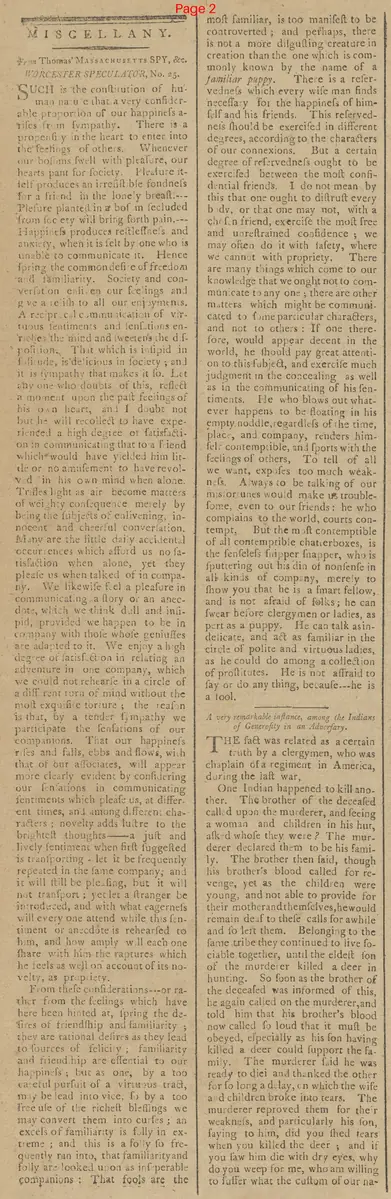
SUCH is the constitution of human nature that a very considerable proportion of our happiness arises from sympathy.
There is a propensity in the heart to enter into the feelings of others.
Whenever our bosoms swell with pleasure, our hearts pant for society. Pleasure itself produces an irresistible fondness for a friend in the lonely breast.—Pleasure planted in a bosom secluded from society will bring forth pain.—Happiness produces restlessness and anxiety, when it is felt by one who is unable to communicate it. Hence springs the commendableness of freedom and familiarity. Society and conversation enliven our feelings and give a relish to all our enjoyments.
A reciprocal communication of virtuous sentiments and sensations enriches the mind and sweetens the disposition. That which is insipid in solitude, is delicious in society; and it is sympathy that makes it so. Let any one who doubts of this, reflect a moment upon the past feelings of his own heart, and I doubt not but he will recollect to have experienced a high degree of satisfaction in communicating that to a friend which would have yielded him little or no amusement to have revolved in his own mind when alone.
Trifles light as air become matters of weighty consequence merely by being the subjects of enlivening, innocent and cheerful conversation. Many are the little daily accidental occurrences which afford us no satisfaction when alone, yet they please us when talked of in company. We likewise feel a pleasure in communicating a story or an anecdote, which we think dull and insipid, provided we happen to be in company with those whose geniuses are adapted to it. We enjoy a high degree of satisfaction in relating an adventure in one company, which we could not rehearse in a circle of a different turn of mind without the most exquisite torture; the reason is that, by a tender sympathy we participate the sensations of our companions. That our happiness rises and falls, ebbs and flows, with that of our associates, will appear more clearly evident by considering our sensations in communicating sentiments which please us, at different times, and among different characters; novelty adds lustre to the brightest thoughts—a just and lively sentiment when first suggested is transporting—let it be frequently repeated in the same company; and it will still be pleasing, but it will not transport; yet let a stranger be introduced, and with what eagerness will every one attend while this sentiment or anecdote is rehearsed to him, and how amply will each one share with him the raptures which he feels as well on account of its novelty, as propriety.
From these considerations—or rather from the feelings which have here been hinted at, spring the desires of friendship and familiarity; they are rational desires as they lead to sources of felicity; familiarity and friendship are essential to our happiness; but as one, by a too careful pursuit of a virtuous tract, may be led into vice, so by a too free use of the richest blessings we may convert them into curses; an excess of familiarity is folly in extreme; and this is a folly so frequently run into, that familiarity and folly are looked upon as inseparable companions: That fools are the
From Thomas's MASSACHUSETTS SPY, &c.
WORCESTER SPECULATOR, NO. 25.
SUCH is the constitution of human nature that a very considerable proportion of our happiness arises from sympathy.
There is a propensity in the heart to enter into the feelings of others.
Whenever our bosoms swell with pleasure, our hearts pant for society. Pleasure itself produces an irresistible fondness for a friend in the lonely breast.—Pleasure planted in a bosom secluded from society will bring forth pain.—Happiness produces restlessness and anxiety, when it is felt by one who is unable to communicate it. Hence springs the commendableness of freedom and familiarity. Society and conversation enliven our feelings and give a relish to all our enjoyments.
A reciprocal communication of virtuous sentiments and sensations enriches the mind and sweetens the disposition. That which is insipid in solitude, is delicious in society; and it is sympathy that makes it so. Let any one who doubts of this, reflect a moment upon the past feelings of his own heart, and I doubt not but he will recollect to have experienced a high degree of satisfaction in communicating that to a friend which would have yielded him little or no amusement to have revolved in his own mind when alone.
Trifles light as air become matters of weighty consequence merely by being the subjects of enlivening, innocent and cheerful conversation. Many are the little daily accidental occurrences which afford us no satisfaction when alone, yet they please us when talked of in company. We likewise feel a pleasure in communicating a story or an anecdote, which we think dull and insipid, provided we happen to be in company with those whose geniuses are adapted to it. We enjoy a high degree of satisfaction in relating an adventure in one company, which we could not rehearse in a circle of a different turn of mind without the most exquisite torture; the reason is that, by a tender sympathy we participate the sensations of our companions. That our happiness rises and falls, ebbs and flows, with that of our associates, will appear more clearly evident by considering our sensations in communicating sentiments which please us, at different times, and among different characters; novelty adds lustre to the brightest thoughts—a just and lively sentiment when first suggested is transporting—let it be frequently repeated in the same company; and it will still be pleasing, but it will not transport; yet let a stranger be introduced, and with what eagerness will every one attend while this sentiment or anecdote is rehearsed to him, and how amply will each one share with him the raptures which he feels as well on account of its novelty, as propriety.
From these considerations—or rather from the feelings which have here been hinted at, spring the desires of friendship and familiarity; they are rational desires as they lead to sources of felicity; familiarity and friendship are essential to our happiness; but as one, by a too careful pursuit of a virtuous tract, may be led into vice, so by a too free use of the richest blessings we may convert them into curses; an excess of familiarity is folly in extreme; and this is a folly so frequently run into, that familiarity and folly are looked upon as inseparable companions: That fools are the
What sub-type of article is it?
Essay
What themes does it cover?
Friendship
Moral Virtue
Social Manners
What keywords are associated?
Sympathy
Happiness
Society
Friendship
Familiarity
Conversation
Human Nature
Moral Reflection
Literary Details
Title
Worcester Speculator, No. 25.
Key Lines
Such Is The Constitution Of Human Nature That A Very Considerable Proportion Of Our Happiness Arises From Sympathy.
There Is A Propensity In The Heart To Enter Into The Feelings Of Others.
A Reciprocal Communication Of Virtuous Sentiments And Sensations Enriches The Mind And Sweetens The Disposition.
Familiarity And Friendship Are Essential To Our Happiness; But As One, By A Too Careful Pursuit Of A Virtuous Tract, May Be Led Into Vice, So By A Too Free Use Of The Richest Blessings We May Convert Them Into Curses