Thank you for visiting SNEWPapers!
Sign up free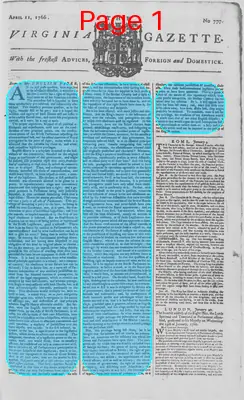
Story
April 11, 1766
The Virginia Gazette
Richmond, Williamsburg, Richmond County, Virginia
What is this article about?
An opinion piece from an English paper arguing against the British Parliament's right to impose taxes on American colonies, citing lack of representation, colonial charters, and principles of English liberty, warning of potential consequences for loyalty.
Clipping
OCR Quality
95%
Excellent
Full Text
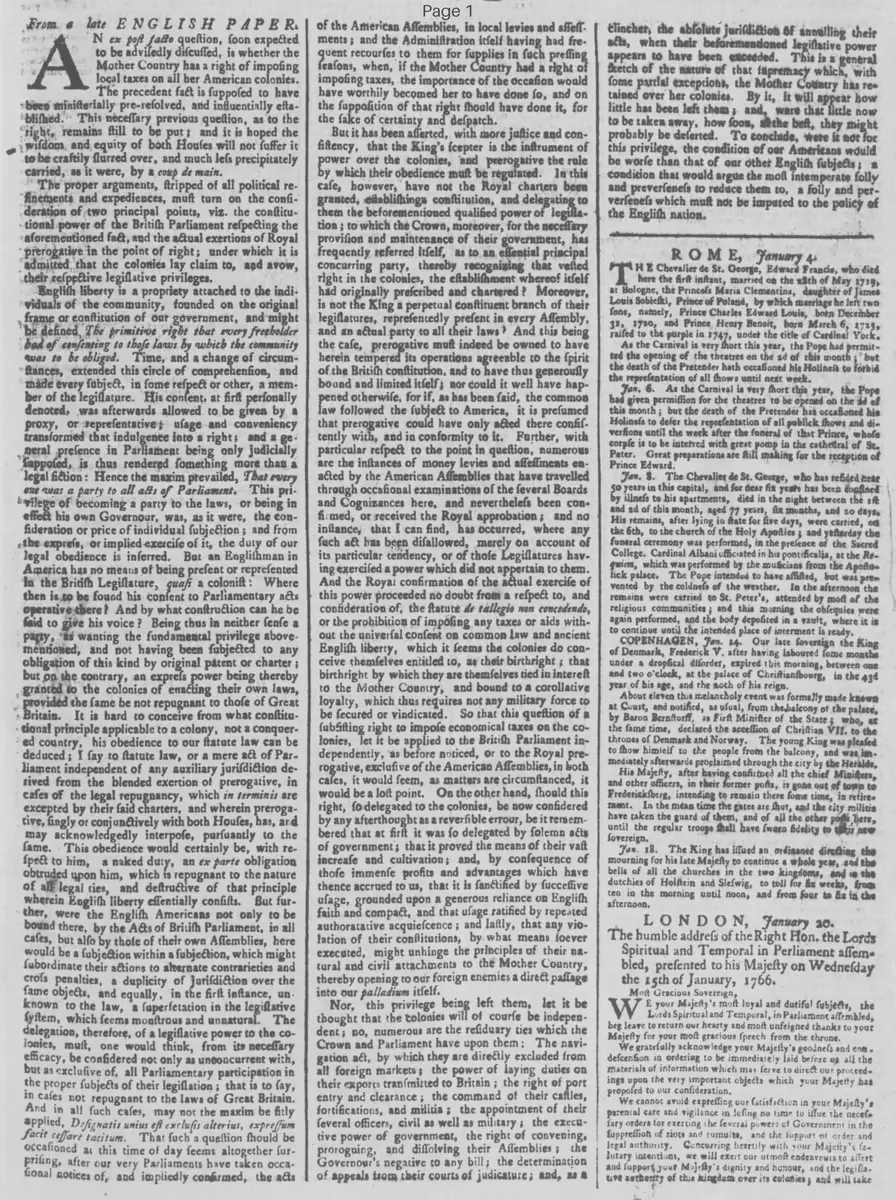
From a late ENGLISH PAPER.
The next post-haste question, soon expected to be advisedly discussed, is whether the Mother Country has a right of imposing local taxes on all her American colonies. The precedent fact is supposed to have been ministerially pre-resolved, and influentially established. This necessary previous question, as to the right, remains still to be put; and it is hoped the wisdom, and equity of both Houses will not suffer it to be craftily slurred over, and much less precipitately carried, as it were, by a coup de main.
The proper arguments, stripped of all political refinements and expediences, must turn on the consideration of two principal points, viz. the constitutional power of the British Parliament respecting the aforementioned fact, and the actual exertions of Royal prerogative in the point of right; under which it is admitted that the colonies lay claim to, and avow, their respective legislative privileges.
English liberty is a propriety attached to the individuals of the community, founded on the original frame or constitution of our government, and might be defined The primitive right that every freeholder had of consenting to those laws by which the community was to be obliged. Time, and a change of circumstances, extended this circle of comprehension, and made every subject, in some respect or other, a member of the legislature. His consent, at first personally denoted, was afterwards allowed to be given by proxy, or representative; usage and conveniency transformed that indulgence into a right; and general presence in Parliament being only judicially supposed, is thus rendered something more than a legal fiction: Hence the maxim prevailed, That every one was a party to all acts of Parliament. This privilege of becoming a party to the laws, or being in effect his own Governour, was, as it were, the consideration or price of individual subjection; and from the express, or implied exercise of it, the duty of our legal obedience is inferred. But an Englishman in America has no means of being present or represented in the British Legislature, qua a colonist: Where then is to be found his consent to Parliamentary acts operative there? And by what construction can he be said to give his voice? Being thus in neither sense a party, as wanting the fundamental privilege above-mentioned, and not having been subjected to any obligation of this kind by original patent or charter; but on the contrary, an express power being thereby granted to the colonies of enacting their own laws, provided the same be not repugnant to those of Great Britain. It is hard to conceive from what constitutional principle applicable to a colony, not a conquered country, his obedience to our statute law can be deduced: I say to statute law. or a mere act of Parliament independent of any auxiliary jurisdiction derived from the blended exertion of prerogative, in cases of the legal repugnancy, which in terminis are excepted by their said charters, and wherein prerogative, singly or conjunctively with both Houses, has, and may acknowledgedly interpose, pursuant to the same. This obedience would certainly be, with respect to him, a naked duty, an ex parte obligation obtruded upon him, which is repugnant to the nature of all legal ties. and destructive of that principle wherein English liberty essentially consists. But further, were the English Americans not only to be bound there. by the Acts of British Parliament, in all cases, but also by those of their own Assemblies, here would be a subjection within a subjection, which might subordinate their actions to alternate contrarieties and cross penalties, a duplicity of jurisdiction over the same objects, and equally, in the first instance, unknown to the law, a superposition in the legislative system, which seems monstrous and unnatural. The delegation, therefore, of a legislative power to the colonies, must, one would think, from its necessary efficacy, be considered not only as unconcurrent with, but as exclusive of, all Parliamentary participation in the proper subjects of their legislation ; that is to say, in cases not repugnant to the laws of Great Britain. And in all such cases, may not the maxim be fitly applied, Desigantes unius est exclusis alterius, expressum facit cessare tacitum. That such a question should be occasioned at this time of day seems altogether surprising, after our very Parliaments have taken occasional notices of. and impliedly confirmed, the acts of the American Assemblies. in local levies and assessments; and the Administration itself having had frequent recourses to them for supplies in such pressing seasons, when, if the Mother Country had a right of imposing taxes, the importance of the Occasion would have worthily become her to have done so, and on the supposition of that right should have done it, for the sake of certainty and dispatch.
But it has been asserted, with more justice and consistency, that the King's scepter is the instrument of power over the colonies, and prerogative the rule by which their obedience must be regulated. In this case, however, have not the Royal charters been granted, establishing a constitution, and delegating to them the beforementioned qualified power of legislation ; to which the Crown, moreover, for the necessary provision and maintenance of their government, has frequently referred itself, as to an essential principal concurring party, thereby recognizing that vested right in the colonies, the establishment whereof itself had originally prescribed and chartered? Moreover, is not the King a perpetual constituent branch of their legislatures, representatively present in every Assembly, and an actual party to all their laws? And this being the case, prerogative must indeed be owned to have herein tempered its operations agreeable to the spirit of the British constitution, and to have thus generously bound and limited itself; nor could it well have happened otherwise, for if, as has been said, the common law followed the subject to America, it is presumed that prerogative could have only acted there consistently with, and in conformity to it. Further, with particular respect to the point in question, numerous are the instances of money levies and assessments enacted by the American Assemblies that have travelled through occasional examinations of the several Boards and Cognizances here, and nevertheless been confirmed, or received the Royal approbation; and no instance, that I can find, has occurred, where any such act has been disallowed, merely on account of its particular tendency, or of those Legislatures having exercised a power which did not appertain to them. And the Royal confirmation of the actual exercise of this power proceeded no doubt from a respect to, and consideration of, the statute de tallagio non concedendo, or the prohibition of imposing any taxes or aids without the universal consent on common law and ancient English liberty, which it seems the colonies do conceive themselves entitled to, as their birthright; that birthright by which they are themselves tied in interest to the Mother Country, and bound to a correlative loyalty, which thus requires not any military force to be secured or vindicated. So that this question of a subsisting right to impose economical taxes on the colonies, let it be applied to the British Parliament independently, as before noticed, or to the Royal prerogative, exclusive of the American Assemblies, in both cases, it would seem, as matters are circumstanced, it would be a lost point. On the other hand, should this right, so delegated to the colonies, be now considered by any afterthought as a reversible error, be it remembered that at first it was so delegated by solemn acts of government; that it proved the means of their vast increase and cultivation; and, by consequence of those immense profits and advantages which have thence accrued to us, that it is sanctified by successive usage, grounded upon a generous reliance on English faith and compact, and that usage ratified by repeated authoritative acquiescence; and lastly, that any violation of their constitutions, by what means soever executed, might unhinge the principles of their natural and civil attachments to the Mother Country, thereby opening to our foreign enemies a direct passage into our palladium itself.
Nor, this privilege being left them, let it be thought that the colonies will of course be independent; no, numerous are the residuary ties which the Crown and Parliament have upon them: The navigation act, by which they are directly excluded from all foreign markets; the power of laying duties on their exports transmitted to Britain; the right of port entry and clearance; the command of their castles, fortifications, and militia; the appointment of their several officers, civil as well as military ; the executive power of government, the right of convening, proroguing, and dissolving their Assemblies; the Governour's negative to any bill; the determination of appeals from their courts of judicature; and, as a Clincher, the absolute jurisdiction Of annulling their acts, when their beforementioned legislative power appears to have been exceeded. This in a general sketch of the nature of that supremacy which, with some partial exceptions, the Mother Country has retained over her colonies. By it, it will appear how little has been left them ; and, were that little now to be taken away, how soon, the best, they might probably be deserted. To conclude, were it not for this privilege, the condition of our Americans would be worse than that of our other English subjects; a condition that would argue the most intemperate folly and perverseness to reduce them to, a folly and perverseness which must not be imputed to the policy of the English nation.
The next post-haste question, soon expected to be advisedly discussed, is whether the Mother Country has a right of imposing local taxes on all her American colonies. The precedent fact is supposed to have been ministerially pre-resolved, and influentially established. This necessary previous question, as to the right, remains still to be put; and it is hoped the wisdom, and equity of both Houses will not suffer it to be craftily slurred over, and much less precipitately carried, as it were, by a coup de main.
The proper arguments, stripped of all political refinements and expediences, must turn on the consideration of two principal points, viz. the constitutional power of the British Parliament respecting the aforementioned fact, and the actual exertions of Royal prerogative in the point of right; under which it is admitted that the colonies lay claim to, and avow, their respective legislative privileges.
English liberty is a propriety attached to the individuals of the community, founded on the original frame or constitution of our government, and might be defined The primitive right that every freeholder had of consenting to those laws by which the community was to be obliged. Time, and a change of circumstances, extended this circle of comprehension, and made every subject, in some respect or other, a member of the legislature. His consent, at first personally denoted, was afterwards allowed to be given by proxy, or representative; usage and conveniency transformed that indulgence into a right; and general presence in Parliament being only judicially supposed, is thus rendered something more than a legal fiction: Hence the maxim prevailed, That every one was a party to all acts of Parliament. This privilege of becoming a party to the laws, or being in effect his own Governour, was, as it were, the consideration or price of individual subjection; and from the express, or implied exercise of it, the duty of our legal obedience is inferred. But an Englishman in America has no means of being present or represented in the British Legislature, qua a colonist: Where then is to be found his consent to Parliamentary acts operative there? And by what construction can he be said to give his voice? Being thus in neither sense a party, as wanting the fundamental privilege above-mentioned, and not having been subjected to any obligation of this kind by original patent or charter; but on the contrary, an express power being thereby granted to the colonies of enacting their own laws, provided the same be not repugnant to those of Great Britain. It is hard to conceive from what constitutional principle applicable to a colony, not a conquered country, his obedience to our statute law can be deduced: I say to statute law. or a mere act of Parliament independent of any auxiliary jurisdiction derived from the blended exertion of prerogative, in cases of the legal repugnancy, which in terminis are excepted by their said charters, and wherein prerogative, singly or conjunctively with both Houses, has, and may acknowledgedly interpose, pursuant to the same. This obedience would certainly be, with respect to him, a naked duty, an ex parte obligation obtruded upon him, which is repugnant to the nature of all legal ties. and destructive of that principle wherein English liberty essentially consists. But further, were the English Americans not only to be bound there. by the Acts of British Parliament, in all cases, but also by those of their own Assemblies, here would be a subjection within a subjection, which might subordinate their actions to alternate contrarieties and cross penalties, a duplicity of jurisdiction over the same objects, and equally, in the first instance, unknown to the law, a superposition in the legislative system, which seems monstrous and unnatural. The delegation, therefore, of a legislative power to the colonies, must, one would think, from its necessary efficacy, be considered not only as unconcurrent with, but as exclusive of, all Parliamentary participation in the proper subjects of their legislation ; that is to say, in cases not repugnant to the laws of Great Britain. And in all such cases, may not the maxim be fitly applied, Desigantes unius est exclusis alterius, expressum facit cessare tacitum. That such a question should be occasioned at this time of day seems altogether surprising, after our very Parliaments have taken occasional notices of. and impliedly confirmed, the acts of the American Assemblies. in local levies and assessments; and the Administration itself having had frequent recourses to them for supplies in such pressing seasons, when, if the Mother Country had a right of imposing taxes, the importance of the Occasion would have worthily become her to have done so, and on the supposition of that right should have done it, for the sake of certainty and dispatch.
But it has been asserted, with more justice and consistency, that the King's scepter is the instrument of power over the colonies, and prerogative the rule by which their obedience must be regulated. In this case, however, have not the Royal charters been granted, establishing a constitution, and delegating to them the beforementioned qualified power of legislation ; to which the Crown, moreover, for the necessary provision and maintenance of their government, has frequently referred itself, as to an essential principal concurring party, thereby recognizing that vested right in the colonies, the establishment whereof itself had originally prescribed and chartered? Moreover, is not the King a perpetual constituent branch of their legislatures, representatively present in every Assembly, and an actual party to all their laws? And this being the case, prerogative must indeed be owned to have herein tempered its operations agreeable to the spirit of the British constitution, and to have thus generously bound and limited itself; nor could it well have happened otherwise, for if, as has been said, the common law followed the subject to America, it is presumed that prerogative could have only acted there consistently with, and in conformity to it. Further, with particular respect to the point in question, numerous are the instances of money levies and assessments enacted by the American Assemblies that have travelled through occasional examinations of the several Boards and Cognizances here, and nevertheless been confirmed, or received the Royal approbation; and no instance, that I can find, has occurred, where any such act has been disallowed, merely on account of its particular tendency, or of those Legislatures having exercised a power which did not appertain to them. And the Royal confirmation of the actual exercise of this power proceeded no doubt from a respect to, and consideration of, the statute de tallagio non concedendo, or the prohibition of imposing any taxes or aids without the universal consent on common law and ancient English liberty, which it seems the colonies do conceive themselves entitled to, as their birthright; that birthright by which they are themselves tied in interest to the Mother Country, and bound to a correlative loyalty, which thus requires not any military force to be secured or vindicated. So that this question of a subsisting right to impose economical taxes on the colonies, let it be applied to the British Parliament independently, as before noticed, or to the Royal prerogative, exclusive of the American Assemblies, in both cases, it would seem, as matters are circumstanced, it would be a lost point. On the other hand, should this right, so delegated to the colonies, be now considered by any afterthought as a reversible error, be it remembered that at first it was so delegated by solemn acts of government; that it proved the means of their vast increase and cultivation; and, by consequence of those immense profits and advantages which have thence accrued to us, that it is sanctified by successive usage, grounded upon a generous reliance on English faith and compact, and that usage ratified by repeated authoritative acquiescence; and lastly, that any violation of their constitutions, by what means soever executed, might unhinge the principles of their natural and civil attachments to the Mother Country, thereby opening to our foreign enemies a direct passage into our palladium itself.
Nor, this privilege being left them, let it be thought that the colonies will of course be independent; no, numerous are the residuary ties which the Crown and Parliament have upon them: The navigation act, by which they are directly excluded from all foreign markets; the power of laying duties on their exports transmitted to Britain; the right of port entry and clearance; the command of their castles, fortifications, and militia; the appointment of their several officers, civil as well as military ; the executive power of government, the right of convening, proroguing, and dissolving their Assemblies; the Governour's negative to any bill; the determination of appeals from their courts of judicature; and, as a Clincher, the absolute jurisdiction Of annulling their acts, when their beforementioned legislative power appears to have been exceeded. This in a general sketch of the nature of that supremacy which, with some partial exceptions, the Mother Country has retained over her colonies. By it, it will appear how little has been left them ; and, were that little now to be taken away, how soon, the best, they might probably be deserted. To conclude, were it not for this privilege, the condition of our Americans would be worse than that of our other English subjects; a condition that would argue the most intemperate folly and perverseness to reduce them to, a folly and perverseness which must not be imputed to the policy of the English nation.
What sub-type of article is it?
Historical Event
What themes does it cover?
Justice
Moral Virtue
What keywords are associated?
Colonial Taxation
Parliamentary Rights
English Liberty
Royal Prerogative
American Assemblies
Where did it happen?
American Colonies, Great Britain
Story Details
Location
American Colonies, Great Britain
Story Details
Argument asserting that Britain lacks the constitutional right to impose taxes on American colonies without their representation, emphasizing colonial charters granting legislative powers and the principles of English liberty.