Thank you for visiting SNEWPapers!
Sign up free
Kentucky Gazette
Lexington, Fayette County, Kentucky
What is this article about?
At London's Old Bailey on October 5, James Hewitt was tried for inducing cotton worker Hutchinson to emigrate to America, violating a George II-era law protecting British manufacturing. Hewitt claimed ignorance but evidence showed he arranged passage. The judge emphasized the crime's harm to industry.
Clipping
OCR Quality
Full Text
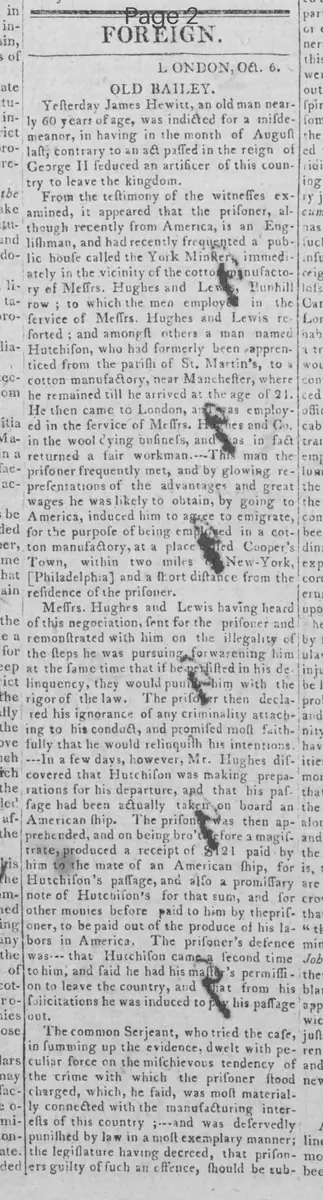
LONDON, Oct. 6.
OLD BAILEY.
Yesterday James Hewitt, an old man nearly 60 years of age, was indicted for a misdemeanor, in having in the month of August last, contrary to an act passed in the reign of George II reduced an artificer of this country to leave the kingdom.
From the testimony of the witnesses examined, it appeared that the prisoner, although recently from America, is an Englishman, and had recently frequented a public house called the York Minister, immediately in the vicinity of the cotton manufactory of Messrs. Hughes and Lewis, Bunhill row; to which the men employed in the service of Messrs. Hughes and Lewis resorted; and amongst others a man named Hutchinson, who had formerly been apprenticed from the parish of St. Martin's, to a cotton manufactory, near Manchester, where he remained till he arrived at the age of 21.
He then came to London, and was employed in the service of Messrs. Hughes and Co. in the wool dying business, and was in fact returned a fair workman.---This man the prisoner frequently met, and by glowing representations of the advantages and great wages he was likely to obtain, by going to America, induced him to agree to emigrate, for the purpose of being employed in a cotton manufactory, at a place called Cooper's Town, within two miles New-York, Philadelphia and a short distance from the residence of the prisoner.
Messrs. Hughes and Lewis having heard of this negociation, sent for the prisoner and remonstrated with him on the illegality of the steps he was pursuing for warning him at the same time that if he persisted in his design, they would punish him with the rigor of the law. The prisoner then declared his ignorance of any criminality attaching to his conduct, and promised most faithfully that he would relinquish his intentions.
---In a few days, however, Mr. Hughes discovered that Hutchinson was making preparations for his departure, and that his passage had been actually taken on board an American ship. The prisoner was then apprehended, and on being brought before a magistrate, produced a receipt of £21 paid by him to the mate of an American ship, for Hutchinson's passage, and also a promissory note of Hutchinson's for that sum, and for other monies before paid to him by the prisoner, to be paid out of the produce of his labors in America. The prisoner's defence was--- that Hutchinson came a second time to him, and said he had his master's permission to leave the country, and that from his solicitations he was induced to pay his passage out.
The common Serjeant, who tried the case, in summing up the evidence, dwelt with peculiar force on the mischievous tendency of the crime with which the prisoner stood charged, which, he said, was most materially connected with the manufacturing interests of this country ;---and was deservedly punished by law in a most exemplary manner; the legislature having decreed, that prisoners guilty of such an offence, should be sub-
What sub-type of article is it?
What keywords are associated?
What entities or persons were involved?
Where did it happen?
Foreign News Details
Primary Location
America
Event Date
Oct. 6
Key Persons
Event Details
James Hewitt, an Englishman recently from America, was indicted at the Old Bailey for inducing cotton worker Hutchinson to emigrate to a manufactory in Cooper's Town near New York and Philadelphia, violating a George II law. Hewitt enticed Hutchinson with promises of high wages, arranged his passage for £21, despite warnings from employers Hughes and Lewis. Hewitt defended by claiming Hutchinson had permission and solicited him. The judge highlighted the crime's threat to British manufacturing interests.