Thank you for visiting SNEWPapers!
Sign up free
Farmers' Gazette, And Cheraw Advertiser
Cheraw, Chesterfield County, South Carolina
What is this article about?
President John Tyler's July 2, 1842, letter from Washington declines an invitation to New York’s Independence Day celebration, defends his administration’s financial and defense proposals, and rebukes Congress for political disagreements over revenue and public lands.
Clipping
OCR Quality
Full Text
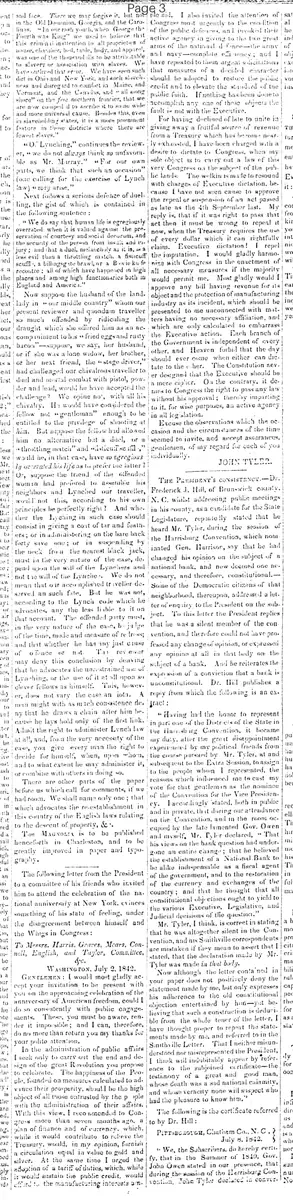
To Messrs. Harris, Graves, Meats, Connell, English, and Taylor, Committee, &c.
Washington, July 2, 1842.
Gentlemen: I would most gladly accept your invitation to be present with you on the approaching celebration of the anniversary of American freedom, could I do so consistently with public engagements. These, you must be aware, render it impossible; and I can, therefore, do no more than return you my thanks for your polite attention.
In the administration of public affairs I seek only to carry out the end and design of the great Revolution you propose to celebrate. The happiness of the People, founded on measures calculated to advance their prosperity, should be the high object of all those entrusted by the people with the administration of their affairs.
With this view, I recommended to Congress more than seven months ago, a plan of finance and of currency, which, while it would contribute to relieve the Treasury, would, in my opinion, furnish a circulation equal in value to gold and silver. At the same time I urged the adoption of a tariff of duties, which, while it would sustain the public credit, would afford to the manufacturing interests ample aid. I also invited the attention of Congress most urgently to the condition of the public debt, and invoked their active agency in giving to the two great arms of the national defense--the army and navy--complete efficiency; and I have repeated to them urgent solicitations that measures of a decided character should be adopted to restore the public credit and to elevate the standard of the public faith. If nothing has been done to accomplish any one of these objects the fault is not with the Executive.
For having declined of late to unite in giving away a fruitful source of revenue from a Treasury which has become nearly exhausted, I have been charged with a desire to dictate to Congress, when my sole object is to carry out a law of this very Congress on the subject of the public lands. The workings made to resound with charges of Executive dictation, because I have not seen cause to approve the repeal or suspension of an act passed as late as the 4th September last. My reply is, that if it was right to pass that act then it must be wrong to repeal it now, when the Treasury requires the use of every dollar which it can rightfully claim. Executive dictation! I repel the imputation. I would gladly harmonize with Congress in the enactment of all necessary measures if the majority would permit me. Most gladly would approve any bill having revenue for its object and the protection of manufacturing industry as its incident, which should be presented to me unconnected with matters having no necessary affiliation, and which are only calculated to embarrass the Executive action. Each branch of the Government is independent of every other, and Heaven forbid that the day should ever come when either can dictate to the other. The Constitution never designed that the Executive should be a mere cipher. On the contrary, it denies to Congress the right to pass any law without his approval; thereby imparting to it, for wise purposes, an active agency in all legislation.
Excuse the observations which the occasion and the circumstances of the time seemed to invite, and accept assurances, gentlemen, of my regard for each of you individually.
JOHN TYLER.
What sub-type of article is it?
What keywords are associated?
What entities or persons were involved?
Where did it happen?
Domestic News Details
Primary Location
Washington
Event Date
July 2, 1842
Key Persons
Event Details
President John Tyler writes a letter declining an invitation from a committee to attend the Independence Day celebration in New York due to public engagements. He expresses his commitment to the principles of the Revolution, defends his recommendations to Congress on finance, currency, tariff, public debt, and national defense, and refutes charges of executive dictation regarding public lands revenue and legislative independence.