Thank you for visiting SNEWPapers!
Sign up free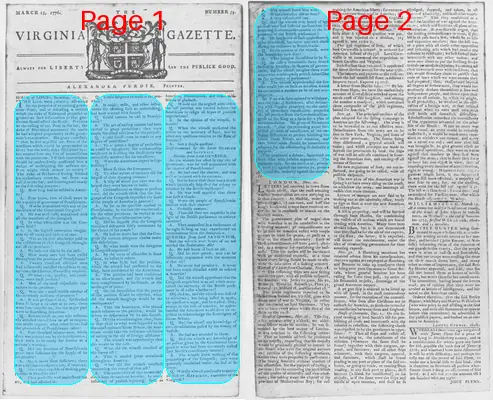
The Virginia Gazette
Williamsburg, Virginia
What is this article about?
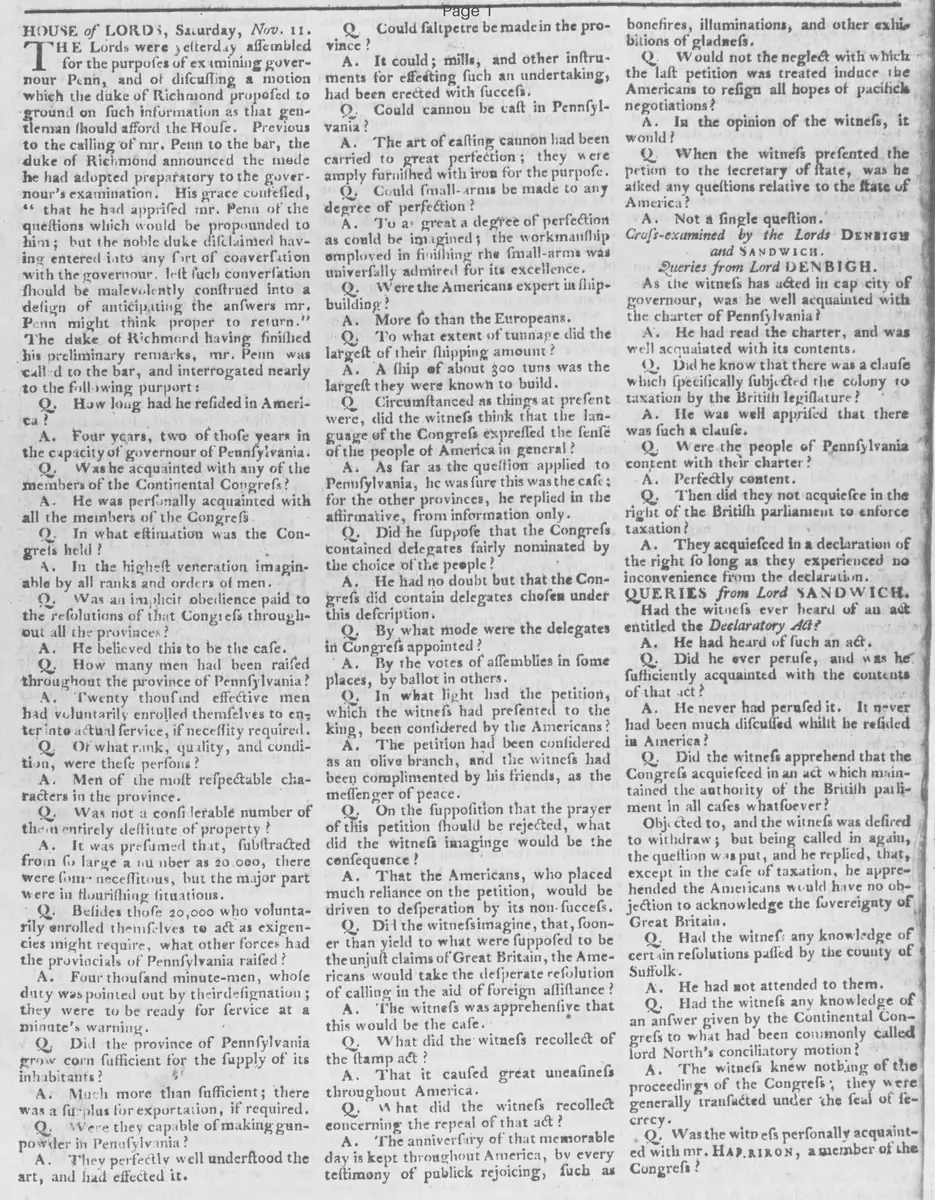
In the House of Lords on Nov. 11, the Duke of Richmond questioned former Pennsylvania Governor Mr. Penn on American sentiments toward the Continental Congress and British policies. Penn described strong support for Congress and potential desperation if petitions fail. A motion for conciliation based on the Congress's petition was defeated 86-33.
Merged-components note: Continuation of the parliamentary examination of Mr. Penn across pages 1 and 2; relabeled from 'story' to 'foreign_news' as it reports on British proceedings regarding American affairs.
Clippings
1 of 2
OCR Quality
Full Text
Their Lordships were yesterday assembled on honour Penn, and of discussing a motion which the Duke of Richmond proposed to ground on such information as that gentleman should afford the House. Previous to the calling of Mr. Penn to the bar, the Duke of Richmond announced the mode he had adopted preparatory to the Governor's examination. His grace confessed that he had apprised Mr. Penn of the questions which would be propounded to him; but the noble duke disclaimed having entered into any sort of conversation with the Governor, lest such conversation should be malevolently construed into a design of anticipating the answers Mr. Penn might think proper to return.
The Duke of Richmond having finished his preliminary remarks, Mr. Penn was called to the bar, and interrogated nearly to the following purport:
Q. How long had he resided in America?
A. Four years, two of those years in the capacity of Governor of Pennsylvania.
Q. Was he acquainted with any of the members of the Continental Congress?
A. He was personally acquainted with all the members of the Congress.
Q. In what estimation was the Congress held?
A. In the highest veneration imaginable by all ranks and orders of men.
Q. Was an implicit obedience paid to the resolutions of that Congress throughout all the provinces?
A. He believed this to be the case.
Q. How many men had been raised throughout the province of Pennsylvania?
A. Twenty thousand effective men had voluntarily enrolled themselves to enter into actual service, if necessity required.
Q. Of what rank, quality, and condition, were these persons?
A. Men of the most respectable characters in the province.
Q. Was not a considerable number of them entirely destitute of property?
A. It was presumed that, abstracted from so large a number as 20,000, there were some necessitous, but the major part were in flourishing situations.
Q. Besides those 20,000 who voluntarily enrolled themselves to act as exigencies might require, what other forces had the provincials of Pennsylvania raised?
A. Four thousand minute-men, whose duty was pointed out by their designation; they were to be ready for service at a minute's warning.
Q. Did the province of Pennsylvania grow corn sufficient for the supply of its inhabitants?
A. Much more than sufficient; there was a surplus for exportation, if required.
Q. Were they capable of making gunpowder in Pennsylvania?
A. They perfectly well understood the art, and had effected it.
Q. Could saltpetre be made in the province?
A. It could; mills, and other instruments for effecting such an undertaking, had been erected with success.
Q. Could cannon be cast in Pennsylvania?
A. The art of casting cannon had been carried to great perfection; they were amply furnished with iron for the purpose.
Q. Could small-arms be made to any degree of perfection?
A. To a great degree of perfection as could be imagined; the workmanship employed in finishing the small-arms was universally admired for its excellence.
Q. Were the Americans expert in shipbuilding?
A. More so than the Europeans.
Q. To what extent of tonnage did the largest of their shipping amount?
A. A ship of about 900 tons was the largest they were known to build.
Q. Circumstanced as things at present were, did the witness think that the language of the Congress expressed the sentiment of the people of America in general?
A. As far as the question applied to Pennsylvania, he was sure this was the case; for the other provinces, he replied in the affirmative from information only.
Q. Did he suppose that the Congress contained delegates fairly nominated by the choice of the people?
A. He had no doubt but that the Congress did contain delegates chosen under this description.
Q. By what mode were the delegates in Congress appointed?
A. By the votes of assemblies in some places, by ballot in others.
Q. In what light had the petition, which the witness had presented to the king, been considered by the Americans?
A. The petition had been considered as an olive branch, and the witness had been complimented by his friends, as the messenger of peace.
Q. On the supposition that the prayer of this petition should be rejected, what did the witness imagine would be the consequence?
A. That the Americans, who placed much reliance on the petition, would be driven to desperation by its non-success.
Q. Did the witness imagine, that, sooner than yield to what were supposed to be the unjust claims of Great Britain, the Americans would take the desperate resolution of calling in the aid of foreign assistance?
A. The witness was apprehensive that this would be the case.
Q. What did the witness recollect of the Stamp Act?
A. That it caused great uneasiness throughout America.
Q. What did the witness recollect concerning the repeal of that act?
A. The anniversary of that memorable day is kept throughout America, by every testimony of public rejoicing, such as bonfires, illuminations, and other exhibitions of gladness.
Q. Would not the neglect with which the last petition was treated induce the Americans to resign all hopes of pacifick negotiations?
A. In the opinion of the witness, it would.
Q. When the witness presented the petition to the secretary of state, was he asked any questions relative to the state of America?
A. Not a single question.
Cross-examined by the Lords Denbigh and Sandwich.
Queries from Lord Denbigh.
As the witness has acted in capacity of governor, was he well acquainted with the charter of Pennsylvania?
A. He had read the charter, and was well acquainted with its contents.
Q. Did he know that there was a clause which specifically subjected the colony to taxation by the British legislature?
A. He was well apprised that there was such a clause.
Q. Were the people of Pennsylvania content with their charter?
A. Perfectly content.
Q. Then did they not acquiesce in the right of the British parliament to enforce taxation?
A. They acquiesced in a declaration of the right so long as they experienced no inconvenience from the declaration.
Queries from Lord Sandwich.
Had the witness ever heard of an act entitled the Declaratory Act?
A. He had heard of such an act.
Q. Did he ever peruse, and was he sufficiently acquainted with the contents of that act?
A. He never had perused it. It never had been much discussed whilst he resided in America.
Q. Did the witness apprehend that the Congress acquiesced in an act which maintained the authority of the British parliament in all cases whatsoever?
Objected to, and the witness was desired to withdraw; but being called in again, the question was put, and he replied, that, except in the case of taxation, he apprehended the Americans would have no objection to acknowledge the sovereignty of Great Britain.
Q. Had the witness any knowledge of certain resolutions passed by the county of Suffolk?
A. He had not attended to them.
Q. Had the witness any knowledge of an answer given by the Continental Congress to what had been commonly called Lord North's conciliatory motion?
A. The witness knew nothing of the proceedings of the Congress; they were generally transacted under the seal of secrecy.
Q. Was the witness personally acquainted with Mr. Harpur Iron, a member of the Congress?
A. The witness knew him well.
Q. What character did he bear?
A. A very respectable one.
Q. Had the witness ever heard of any persons who had suffered persecutions for declaring sentiments favourable to the supremacy of the British parliament?
A. He had heard of such oppressions in other provinces, but never met with them during his residence in Pennsylvania.
Q. In the opinion of the witness, were the Americans now free?
A. They imagine themselves to be so.
Q. In case a formidable force should be sent to America, in support of government, did the witness imagine there were many who would openly profess submission to the authority of parliament?
A. The witness apprehended the few who would join on such an occasion would be too trivial a number to be of any consequence.
Mr. Penn was then ordered to withdraw, and the duke of Richmond, after descanting with singular propriety on the necessity of immediate conciliation, proposed the last petition from the Continental Congress to the King as a basis for a plan of accommodation. His grace of Richmond moved, "that the preceding paper furnished grounds of conciliation of the unhappy differences at present subsisting between Great Britain and America, and that some mode should be immediately adopted for the effectuating so desirable a purpose."
This produced a debate, supported on both sides with infinite ingenuity. The numbers were, for the motion 27, proxies 6, total 33; against the motion 50, proxies 36, total 86; majority against the motion, 53.
What sub-type of article is it?
What keywords are associated?
What entities or persons were involved?
Where did it happen?
Foreign News Details
Primary Location
Pennsylvania
Event Date
Saturday, Nov. 11.
Key Persons
Outcome
motion for conciliation defeated: 33 for, 86 against, majority 53 against.
Event Details
The House of Lords assembled to question Mr. Penn, former Governor of Pennsylvania, on his knowledge of American affairs, including the Continental Congress's influence, military preparations, manufacturing capabilities, and reactions to British policies like the Stamp Act and petitions. Penn affirmed high veneration for Congress, voluntary enrollments of 20,000 men and 4,000 minute-men, self-sufficiency in resources, and fears of desperation if petitions rejected. Cross-examination covered the Pennsylvania charter, Declaratory Act, and potential foreign aid. The Duke of Richmond proposed a motion for conciliation based on the Congress's petition, leading to a debate and defeat.