Thank you for visiting SNEWPapers!
Sign up free
Berkeley And Jefferson Intelligencer
Martinsburg, Berkeley County, Virginia
What is this article about?
Continuation of Aaron Burr's treason trial in Richmond, Virginia, featuring defense arguments by Botts, Randolph, Wickham, and Burr against additional bail, citing delays in witnesses like Gen. Wilkinson, potential jury prejudice, and government overreach; prosecution responses by Hay and Wirt; court adjourns grand jury sessions in early June.
Merged-components note: This is a continuation of the Aaron Burr trial transcript from the Virginia Argus, spanning pages 1 and 2, as the text flows directly from one component to the next.
Clippings
1 of 2
OCR Quality
Full Text
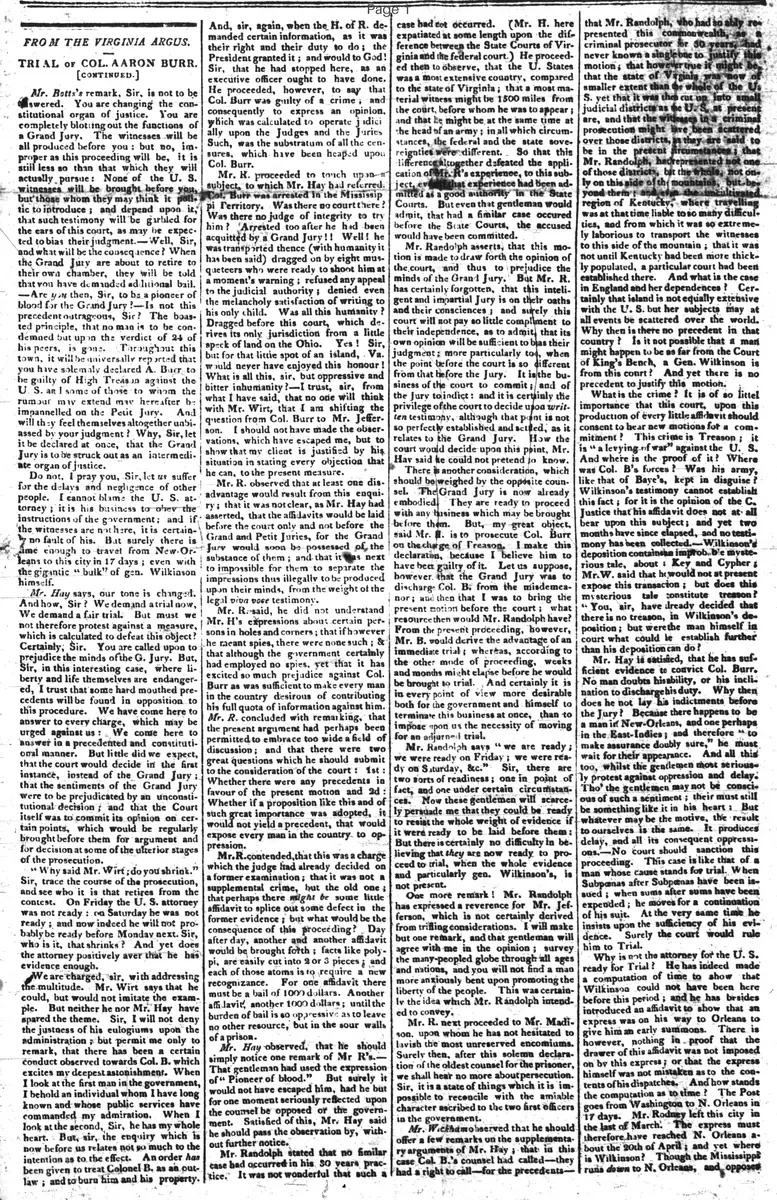
TRIAL OF COL. AARON BURR.
[Continued.]
Mr. Botts's remark, Sir, is not to be answered. You are changing the constitutional organ of justice. You are completely blotting out the functions of a Grand Jury. The witnesses will be all produced before you: but no, improper as this proceeding will be, it is still less so than that which they will actually pursue: None of the U. S. witnesses will be brought before you, but those whom they may think it politic to introduce; and depend upon it, that such testimony will be garbled for the ears of this court, as may be expected to bias their judgment.—Well, Sir, and what will be the consequence? When the Grand Jury are about to retire to their own chamber, they will be told that you have demanded additional bail.—Are you then, Sir, to be a pioneer of blood for the Grand Jury?—Is not this precedent outrageous, Sir? The boasted principle, that no man is to be condemned but upon the verdict of 24 of his peers, is gone.—Throughout this town, it will be universally reported that you have solemnly declared A. Burr to be guilty of High Treason against the U. S. and some of those—to whom the rumour may extend may hereafter be impannelled on the Petit Jury. And will they feel themselves altogether unbiased by your judgment? Why, Sir, let it be declared at once, that the Grand Jury is to be struck out as an intermediate organ of justice.
Do not, I pray you, Sir, let us suffer for the delays and negligence of other people. I cannot blame the U. S. attorney; it is his business to obey the instructions of the government; and if the witnesses are not here, it is certainly no fault of his. But surely there is time enough to travel from New-Orleans to this city in 17 days: even with the gigantic "bulk" of Gen. Wilkinson himself.
Mr. Hay says, our tone is changed. And how, Sir? We demand a trial now, We demand a fair trial. But must we not therefore protest against a measure, which is calculated to defeat this object? Certainly: Sir. You are called upon to prejudice the minds of the G. Jury. But, Sir, in this interesting case, where liberty and life themselves are endangered, I trust that some hard mouthed precedents will be found in opposition to this procedure. We have come here to answer to every charge, which may be urged against us: We come here to answer in a precedented and constitutional manner. But little did we expect, that the court would decide in the first instance, instead of the Grand Jury: that the sentiments of the Grand Jury were to be prejudicated by an unconstitutional decision; and that the Court itself was to commit its opinion on certain points, which would be regularly brought before them for argument and for decision at some of the ulterior stages of the prosecution.
"Why said Mr. Wirt; do you shrink." Sir, trace the course of the prosecution, and see who it is that retires from the contest. On Friday the U. S. attorney was not ready: on Saturday he was not ready; and now indeed he will not probably be ready before Monday next. Sir. who is it, that shrinks? And yet does the attorney positively aver that he has evidence enough.
We are charged," sir. with addressing the multitude. Mr. Wirt says that he could, but would not imitate the example. But neither he nor Mr. Hay have spared the theme. Sir, I will not deny the justness of his eulogiums upon the administration; but permit me only to remark, that there has been a certain conduct observed towards Col. B. which excites my deepest astonishment. When I look at the first man in the government I behold an individual whom I have long known and whose public services have commanded my admiration, When I look at the second, Sir, he has my whole heart.: But, sir, the enquiry which is now before us relates not so much to the intention as to the effect. An order has been given to treat Colonel B. as an outlaw; and to burn him and his property.
And, sir, again, when the H. of R. demanded certain information, as it was their right and their duty to do; the President granted it: and would to God! Sir, that he had stopped here, as an executive officer ought to have done. He proceeded, however, to say that Col. Burr was guilty of a crime; and consequently to express an opinion, which was calculated to operate judicially upon the Judges and the Juries Such, was the substratum of all the censures, which have been heaped upon Col. Burr.
Mr. K. proceeded to touch upon a subject, to which Mr. Hay had referred. Col. Burr was arrested in the Mississippi Territory. Was there no court there? Was there no judge of integrity to try him? Arrested too after he had been acquitted by a Grand Jury!! Well! he was transported thence (with humanity it has been said) dragged on by eight musqueteers who were ready to shoot him at a moment's warning; refused any appeal to the judicial authority; denied even the melancholy satisfaction of writing to his only child. Was all this humanity? Dragged before this court, which derives its only jurisdiction from a little speck of land on the Ohio. Yes! Sir, but for that little spot of an island, Va. would never have enjoyed this honour! What is all this, sir, but oppressive and bitter inhumanity?—I trust, sir, from what I have said, that no one will think with Mr. Wirt; that I am shifting the question from Col. Burr to Mr. Jefferson. I should not have made the observations, which have escaped me, but to show that my client is justified by his situation in stating every objection that he can, to the present measure.
Mr. R. observed that at least one disadvantage would result from this enquiry: that it was not clear, as Mr. Hay had asserted, that the affidavits would be laid before the court only and not before the Grand and Petit Juries, for the Grand Jury would soon be possessed of the substance of them: and that it was next to impossible for them to separate the impressions thus illegally to be produced upon their minds, from the weight of the legal viva voce testimony.
Mr. R. said he did not understand Mr. H's expressions about certain persons in holes and corners; that if however he meant spies, there were none such; & that although the government certainly had employed no spies, yet that it has excited so much prejudice against Col. Burr as was sufficient to make every man in the country desirous of contributing his full quota of information against him.
Mr. R. concluded with remarking, that the present argument had perhaps been permitted to embrace too wide a field of discussion; and that there were two great questions which he should submit to the consideration of the court: 1st: Whether there were any precedents in favour of the present motion and 2d: Whether if a proposition like this and of such great importance was adopted, it would not yield a precedent, that would expose every man in the country to oppression.
Mr. R. contended, that this was a charge which the judge had already decided on a former examination; that it was not a supplemental crime, but the old one; that perhaps there might be some little affidavit to splice out some defect in the former evidence; but what would be the consequence of this proceeding? Day after day, another and another affidavit would be brought forth; facts like poly are easily cut into 2 or 3 pieces; and each of those atoms is to require a new recognizance. For one affidavit there must be a bail of 1000 dollars. Another affidavit, another 1000 dollars; until the burden of bail is so oppressive as to leave no other resource, but in the sour walls of a prison.
Mr. Hay observed, that he should simply notice one remark of Mr R's.—That gentleman had used the expression of "Pioneer of blood." But surely it would not have escaped him, had he but for one moment seriously reflected upon the counsel he opposed or the government. Satisfied of this, Mr. Hay said he should pass the observation by, without further notice.
Mr. Randolph stated that no similar case had occurred in his 50 years practice. It was not wonderful that such a case had not occurred. (Mr. H. here expatiated at some length upon the difference between the State Courts of Virginia and the federal court.) He proceeded then to observe, that the U. States was a most extensive country, compared to the state of Virginia; that a most material witness might be 1500 miles from the court, before whom he was to appear; and that he might be, at the same time at the head of an army: in all which circumstances, the federal and the state sovereignties were different. So that this difference altogether defeated the application of Mr R's experience, to this subject, even that experience had been admitted as a good authority in the State Courts, But even that gentleman would admit, that had a similar case occurred before the State Courts, the accused would have been committed.
Mr. Randolph asserts, that this motion is made to draw forth the opinion of the court, and thus to prejudice the minds of the Grand Jury. But Mr. R. has certainly forgotten that this intelligent and impartial Jury is on their oaths and their consciences; and surely this court will not pay so little compliment to their independence, as to admit that its own opinion will be sufficient to bias their judgment; more particularly too, when the point before the court is so different from that before the Jury. It is the business of the court to commit; and of the Jury to indict: and it is certainly the privilege of the court to decide upon written testimony, although that point is not so perfectly established and settled, as it relates to the Grand Jury. How the court would decide upon this point, Mr. Hay said he could not pretend to know.
There is another consideration, which should be weighed by the opposite counsel. The Grand Jury is now already embodied. They are ready to proceed with any business which may be brought before them. But, my great object, said Mr. H. is to prosecute Col. Burr on the charge of Treason. I make this declaration, because I believe him to have been guilty of it. Let us suppose, however, that the Grand Jury was to discharge Col. B. from the misdemeanor; and then that I was to bring the present motion before the court; what resource then would Mr. Randolph have? From the present proceeding, however, Mr. B. would derive the advantage of an immediate trial; whereas, according to the other mode of proceeding, weeks and months might elapse before he would be brought to trial. And certainly it is in every point of view more desirable both for the government and himself to terminate this business at once, than to impose upon us the necessity of moving for an adjourned trial.
Mr. Randolph says "we are ready; we were ready on Friday; we were ready on Saturday, &c." Sir, there are two sorts of readiness; one in point of fact, and one under certain circumstances. Now these gentlemen will scarcely persuade me that they could be ready to resist the whole weight of evidence if it were ready to be laid before them: But there is certainly no difficulty in believing that they are now ready to proceed to trial, when the whole evidence and particularly gen. Wilkinson's, is not present.
One more remark! Mr. Randolph has expressed a reverence for Mr. Jefferson, which is not certainly derived from trifling considerations. I will make but one remark, and that gentleman will agree with me in the opinion; survey the many-peopled globe through all ages and nations, and you will not find a man more anxiously bent upon promoting the liberty of the people. This was certainly the idea which Mr. Randolph intended to convey:
Mr. R. next proceeded to Mr. Madison, upon whom he has not hesitated to lavish the most unreserved encomiums. Surely then, after this solemn declaration of the oldest counsel for the prisoner, we shall hear no more about persecution. Sir, it is a state of things which it is impossible to reconcile with the amiable character ascribed to the two first officers in the government.
Mr. Wickham observed that he should offer a few remarks on the supplementary arguments of Mr. Hay;—that in this case Col. B.'s counsel had called—they had a right to call—for the precedents—that Mr. Randolph, who had so ably represented this commonwealth as criminal prosecutor for 50 years—had never known a single one to justify the motion; that however true it might be that the state of Virginia was now of smaller extent than the whole of the U. S. yet that it was then cut up into small judicial districts as the U. S. at present are, and that the witnesses in a criminal prosecution might have been scattered over those districts, as they are said to be in the present circumstances; that Mr. Randolph had represented not one of those districts, but the whole not only on this side of the mountains, but beyond them; and even the uncultivated region of Kentucky, where travelling was at that time liable to so many difficulties, and from which it was so extremely laborious to transport the witnesses to this side of the mountain; that it was not until Kentucky had been more thickly populated, a particular court had been established there. And what is the case in England and her dependences? Certainly that island is not equally extensive with the U. S. but her subjects may at all events be scattered over the world. Why then is there no precedent in that country? Is it not possible that a man might happen to be as far from the Court of King's Bench, as Gen. Wilkinson is from this court? And yet there is no precedent to justify this motion.
What is the crime? It is of so little importance that this court, upon the production of every little affidavit should consent to hear new motions for a commitment? This crime is Treason; it is "a levying of war" against the U. S. And where is the proof of it? Where was Col. B's forces? Was his army, like that of Baye's, kept in disguise? Wilkinson's testimony cannot establish this fact; for it is the opinion of the C. Justice that his affidavit does not at all bear upon this subject; and yet two months have since elapsed, and no testimony has been collected.—Wilkinson's deposition contains an improbable mysterious tale, about Key and Cypher: Mr. W. said that he would not at present expose this transaction; but does this mysterious tale constitute treason?
"You, sir, have already decided that there is no treason, in Wilkinson's deposition; but were the man himself in court what could he establish further than his deposition can do?
Mr. Hay is satisfied, that he has sufficient evidence to convict Col. Burr. No man doubts his ability, or his inclination to discharge his duty. Why then does he not lay his indictments before the Jury? Because there happens to be a man in New-Orleans, and one perhaps in the East-Indies; and therefore "to make assurance doubly sure," he must wait for their appearance. And all this too, whilst the gentlemen most seriously protest against oppression and delay.
Tho' the gentlemen may not be conscious of such a sentiment; there must still be something like it in his heart: But whatever may be the motive, the result to ourselves is the same. It produces delay, and all its consequent oppressions.—No court should sanction this proceeding. This case is like that of a man whose Cause stands for trial. When Subpœnas after Subpœnas have been issued; when sums after sums have been expended; he moves for a continuation of his suit. At the very same time he insists upon the sufficiency of his evidence. Surely the court would rule him to Trial.
Why is not the attorney for the U. S. ready for Trial? He has indeed made a computation of time to show that Wilkinson could not have been here before this period; and he has besides introduced an affidavit to show that an express was on his way to Orleans to give him an early summons. There is however, nothing in proof that the drawer of this affidavit was not imposed on by this express; or that the express himself was not mistaken as to the contents of his dispatches. "And how stands the computation as to time? The Post goes from Washington to N. Orleans in 17 days. Mr. Rodney left this city in the last of March. The express must therefore have reached N. Orleans about the 20th of April; and yet where is Wilkinson? Though the Mississippi runs down to N. Orleans, and opposed a strong current to those who ascend it, yet it is surely a reasonable proposition that on land it requires no longer time to come than to go. And yet Gen. Wilkinson is not here!
Mr Hay says it is of no consequence whether the Grand Jury is present or not. But is this consonant with the sound principles of law? Is it constitutional, sir, where there is a particular body set apart for the investigation of acts, for the court to step in and rudely take this power from them? He says that perhaps he shall not send up his bills before the present Grand Jury. But I trust in God, sir, that this determination will be overruled by the court; and that if this prosecution is ever to be closed, we may see the curtain drop upon it now and forever! If, sir, the prosecution obtains a postponement of this trial and for want of evidence on their part, we might properly contend that Col. Burr, if bound to bail at all, should be held in smaller recognizance than at present. But we shall waive this right. It is not our wish to discharge the Grand Jury but to set this question at rest forever.
We have said, that we were ready for trial. We are so, sir, in fact as well as in the abstract. The prosecutors say, that we do not believe them to be ready, But how the gentleman can suppose that we mean to pay so poor a compliment to their veracity as to believe that he acts upon his own facts as if he himself did not believe them to be true?
The gentleman, sir, has warmly eulogised the present administration. As a private citizen, sir, no man has less to say with the politics of this country than myself. That gentleman has drawn a picture of our national prosperity; and I am happy to hope that it is true to the life in every thing one feature only excepted. What, however, will he say of the persecution of my client? Sir, let that gentleman draw the most animated pictures of our happiness which his imagination can supply; let them be howsoever cheering or howsoever just, it will be but little alleviation to the wounds of my persecuted client, that he is the only man in the nation whose rights are not secure from violation:
Mr. Burr then rose and addressed the court to the following effect:
I am not, I hope, sir, wasting the time of the court upon the present occasion:
The motion proposed is admitted on all hands to be important; and it is certainly a new one. Perhaps it was to have been expected, that on a point so novel, some precedents would have been produced: but in this expectation we have been disappointed. Its novelty will, however, be productive of another effect. It will still better qualify it for making another small feature in a picture of oppressions and grievances, which have never been paralleled in the records of criminal law.
The case is this: no man denies the authority of the court to commit for a crime: but no commitment ought to be made except on probable cause. This authority is necessary; because policy requires that there should be some power to bind an accused individual for his personal appearance, until there shall be a sufficient time to obtain witnesses for his trial. But this power ought to be controlled as much as possible.
The question in the present case is whether there is probable cause of guilt; and whether time ought to be allowed to collect testimony against me. This time ought generally to be limited; but there is no precise standard on the subject; and much is of course left to the sound discretion of the court. Two months ago, however, you declared that there had been time enough to collect the evidence necessary to commit on probable cause: and surely if this argument was good then, it is still better now.
As soon as a prosecutor has notice of a crime, he generally looks out for witnesses. It is his object to obtain probable cause for committing the accused. Five months ago, a high authority declared that there was a crime, that I was at the head of it: and it mentioned the very place too where the crime was in a state of preparation. The principal witness against me is said to be Mr. Wilkinson. Now from what period is the time to be computed? If from the time I was suspected, five months; if from the time when I was seized, 3 months; or is it to be only computed from the time when I was committed? so that it is near 40 days since the notice must have arrived at New-Orleans. But a vessel navigates the coast from N. Orleans to Norfolk, in three weeks I contend, however, that witnesses ought to be procured from the very time when the crimes are said to be committed. There is then no apology for the delay of the prosecution, as far as it respects the only person for whom an analogy is attempted to be made.
There are other serious objections to my situation: Must I be ready to proceed to trial? True, sir, but then it must be in their own way. Are we then on equal terms here? Certainly not. And again as to affidavits. The U. S. can have compulsory process to obtain them: but I have no such advantage. An ex parte evidence then is brought before this court on a motion for commitment. The evidence on one side only is exhibited, but if I had mine also to adduce, it would probably contradict and counteract the evidence of the United States. Well, sir, and these affidavits are put into the News-Papers: and they fall into the hands of the Grand Jury. I have no such means as these, sir: and where then is the equality between the government and myself?.
The opinion of the court to be committed against me. Is this no evil? A sufficient answer, sir, has been given to the argument about my delay; and its disadvantages to myself have been ably developed. But my counsel have been charged with declamation against the government of the U. S. I certainly sir. shall not be charged with declamation. But surely it is an established principle, sir, that no government is so high as to be beyond the reach of criticism. And it is more particularly, laid down, that this vigilance is more peculiarly necessary, when any government institutes a prosecution, and one reason is, on account of the vast disproportion of means which exists between it and the accused. But if ever there was a case which justified this vigilance, it is certainly the present one when the government has displayed such uncommon activity. If then this government has been so peculiarly active against me, it is not improper to make the assertion here, for the purpose of increasing the circumspection of the court.
Mr. Burr observed, that he meant by persecution the harassing of any individual contrary to the forms of law; and that his case unfortunately presented too many instances of this description. He would merely state a few of them. He said that his friends had been every where seized by the military authority; a practice truly consonant with European despotisms. He said that persons had been dragged by compulsory process before particular tribunals, and compelled to give testimony against him. His papers too had been seized. And yet in England, where we say they know nothing of Liberty, a gentleman who had been seized and detained two hours in a back parlour, had obtained damages to the amount of 1000 guineas. He said that an order had been issued to kill him as he was descending the Mississippi and seize his property. And yet they could only have killed his person, if he had been formally condemned for treason. He said that even Post-Offices had been broken open, and robbed of his papers: that in the Mississippi territory even an indictment was about to be laid against the Post-Master; that he had always taken this for a felony; but that nothing seemed too extravagant to be forgiven by the amiable morality of this government. Mr. Burr said, there seemed to be something mingled in these proceedings, which manifested a more than usual inclination to attain the ends of justice. As far as it related to himself. perhaps, these things were of no account; but what was then to be said of those and other measures, such as the suspension of the Habeas Corpus act, which concerned the whole nation? If in the island of G. Britain, such a measure was calculated to produce so much disturbance, what kind of sensation ought it to produce in this country?
Our president said Mr. B. is a lawyer, and a great one too. He certainly ought to know what it is that constitutes a war. Six months ago he proclaimed that there was a civil war; and yet for six months have they been hunting for it, and still cannot find one spot where it existed. There was to be sure, a most terrible war in the newspapers; but nowhere else. When I appeared before the Grand Jury in Kentucky, they had no charge to bring against me; and I was consequently dismissed. When I appeared for a second time before a Grand Jury (in the Mississippi Territory) there was nothing to appear against me: and the judge even told the U. S. Attorney that if he did not send up his bill before the Grand Jury, he himself would proceed to name as many of the witnesses as he could & bring it before the court. Still there was no proof of war. At length, however, the Spaniards invaded our territory: and yet there was no war: But, sir, if there was a war, certainly no man can pretend to say that the government is able to find it out. The scene to which they have now hunted it, is only 300 miles distant; and still there is no evidence to prove this war.
Mr. Burr requested the court to consider the consequences which would now result from a commitment for treason: that if he were bound now, the law of Virginia declared that he should so remain till the next term; that this delay was the very inconvenience he would wish to avoid; and that he presumed he was to remain in prison six months, until they could find out this war.
Monday, June 1.
Present, Chief Justice Marshall.
The Grand Jury met at 2 o'clock: and were adjourned till tomorrow 10 o'clock.
Mr. Hay observed, that it was extremely disagreeable for him to detain the Grand Jury; but he knew of no better expedient under existing circumstances; that he had received no new information respecting General Wilkinson; and that the only new communications which he had received by the last western mail, was a mass of affidavits from Chillicothe, drawn up by persons who had descended the river with Col. Burr, and that though their affidavits were extremely important, they could not be brought into court as evidence, there being no evidence that the person before whom they were taken was really a magistrate.
Tuesday, June 2.
Present Judges Marshall and Griffin.
The Grand Jury met & were adjourned till to-morrow 10 o'clock. There were no other proceedings connected with the trial.
[To be continued]
What sub-type of article is it?
What themes does it cover?
What keywords are associated?
What entities or persons were involved?
Where did it happen?
Story Details
Key Persons
Location
Richmond, Virginia
Event Date
Early June 1807
Story Details
Defense counsel argue against additional bail for Aaron Burr in his treason trial, protesting delays in key witness Gen. Wilkinson's arrival, potential prejudice to the grand jury from court opinions and affidavits, lack of precedents, and government persecution; prosecution counters on readiness, constitutional differences, and desire for swift trial; Burr addresses court on unequal terms and past injustices; grand jury sessions adjourned June 1-2.