Thank you for visiting SNEWPapers!
Sign up free
Letter to Editor
June 17, 1859
Pioneer And Democrat
Olympia, Thurston County, Washington
What is this article about?
J. K. Applegate writes to correct a newspaper report on an Indian threat at Blunt's Island Lighthouse on May 29, 1859. He details the schooner Caroline's encounter, his defense of the lighthouse, and a volunteer rescue from Port Townsend, emphasizing the real danger posed by the warriors.
Clipping
OCR Quality
95%
Excellent
Full Text
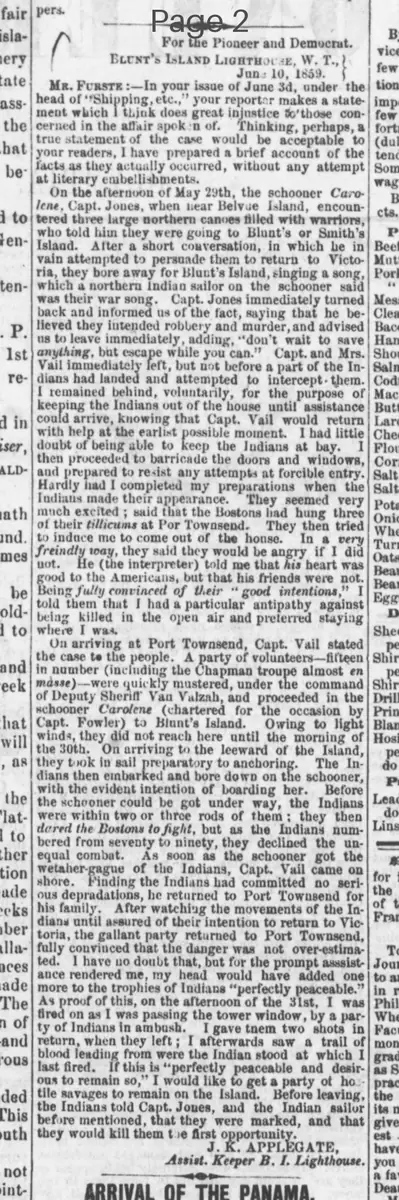
For the Pioneer and Democrat.
Blunt's Island Lighthouse, W. T.,
June 10, 1859.
MR. FURSTE:—In your issue of June 3d, under the head of 'Shipping, etc.,' your reporter makes a statement which I think does great injustice to those concerned in the affair spoken of. Thinking, perhaps, a true statement of the case would be acceptable to your readers, I have prepared a brief account of the facts as they actually occurred, without any attempt at literary embellishments.
On the afternoon of May 29th, the schooner Caroline, Capt. Jones, when near Belvue Island, encountered three large northern canoes filled with warriors, who told him they were going to Blunt's or Smith's Island. After a short conversation, in which he in vain attempted to persuade them to return to Victoria, they bore away for Blunt's Island, singing a song, which a northern Indian sailor on the schooner said was their war song. Capt. Jones immediately turned back and informed us of the fact, saying that he believed they intended robbery and murder, and advised us to leave immediately, adding, "don't wait to save anything, but escape while you can." Capt. and Mrs. Vail immediately left, but not before a part of the Indians had landed and attempted to intercept them.
I remained behind, voluntarily, for the purpose of keeping the Indians out of the house until assistance could arrive, knowing that Capt. Vail would return with help at the earliest possible moment. I had little doubt of being able to keep the Indians at bay. I then proceeded to barricade the doors and windows, and prepared to resist any attempts at forcible entry. Hardly had I completed my preparations when the Indians made their appearance. They seemed very much excited; said that the Bostons had hung three of their tillicums at Port Townsend. They then tried to induce me to come out of the house. In a very friendly way, they said they would be angry if I did not. He (the interpreter) told me that his heart was good to the Americans, but that his friends were not. Being fully convinced of their "good intentions," I told them that I had a particular antipathy against being killed in the open air and preferred staying where I was.
On arriving at Port Townsend, Capt. Vail stated the case to the people. A party of volunteers—fifteen in number (including the Chapman troupe almost en masse)—were quickly mustered, under the command of Deputy Sheriff Van Valzah, and proceeded in the schooner Caroline (chartered for the occasion by Capt. Fowler) to Blunt's Island. Owing to light winds, they did not reach here until the morning of the 30th. On arriving to the leeward of the Island, they took in sail preparatory to anchoring. The Indians then embarked and bore down on the schooner, with the evident intention of boarding her. Before the schooner could be got under way, the Indians were within two or three rods of them; they then ordered the Bostons to fight, but as the Indians numbered from seventy to ninety, they declined the unequal combat. As soon as the schooner got the weather-gauge of the Indians, Capt. Vail came on shore. Finding the Indians had committed no serious depredations, he returned to Port Townsend for his family. After watching the movements of the Indians until assured of their intention to return to Victoria, the gallant party returned to Port Townsend, fully convinced that the danger was not over-estimated. I have no doubt that, but for the prompt assistance rendered me, my head would have added one more to the trophies of Indians "perfectly peaceable."
As proof of this, on the afternoon of the 31st, I was fired on as I was passing the tower window, by a party of Indians in ambush. I gave them two shots in return, when they left; I afterwards saw a trail of blood leading from where the Indian stood at which I last fired. If this is "perfectly peaceable and desirous to remain so," I would like to get a party of hostile savages to remain on the Island. Before leaving, the Indians told Capt. Jones, and the Indian sailor before mentioned, that they were marked, and that they would kill them the first opportunity.
J. K. APPLEGATE.
Assist. Keeper B. I. Lighthouse.
Blunt's Island Lighthouse, W. T.,
June 10, 1859.
MR. FURSTE:—In your issue of June 3d, under the head of 'Shipping, etc.,' your reporter makes a statement which I think does great injustice to those concerned in the affair spoken of. Thinking, perhaps, a true statement of the case would be acceptable to your readers, I have prepared a brief account of the facts as they actually occurred, without any attempt at literary embellishments.
On the afternoon of May 29th, the schooner Caroline, Capt. Jones, when near Belvue Island, encountered three large northern canoes filled with warriors, who told him they were going to Blunt's or Smith's Island. After a short conversation, in which he in vain attempted to persuade them to return to Victoria, they bore away for Blunt's Island, singing a song, which a northern Indian sailor on the schooner said was their war song. Capt. Jones immediately turned back and informed us of the fact, saying that he believed they intended robbery and murder, and advised us to leave immediately, adding, "don't wait to save anything, but escape while you can." Capt. and Mrs. Vail immediately left, but not before a part of the Indians had landed and attempted to intercept them.
I remained behind, voluntarily, for the purpose of keeping the Indians out of the house until assistance could arrive, knowing that Capt. Vail would return with help at the earliest possible moment. I had little doubt of being able to keep the Indians at bay. I then proceeded to barricade the doors and windows, and prepared to resist any attempts at forcible entry. Hardly had I completed my preparations when the Indians made their appearance. They seemed very much excited; said that the Bostons had hung three of their tillicums at Port Townsend. They then tried to induce me to come out of the house. In a very friendly way, they said they would be angry if I did not. He (the interpreter) told me that his heart was good to the Americans, but that his friends were not. Being fully convinced of their "good intentions," I told them that I had a particular antipathy against being killed in the open air and preferred staying where I was.
On arriving at Port Townsend, Capt. Vail stated the case to the people. A party of volunteers—fifteen in number (including the Chapman troupe almost en masse)—were quickly mustered, under the command of Deputy Sheriff Van Valzah, and proceeded in the schooner Caroline (chartered for the occasion by Capt. Fowler) to Blunt's Island. Owing to light winds, they did not reach here until the morning of the 30th. On arriving to the leeward of the Island, they took in sail preparatory to anchoring. The Indians then embarked and bore down on the schooner, with the evident intention of boarding her. Before the schooner could be got under way, the Indians were within two or three rods of them; they then ordered the Bostons to fight, but as the Indians numbered from seventy to ninety, they declined the unequal combat. As soon as the schooner got the weather-gauge of the Indians, Capt. Vail came on shore. Finding the Indians had committed no serious depredations, he returned to Port Townsend for his family. After watching the movements of the Indians until assured of their intention to return to Victoria, the gallant party returned to Port Townsend, fully convinced that the danger was not over-estimated. I have no doubt that, but for the prompt assistance rendered me, my head would have added one more to the trophies of Indians "perfectly peaceable."
As proof of this, on the afternoon of the 31st, I was fired on as I was passing the tower window, by a party of Indians in ambush. I gave them two shots in return, when they left; I afterwards saw a trail of blood leading from where the Indian stood at which I last fired. If this is "perfectly peaceable and desirous to remain so," I would like to get a party of hostile savages to remain on the Island. Before leaving, the Indians told Capt. Jones, and the Indian sailor before mentioned, that they were marked, and that they would kill them the first opportunity.
J. K. APPLEGATE.
Assist. Keeper B. I. Lighthouse.
What sub-type of article is it?
Informative
Persuasive
What themes does it cover?
Military War
Crime Punishment
What keywords are associated?
Blunt's Island Lighthouse
Indian Warriors
Port Townsend Volunteers
Schooner Caroline
Threat Of Murder
Washington Territory
What entities or persons were involved?
J. K. Applegate
Mr. Furste
Letter to Editor Details
Author
J. K. Applegate
Recipient
Mr. Furste
Main Argument
the newspaper's report on the indian incident at blunt's island lighthouse on may 29, 1859, does great injustice; the writer provides a true account of the warriors' threatening intentions, his defense, and the volunteer rescue to demonstrate the real danger.
Notable Details
Indians Singing War Song
Barricaded House Against Indians
Volunteers From Port Townsend Under Deputy Sheriff Van Valzah
Fired Upon By Indians On May 31st, Trail Of Blood