Thank you for visiting SNEWPapers!
Sign up free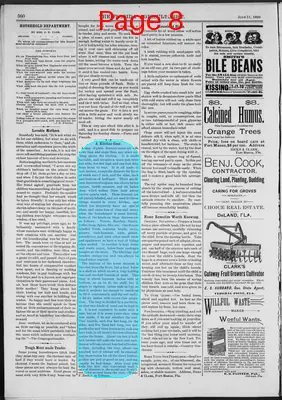
Story
June 11, 1890
The Florida Agriculturist
Jacksonville, De Land, Duval County, Volusia County, Florida
What is this article about?
Waldo F. Brown describes a homemade movable kitchen drawer case, 3ft wide by 5ft high by 1ft deep, with 15 labeled drawers for essentials like towels, matches, and tools, plus a meal tray, saving his wife time and steps.
Clipping
OCR Quality
98%
Excellent
Full Text
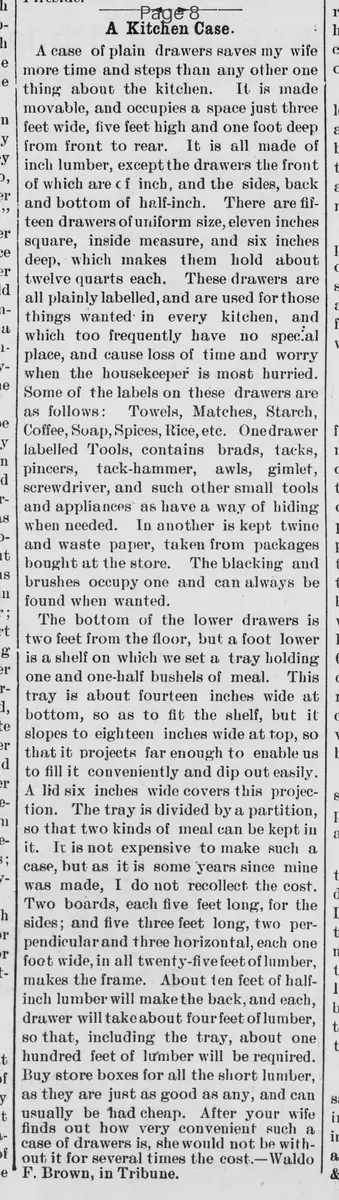
A Kitchen Case.
A case of plain drawers saves my wife more time and steps than any other one thing about the kitchen. It is made movable, and occupies a space just three feet wide, five feet high and one foot deep from front to rear. It is all made of inch lumber, except the drawers the front of which are of inch, and the sides, back and bottom of half-inch. There are fifteen drawers of uniform size, eleven inches square, inside measure, and six inches deep, which makes them hold about twelve quarts each. These drawers are all plainly labelled, and are used for those things wanted in every kitchen, and which too frequently have no special place, and cause loss of time and worry when the housekeeper is most hurried.
Some of the labels on these drawers are as follows: Towels, Matches, Starch, Coffee, Soap, Spices, Rice, etc. One drawer labelled Tools, contains brads, tacks, pincers, tack-hammer, awls, gimlet, screwdriver, and such other small tools and appliances as have a way of hiding when needed. In another is kept twine and waste paper, taken from packages bought at the store. The blacking and brushes occupy one and can always be found when wanted.
The bottom of the lower drawers is two feet from the floor, but a foot lower is a shelf on which we set a tray holding one and one-half bushels of meal. This tray is about fourteen inches wide at bottom, so as to fit the shelf, but it slopes to eighteen inches wide at top, so that it projects far enough to enable us to fill it conveniently and dip out easily. A lid six inches wide covers this projection. The tray is divided by a partition, so that two kinds of meal can be kept in it. It is not expensive to make such a case, but as it is some years since mine was made, I do not recollect the cost. Two boards, each five feet long, for the sides; and five three feet long, two perpendicular and three horizontal, each one foot wide, in all twenty-five feet of lumber, makes the frame. About ten feet of half-inch lumber will make the back, and each drawer will take about four feet of lumber, so that, including the tray, about one hundred feet of lumber will be required. Buy store boxes for all the short lumber, as they are just as good as any, and can usually be had cheap. After your wife finds out how very convenient such a case of drawers is, she would not be without it for several times the cost.—Waldo F. Brown, in Tribune.
A case of plain drawers saves my wife more time and steps than any other one thing about the kitchen. It is made movable, and occupies a space just three feet wide, five feet high and one foot deep from front to rear. It is all made of inch lumber, except the drawers the front of which are of inch, and the sides, back and bottom of half-inch. There are fifteen drawers of uniform size, eleven inches square, inside measure, and six inches deep, which makes them hold about twelve quarts each. These drawers are all plainly labelled, and are used for those things wanted in every kitchen, and which too frequently have no special place, and cause loss of time and worry when the housekeeper is most hurried.
Some of the labels on these drawers are as follows: Towels, Matches, Starch, Coffee, Soap, Spices, Rice, etc. One drawer labelled Tools, contains brads, tacks, pincers, tack-hammer, awls, gimlet, screwdriver, and such other small tools and appliances as have a way of hiding when needed. In another is kept twine and waste paper, taken from packages bought at the store. The blacking and brushes occupy one and can always be found when wanted.
The bottom of the lower drawers is two feet from the floor, but a foot lower is a shelf on which we set a tray holding one and one-half bushels of meal. This tray is about fourteen inches wide at bottom, so as to fit the shelf, but it slopes to eighteen inches wide at top, so that it projects far enough to enable us to fill it conveniently and dip out easily. A lid six inches wide covers this projection. The tray is divided by a partition, so that two kinds of meal can be kept in it. It is not expensive to make such a case, but as it is some years since mine was made, I do not recollect the cost. Two boards, each five feet long, for the sides; and five three feet long, two perpendicular and three horizontal, each one foot wide, in all twenty-five feet of lumber, makes the frame. About ten feet of half-inch lumber will make the back, and each drawer will take about four feet of lumber, so that, including the tray, about one hundred feet of lumber will be required. Buy store boxes for all the short lumber, as they are just as good as any, and can usually be had cheap. After your wife finds out how very convenient such a case of drawers is, she would not be without it for several times the cost.—Waldo F. Brown, in Tribune.
What sub-type of article is it?
Biography
Curiosity
What themes does it cover?
Family
Triumph
What keywords are associated?
Kitchen Case
Movable Drawers
Household Organization
Meal Tray
Domestic Convenience
What entities or persons were involved?
Waldo F. Brown
Where did it happen?
Kitchen
Story Details
Key Persons
Waldo F. Brown
Location
Kitchen
Story Details
Waldo F. Brown shares details of a custom-built movable kitchen organizer with labeled drawers for common items and a meal storage tray, emphasizing its convenience and time-saving benefits for his wife.