Thank you for visiting SNEWPapers!
Sign up free
Gazette Of The United States
New York, New York County, New York
What is this article about?
Report from Secretary of the Treasury to House of Representatives on January 9, 1790, arguing against discriminating between original holders and purchasers of public securities, advocating for equal treatment and federal assumption of state debts to strengthen national credit and finances.
Clipping
OCR Quality
Full Text
Treasury Department, Jan. 9, 1790.
Continuation.
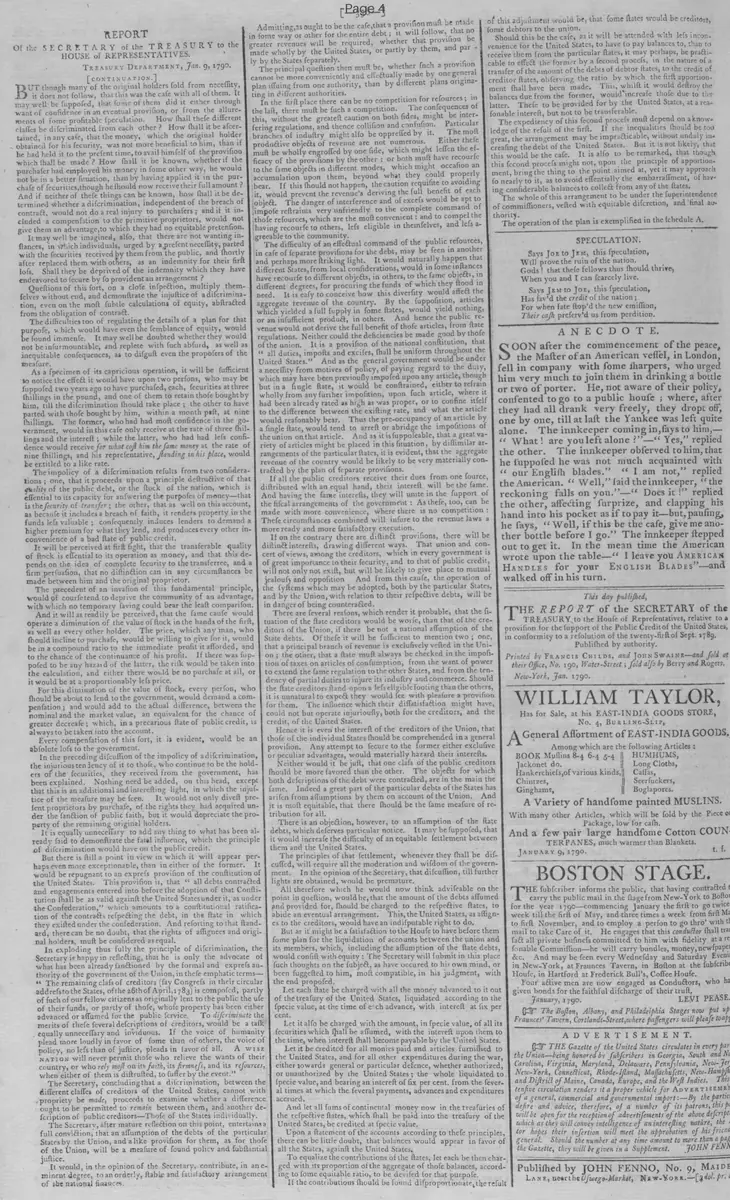
But though many of the original holders sold from necessity, it does not follow, that this was the case with all of them. It may well be supposed, that some of them did it either through want of confidence in an eventual provision, or from the allurements of some profitable speculation. How shall these different classes be discriminated from each other? How shall it be ascertained, in any case, that the money, which the original holder obtained for his security, was not more beneficial to him, than if he had held it to the present time, to avail himself of the provision which shall be made? How shall it be known, whether if the purchaser had employed his money in some other way, he would not be in a better situation, than by having applied it in the purchase of securities, though he should now receive their full amount? And if neither of these things can be known, how shall it be determined whether a discrimination, independent of the breach of contract, would not do a real injury to purchasers; and if it included a compensation to the primitive proprietors, would not give them an advantage, to which they had no equitable pretension.
It may well be imagined, also, that there are not wanting instances, in which individuals, urged by a present necessity, parted with the securities received by them from the public, and shortly after replaced them with others, as an indemnity for their first loss. Shall they be deprived of the indemnity which they have endeavored to secure by so provident an arrangement?
Questions of this sort, on a close inspection, multiply themselves without end, and demonstrate the injustice of a discrimination, even on the most subtle calculations of equity, abstracted from the obligation of contract.
The difficulties too of regulating the details of a plan for that purpose, which would have even the semblance of equity, would be found immense. It may well be doubted whether they would not be insurmountable, and replete with such absurd, as well as inequitable consequences, as to disgust even the proposers of the measure.
As a specimen of its capricious operation, it will be sufficient to notice the effect it would have upon two persons, who may be supposed two years ago to have purchased, each, securities at three shillings in the pound, and one of them to retain those bought by him, till the discrimination should take place; the other to have parted with those bought by him, within a month past, at nine shillings. The former, who had had most confidence in the government, would in this case only receive at the rate of three shillings and the interest; while the latter, who had had less confidence would receive for what cost him the same money at the rate of nine shillings, and his representative, standing in his place, would be entitled to a like rate.
The impolicy of a discrimination results from two considerations; one, that it proceeds upon a principle destructive of that quality of the public debt, or the stock of the nation, which is essential to its capacity for answering the purposes of money—that is the security of transfer; the other, that as well on this account, as because it includes a breach of faith, it renders property in the funds less valuable; consequently induces lenders to demand a higher premium for what they lend, and produces every other inconvenience of a bad state of public credit.
It will be perceived at first sight, that the transferable quality of stock is essential to its operation as money, and that this depends on the idea of complete security to the transferee, and a firm persuasion, that no distinction can in any circumstances be made between him and the original proprietor.
The precedent of an invasion of this fundamental principle, would of course tend to deprive the community of an advantage, with which no temporary saving could bear the least comparison.
And it will as readily be perceived, that the same cause would operate a diminution of the value of stock in the hands of the first, as well as every other holder. The price, which any man, who should incline to purchase, would be willing to give for it, would be in a compound ratio to the immediate profit it afforded, and to the chance of the continuance of his profit. If there was supposed to be any hazard of the latter, the risk would be taken into the calculation, and either there would be no purchase at all, or it would be at a proportionably less price.
For this diminution of the value of stock, every person, who should be about to lend to the government, would demand a compensation; and would add to the actual difference, between the nominal and the market value, an equivalent for the chance of greater decrease; which, in a precarious state of public credit, is always to be taken into the account.
Every compensation of this sort, it is evident, would be an absolute loss to the government.
In the preceding discussion of the impolicy of a discrimination, the injurious tendency of it to those, who continue to be the holders of the securities, they received from the government, has been explained. Nothing need be added, on this head, except that this is an additional and interesting light, in which the injustice of the measure may be seen. It would not only divest present proprietors by purchase, of the rights they had acquired under the sanction of public faith, but it would depreciate the property of the remaining original holders.
It is equally unnecessary to add any thing to what has been already said to demonstrate the fatal influence, which the principle of discrimination would have on the public credit.
But there is still a point in view in which it will appear perhaps even more exceptionable, than in either of the former. It would be repugnant to an express provision of the constitution of the United States. This provision is, that "all debts contracted and engagements entered into before the adoption of that Constitution shall be as valid against the United States under it, as under the Confederation," which amounts to a constitutional ratification of the contracts respecting the debt, in the state in which they existed under the confederation. And resorting to that standard, there can be no doubt, that the rights of assignees and original holders, must be considered as equal.
In exploding thus fully the principle of discrimination, the Secretary is happy in reflecting, that he is only the advocate of what has been already sanctioned by the formal and express authority of the government of the Union, in these emphatic terms—
"The remaining class of creditors (say Congress in their circular address to the States, of the 26th of April, 1783) is composed, partly of such of our fellow citizens as originally lent to the public the use of their funds, or partly of those, whose property has been either advanced or assumed for the public service. To discriminate the merits of these several descriptions of creditors, would be a task equally unnecessary and invidious. If the voice of humanity plead more loudly in favor of some than of others, the voice of policy, no less than of justice, pleads in favor of all. A wise NATION will never permit those who relieve the wants of their country, or who rely most on its faith, its firmness, and its resources, when either of them is distrusted, to suffer by the event."
The Secretary, concluding that a discrimination, between the different classes of creditors of the United States, cannot with propriety be made, proceeds to examine whether a difference ought to be permitted to remain between them, and another description of public creditors—Those of the States individually.
The Secretary, after mature reflection on this point, entertains a full conviction, that an assumption of the debts of the particular States by the Union, and a like provision for them, as for those of the Union, will be a measure of sound policy and substantial justice.
It would, in the opinion of the Secretary, contribute, in an eminent degree, to an orderly, stable and satisfactory arrangement of the national finances.
Admitting, as ought to be the case, that a provision must be made in some way or other for the entire debt; it will follow, that no greater revenues will be required, whether that provision be made wholly by the United States, or partly by them, and partly by the States separately.
The principal question then must be, whether such a provision cannot be more conveniently and effectually made by one general plan issuing from one authority, than by different plans originating in different authorities.
In the first place there can be no competition for resources; in the last, there must be such a competition.
The consequences of this, without the greatest caution on both sides, might be interfering regulations, and thence collision and confusion.
Particular branches of industry might also be oppressed by it.
The most productive objects of revenue are not numerous.
Either these must be wholly engrossed by one side, which might lessen the efficacy of the provisions by the other: or both must have recourse to the same objects in different modes, which might occasion an accumulation upon them, beyond what they could properly bear. If this should not happen, the caution requisite to avoiding it, would prevent the revenue's deriving the full benefit of each impost, restrain very unfriendly to the complete command of those resources, which are the most convenient: and to compel the having recourse to others, less eligible in themselves, and less agreeable to the community.
The difficulty of an effectual command of the public resources, in case of separate provisions for the debt, may be seen in another and perhaps more striking light. It would naturally happen that different States, from local considerations, would in some instances have recourse to different objects, in others, to the same objects, in different degrees, for procuring the funds of which they stood in need. It is easy to conceive how this diversity would affect the aggregate revenue of the country. By the supposition, articles which yielded a full supply in some states, would yield nothing, or an insufficient product, in others. And hence the public revenue would not derive the full benefit of those articles, from state regulations. Neither could the deficiencies be made good by those of the union. It is a provision of the national constitution, that "all duties, imposts and excises, shall be uniform throughout the United States." And as the general government would be under a necessity from motives of policy, of paying regard to the duty, which may have been previously imposed upon any article, though but in a single state, it would be constrained, either to refrain wholly from any further imposition, upon such article, where it had been already rated as high as was proper, or to confine itself to the difference between the existing rate, and what the article would reasonably bear. Thus the pre-occupancy of an article by a single state, would tend to arrest or abridge the impositions of the union on that article. And as it is supposable, that a great variety of articles might be placed in this situation, by dissimilar arrangements of the particular states, it is evident, that the aggregate revenue of the country would be likely to be very materially contracted by the plan of separate provisions.
If all the public creditors receive their dues from one source, distributed with an equal hand, their interest will be the same.
And having the same interests, they will unite in the support of the fiscal arrangements of the government: As these, too, can be made with more convenience, where there is no competition;
These circumstances combined will insure to the revenue laws a more ready and more satisfactory execution.
If on the contrary there are distinct provisions, there will be distinct interests, drawing different ways. That union and concert of views, among the creditors, which in every government is of great importance to their security, and to that of public credit, will not only not exist, but will be likely to give place to mutual jealousy and opposition. And from this cause, the operation of the systems which may be adopted, both by the particular States, and by the Union, with relation to their respective debts, will be in danger of being counteracted.
There are several reasons, which render it probable, that the situation of the state creditors would be worse, than that of the creditors of the Union, if there be not a national assumption of the State debts. Of these it will be sufficient to mention two; one, that a principal branch of revenue is exclusively vested in the Union; the other, that a state must always be checked in the imposition of taxes on articles of consumption, from the want of power to extend the same regulation to the other States, and from the tendency of partial duties to injure its industry and commerce. Should the state creditors stand upon a less eligible footing than the others, it is unnatural to expect they would see with pleasure a provision for them.
The influence which their dissatisfaction might have, could not but operate injuriously, both for the creditors, and the credit, of the United States.
Hence it is even the interest of the creditors of the Union, that those of the individual States should be comprehended in a general provision. Any attempt to secure to the former either exclusive or peculiar advantages, would materially hazard their interests.
Neither would it be just, that one class of the public creditors should be more favored than the other. The objects for which both descriptions of the debt were contracted, are in the main the same.
Indeed a great part of the particular debts of the States has arisen from assumptions by them on account of the Union. And it is most equitable, that there should be the same measure of retribution for all.
There is an objection, however, to an assumption of the state debts, which deserves particular notice.
It may be supposed, that it would increase the difficulty of an equitable settlement between them and the United States.
The principles of that settlement, whenever they shall be discussed, will require all the moderation and wisdom of the government. In the opinion of the Secretary, that discussion, till further lights are obtained, would be premature.
All therefore which he would now think advisable on the point in question, would be, that the amount of the debts assumed and provided for, should be charged to the respective states, to abide an eventual arrangement. This, the United States, as assignees to the creditors, would have an indisputable right to do.
But as it might be a satisfaction to the House to have before them some plan for the liquidation of accounts between the union and its members, which, including the assumption of the state debts, would consist with equity: The Secretary will submit in this place such thoughts on the subject, as have occurred to his own mind, or been suggested to him, most compatible, in his judgment, with the end proposed.
Let each state be charged with all the money advanced to it out of the treasury of the United States, liquidated according to the specie value, at the time of each advance, with interest at six per cent.
Let it also be charged with the amount, in specie value, of all its securities which shall be assumed, with the interest upon them to the time, when interest shall become payable by the United States.
Let it be credited for all monies paid and articles furnished to the United States, and for all other expenditures during the war, either towards general or particular defence, whether authorized, or unauthorized by the United States; the whole liquidated to specie value, and bearing an interest of six per cent. from the several times at which the several payments, advances and expenditures accrued.
And let all sums of continental money now in the treasuries of the respective states, which shall be paid into the treasury of the United States, be credited at specie value.
Upon a statement of the accounts according to these principles, there can be little doubt, that balances would appear in favor of all the States, against the United States.
To equalize the contributions of the states, let each be then charged with its proportion of the aggregate of those balances, according to some equitable ratio, to be devised for that purpose.
If the contributions should be found disproportionate, the result of this adjustment would be, that some states would be creditors, some debtors to the union.
Should this be the case, as it will be attended with less inconvenience for the United States, to have to pay balances to, than to receive them from the particular states, it may perhaps, be practicable to effect the former by a second process, in the nature of a transfer of the amount of the debts of debtor states, to the credit of creditor states, observing the ratio by which the first apportionment shall have been made. This, whilst it would destroy the balances due from the former, would increase those due to the latter. These to be provided for by the United States, at a reasonable interest, but not to be transferable.
The expediency of this second process must depend on a knowledge of the result of the first. If the inequalities should be too great, the arrangement may be impracticable, without unduly increasing the debt of the United States. But it is not likely, that this would be the case. It is also to be remarked, that though this second process might not, upon the principle of apportionment, bring the thing to the point aimed at, yet it may approach so nearly to it, as to avoid essentially the embarrassment, of having considerable balances to collect from any of the states.
The whole of this arrangement to be under the superintendence of commissioners, vested with equitable discretion, and final authority.
What sub-type of article is it?
What keywords are associated?
What entities or persons were involved?
Where did it happen?
Domestic News Details
Primary Location
United States
Event Date
1790 01 09
Key Persons
Outcome
recommends against discrimination between creditors and for federal assumption of state debts to ensure equitable treatment, strengthen public credit, and unify fiscal policy.
Event Details
The Secretary argues that discriminating between original holders and assignees of public securities would breach contracts, violate the Constitution, harm public credit, and lead to inequities; proposes equal provision for all creditors and assumption of state debts by the Union for stable national finances, including a plan for settling accounts between the United States and states.