Thank you for visiting SNEWPapers!
Sign up free
Norfolk Gazette And Publick Ledger
Norfolk, Virginia
What is this article about?
A Philadelphia merchant writes to Albert Gallatin opposing additional duties on imported merchandise, arguing they would encourage smuggling, destroy revenue, harm honest importers, and fail to benefit domestic manufactures, advocating instead for balanced agriculture and commerce. Dated March 10, 1810.
Merged-components note: Sequential reading order and text continuation ('exemplifies' to 'the correctness') indicate these are parts of the same letter
Clipping
OCR Quality
Full Text
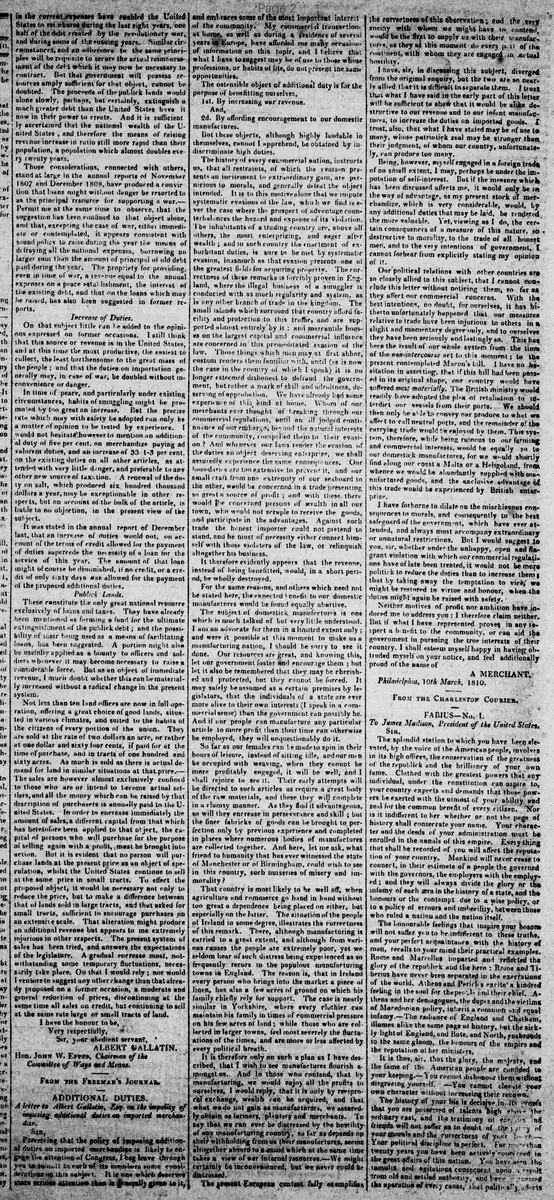
ADDITIONAL DUTIES.
A letter to Albert Gallatin, Esq: on the impolicy of imposing additional duties on imported merchandise.
Sir,
Perceiving that the policy of imposing additional duties on imported merchandise is likely to engage the attention of Congress, I beg leave through you to submit to each of its members some considerations on this subject. It is one which deserves more serious attention than is generally given to it, and embraces some of the most important interests of the community. My commercial transactions at home, as well as during a residence of several years in Europe, have afforded me many occasions of information on this topic, and I believe that what I have to suggest may be of use to those whose professions, or habits of life, do not present the same opportunities.
The ostensible object of additional duty is for the purpose of benefitting ourselves,
1st. By increasing our revenue.
And,
2d. By affording encouragement to our domestic manufactures.
But these objects, although highly laudable in themselves, cannot I apprehend, be obtained by indiscriminate high duties.
The history of every commercial nation, instructs us, that all restraints, of which the evasion presents an incitement to extraordinary gain, are pernicious to morals, and generally defeat the object intended. It is to this motive alone that we impute systematic evasions of the law, which we find is ever the case where the prospect of advantage counterbalances the hazard and expense of its violation.
The inhabitants of a trading country are, above all others, the most enterprizing, and eager after wealth; and in such country the enactment of exorbitant duties, is sure to be met by systematic evasion, inasmuch as that evasion presents one of the greatest fields for acquiring property. The correctness of these remarks is forcibly proven in England, where the illegal business of a smuggler is conducted with as much regularity and system, as is any other branch of trade in the kingdom. The small islands which surround that country afford facility and protection to this traffic, and are supported almost entirely by it: and mercantile houses on the largest capital and commercial influence are concerned in this premeditated evasion of the law. Those things which men may at first abhor, custom renders them familiar with, until (as is now the case in the country of which I speak) it is no longer esteemed dishonest to defraud the government, but rather a mark of skill and adroitness, deserving of approbation. We have already had some experience of this kind at home. Who of our merchants ever thought of breaking through our commercial regulations, until an ill judged continuance of our embargo, beyond the natural interests of the community, compelled them to their evasion? And whenever our laws render the evasion of the duties an object deserving enterprize, we shall assuredly experience the same consequences. Our boundaries are too extensive to prevent it, and our small craft from one extremity of our seaboard to the other, would be concerned in a trade presenting so great a source of profit; and with these, there would be concerned persons of wealth in all our towns, who would not scruple to receive the goods, and participate in the advantages. Against such trade the honest importer could not pretend to stand, and he must of necessity either connect himself with those violaters of the law, or relinquish altogether his business.
It therefore evidently appears that the revenue, instead of being benefitted, would, in a short period, be wholly destroyed.
For the same reasons, and others which need not be stated here, the expected benefit to our domestic manufactures would be found equally abortive.
The subject of domestic manufactures is one which is much talked of but very little understood. I am an advocate for them in a limited extent only; and were it possible at this moment to make us a manufacturing nation, I should be sorry to see it done. Our resources are great, and knowing this, let our government foster and encourage them; but let it also be remembered that they may be cherished and protected, but they cannot be forced. It may safely be assumed as a certain premise by legislators, that the individuals of a state are ever more alive to their own interests (I speak in a commercial sense) than the government can possibly be. And if our people can manufacture any particular article to more profit than their time can otherwise be employed, they will unquestionably do it.
So far as our females can be made to spin in their hours of leisure, instead of sitting idle, and our men be occupied with weaving, when they cannot be more profitably engaged, it will be well; and I shall rejoice to see it. Their early attempts will be directed to such articles as require a great body of the raw materials, and these they will complete in a clumsy manner. As they find it advantageous, so will they increase in perseverance and skill; but the finer fabricks of goods can be brought to perfection only by previous experience and completed in places where numerous bodies of manufacturers are collected together. And here, let me ask, what friend to humanity that has ever witnessed the state of Manchester or of Birmingham, could wish to see in this country, such nuiseries of misery and immorality?
That country is most likely to be well off, when agriculture and commerce go hand in hand without too great a dependence being placed on either, but especially on the latter. The situation of the people of Ireland in some degree, illustrates the correctness of this remark. There, although manufacturing is carried to a great extent, and although from various causes the people are extremely poor, yet we seldom hear of such distress being experienced as so frequently recurs in the populous manufacturing towns in England. The reason is, that in Ireland every person who brings into the market a piece of linen, has also a few acres of ground on which his family chiefly rely for support. The case is nearly similar in Yorkshire, where every clothier can maintain his family in times of commercial pressure on his few acres of land; while those who are collected in larger towns, feel most severely the fluctuations of the times, and are more or less affected by every political breath.
It is therefore only on such a plan as I have described, that I wish to see manufactures flourish amongst us. And to those who contend, that by manufacturing, we would enjoy all the profits to ourselves, I would reply, that it is only by reciprocal exchange, wealth can be acquired, and that what we do not gain as manufacturers, we assuredly obtain as farmers, planters and merchants. To say that we can ever be distressed by the hostility of any manufacturing country, so far as depends on their withholding from us their manufactures, seems altogether absurd to a mind which at the same time takes a view of our internal resources. We might certainly be inconvenienced, but we never could be
distressed.
The present European contest fully exemplifies
the correctness of this observation; and the very enemy with whom we might have to contend would be the first to supply us with their manufactures, as they at this moment do every part of the continent, with whom they are engaged in actual hostility.
I have, sir, in discussing this subject, diverged from the original enquiry, but the two are so nearly allied that it is difficult to separate them. I trust that what I have said in the early part of this letter will be sufficient to shew that it would be alike destructive to our revenue and to our infant manufactures, to increase the duties on imported goods. I trust, also, that what I have stated may be of use to many, whose patriotick zeal may be stronger than their judgment, of whom our country, unfortunately, can produce too many.
Being, however, myself engaged in a foreign trade of no small extent, I may, perhaps be under the imputation of self-interest. But if the measure which has been discussed affects me, it would only be in the way of advantage, as my present stock of merchandise, which is very considerable, would, by any additional duties that may be laid, be rendered the more valuable. Yet, viewing as I do, the certain consequences of a measure of this nature, so destructive to morality, to the trade of all honest men, and to the very intentions of government, I cannot forbear from explicitly stating my opinion of it.
Our political relations with other countries are so closely allied to this subject, that I cannot conclude this letter without noticing them, so far as they affect our commercial concerns. With the best intentions, no doubt, on our part, it has hitherto unfortunately happened that our measures relative to trade have been injurious to others in a slight and momentary degree only, and to ourselves they have been seriously and lastingly so. This has been the result of our whole system from the time of the non-intercourse act to this moment; to the present contemplated Macon's bill. I have no hesitation in asserting, that if this bill had been passed in its original shape, our country would have suffered most materially. The British ministry would readily have adopted the plea of retaliation to interdict our vessels from their ports. We should then only be able to convey our produce to what we affect to call neutral ports, and the remainder of the carrying trade would be enjoyed by them. This system, therefore, while being ruinous to our shipping and commercial interests, would be equally so to our domestic manufactures, for we would shortly find along our coast a Malta or a Heligoland, from whence we would be abundantly supplied with manufactured goods, and the exclusive advantage of this trade would be experienced by British enterprize.
I have forborne to dilate on the mischievous consequences to morals, and consequently to the best safeguard of the government, which have ever attended, and always must accompany extraordinary or unnatural restrictions. But I would suggest to you, sir, whether under the unhappy, open and flagrant violation with which our commercial regulations have of late been treated, it would not be more politic to reduce the duties than to increase them that by taking away the temptation to vice, we might be restored to virtue and honour, when the duties might again be raised with safety.
Neither motives of profit nor ambition have induced me to address you: I therefore claim neither. But if what I have represented proves in any respect a benefit to the community, or can aid the government in pursuing the true interests of their country, I shall esteem myself happy in having obtruded myself on your notice, and feel additionally proud of the name of
A MERCHANT.
Philadelphia, 10th March, 1810.
What sub-type of article is it?
What themes does it cover?
What keywords are associated?
What entities or persons were involved?
Letter to Editor Details
Author
A Merchant
Recipient
Albert Gallatin, Esq:
Main Argument
imposing additional duties on imported merchandise would encourage systematic smuggling, destroy revenue, harm honest trade, and fail to benefit domestic manufactures, which should develop naturally alongside agriculture and commerce rather than through forced protectionism.
Notable Details