Thank you for visiting SNEWPapers!
Sign up free
Editorial
July 9, 1845
Morning Star
Limerick, York County, Maine
What is this article about?
An editorial criticizes the Presbyterian Church's 1845 reversal of its earlier doctrine labeling slaveholding as 'man-stealing,' arguing it contradicts biblical teachings, apostolic practices, and the principles of the Declaration of Independence, equating church leaders to traitors.
Clipping
OCR Quality
95%
Excellent
Full Text
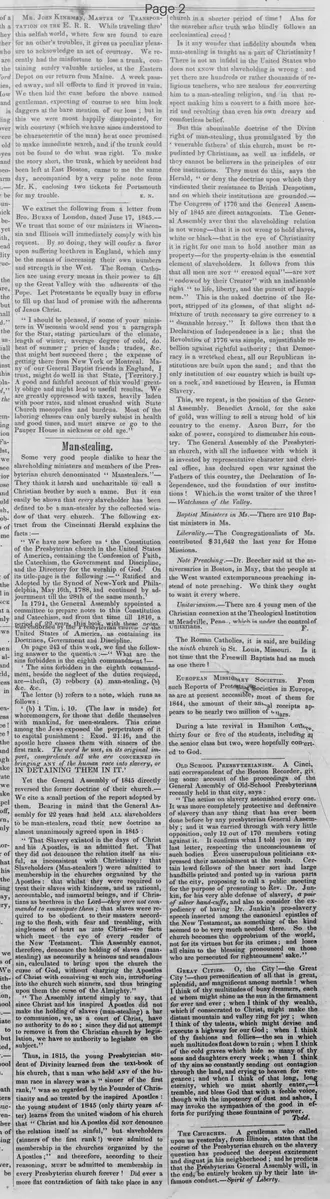
Man-stealing.
Some very good people dislike to hear the slaveholding ministers and members of the Presbyterian church denominated "Man-stealers."—They think it harsh and uncharitable to call a Christian brother by such a name. But it can easily be shown that every slaveholder has been defined to be a man-stealer by the collected wisdom of that very church. The following extract from the Cincinnati Herald explains the facts:-
"We have now before us the Constitution of the Presbyterian church in the United States of America, containing the Confession of Faith, the Catechism, the Government and Discipline, and the Directory for the worship of God. On its title-page is the following: 'Ratified and Adopted by the Synod of New-York and Philadelphia, May 16th, 1788, and continued by adjournment till the 28th of the same month. In 1791, the General Assembly appointed a committee to prepare notes to this Constitution and Catechism, and from that time till 1816, a period passed, this book with these United States of America, as containing its Doctrines, Government and Discipline.
On page 243 of this work, we find the following answer to the question:- "What are the sins forbidden in the eighth commandment?
The sins forbidden in the eighth commandment, beside the neglect of the duties required, are—theft, (3)robbery (a)man-stealing, (b) &c. &c.
The letter (b) refers to a note, which runs as follows:
(b) 1 Tim. i. 10. (The law is made) for whoremongers, for those that defile themselves with mankind, for men-stealers. This crime among the Jews exposed the perpetrators of it to capital punishment: Exod. 21:16, and the apostle here classes them with sinners of the first rank. The word he uses, in its original import, comprehends all who are concerned in bringing any of the human race into slavery, or IN DETAINING THEM IN IT.'
Yet the General Assembly of 1845 directly reversed the former doctrine of their church.-We cite a small portion of the report adopted by them. Bearing in mind that the General Assembly for 22 years had held ALL slaveholders to be man-stealers, read their new doctrine as almost unanimously agreed upon in 1845:
"That Slavery existed in the days of Christ and his Apostles, is an admitted fact. That they did not denounce the relation itself as sinful, as inconsistent with Christianity: that Slaveholders (Man-stealers!) were admitted to membership in the churches organized by the Apostles: that whilst they were required to treat their slaves with kindness, and as rational, accountable, and immortal beings, and if Christians as brethren in the Lord—they were not commanded to emancipate them: that slaves were required to be obedient to their masters according to the flesh, with fear and trembling, with singleness of heart as unto Christ—are facts which meet the eye of every reader of the New Testament. This Assembly cannot, therefore, denounce the holding of slaves (man stealing) as necessarily a heinous and scandalous sin, calculated to bring upon the church the curse of God, without charging the Apostles of Christ with conniving at such sin, introducing into the church such sinners, and thus bringing upon them the curse of the Almighty."
"The Assembly intend simply to say, that since Christ and his inspired Apostles did not make the holding of slaves (man-stealing) a bar to communion, we, as a court of Christ, have no authority to do so; since they did not attempt to remove it from the Christian church by legislation, we have no authority to legislate on the subject."
Thus, in 1815, the young Presbyterian student of Divinity learned from the text-book of his church, that a man who held any of the human race in slavery was a "sinner of the first rank," was so regarded by the Founder of Christianity and so treated by the inspired Apostles: the young student of 1845 (only thirty years after) learns from the united wisdom of his church that "Christ and his Apostles did not denounce the relation itself as sinful," but slaveholders (sinners of the first rank!) were admitted to membership in the churches organized by the Apostles;" and therefore, according to their reasoning, MUST be admitted to membership in every Presbyterian church forever! Did ever a more flat contradiction of faith take place in any church in a shorter period of time? Alas for the searcher after truth who blindly follows an ecclesiastical creed!
Is it any wonder that infidelity abounds when man-stealing is taught as a part of Christianity? There is not an infidel in the United States who does not know that slaveholding is wrong: and yet there are hundreds or rather thousands of religious teachers, who are zealous for converting him to a man-stealing religion, and in that respect making him a convert to a faith more horrid and revolting than even his own dreary and comfortless belief.
But this abominable doctrine of the Divine right of man-stealing, thus promulgated by the 'venerable fathers' of this church, must be repudiated by Christians, as well as infidels, or they cannot be believers in the principles of our free institutions. They must do this, says the Herald, "or deny the doctrine upon which they vindicated their resistance to British Despotism, and on which their institutions are grounded.—The Congress of 1776 and the General Assembly of 1845 are direct antagonists. The General Assembly aver that the slaveholding relation is not wrong—that it is not wrong to hold slaves, white or black—that in the eye of Christianity it is right for one man to hold another man as property—for the property-claim is the essential element of slaveholding. It follows from this that all men are NOT "created equal"—are NOT "endowed by their Creator" with an inalienable right "to life, liberty, and the pursuit of happiness."
This is the naked doctrine of the Report, stripped of its glosses, of that slight admixture of truth necessary to give currency to a "damnable heresy." It follows then that the Declaration of Independence is a lie; that the Revolution of 1776 was simple, unjustifiable rebellion against rightful authority; that Democracy is a wretched cheat, all our Republican institutions are built upon the sand; and that the only institution of our country which is built upon a rock, and sanctioned by Heaven, is Human Slavery.
This, we repeat, is the position of the General Assembly. Benedict Arnold, for the sake of gold, was willing to sell a strong hold of his country to the enemy. Aaron Burr, for the sake of power, conspired to dismember his country. The General Assembly of the Presbyterian church, with all the influence with which it is invested by representative character and clerical office, has declared open war against the Fathers of this country, the Declaration of Independence, and the foundation of our institutions! Which is the worst traitor of the three?
—Watchman of the Valley.
Some very good people dislike to hear the slaveholding ministers and members of the Presbyterian church denominated "Man-stealers."—They think it harsh and uncharitable to call a Christian brother by such a name. But it can easily be shown that every slaveholder has been defined to be a man-stealer by the collected wisdom of that very church. The following extract from the Cincinnati Herald explains the facts:-
"We have now before us the Constitution of the Presbyterian church in the United States of America, containing the Confession of Faith, the Catechism, the Government and Discipline, and the Directory for the worship of God. On its title-page is the following: 'Ratified and Adopted by the Synod of New-York and Philadelphia, May 16th, 1788, and continued by adjournment till the 28th of the same month. In 1791, the General Assembly appointed a committee to prepare notes to this Constitution and Catechism, and from that time till 1816, a period passed, this book with these United States of America, as containing its Doctrines, Government and Discipline.
On page 243 of this work, we find the following answer to the question:- "What are the sins forbidden in the eighth commandment?
The sins forbidden in the eighth commandment, beside the neglect of the duties required, are—theft, (3)robbery (a)man-stealing, (b) &c. &c.
The letter (b) refers to a note, which runs as follows:
(b) 1 Tim. i. 10. (The law is made) for whoremongers, for those that defile themselves with mankind, for men-stealers. This crime among the Jews exposed the perpetrators of it to capital punishment: Exod. 21:16, and the apostle here classes them with sinners of the first rank. The word he uses, in its original import, comprehends all who are concerned in bringing any of the human race into slavery, or IN DETAINING THEM IN IT.'
Yet the General Assembly of 1845 directly reversed the former doctrine of their church.-We cite a small portion of the report adopted by them. Bearing in mind that the General Assembly for 22 years had held ALL slaveholders to be man-stealers, read their new doctrine as almost unanimously agreed upon in 1845:
"That Slavery existed in the days of Christ and his Apostles, is an admitted fact. That they did not denounce the relation itself as sinful, as inconsistent with Christianity: that Slaveholders (Man-stealers!) were admitted to membership in the churches organized by the Apostles: that whilst they were required to treat their slaves with kindness, and as rational, accountable, and immortal beings, and if Christians as brethren in the Lord—they were not commanded to emancipate them: that slaves were required to be obedient to their masters according to the flesh, with fear and trembling, with singleness of heart as unto Christ—are facts which meet the eye of every reader of the New Testament. This Assembly cannot, therefore, denounce the holding of slaves (man stealing) as necessarily a heinous and scandalous sin, calculated to bring upon the church the curse of God, without charging the Apostles of Christ with conniving at such sin, introducing into the church such sinners, and thus bringing upon them the curse of the Almighty."
"The Assembly intend simply to say, that since Christ and his inspired Apostles did not make the holding of slaves (man-stealing) a bar to communion, we, as a court of Christ, have no authority to do so; since they did not attempt to remove it from the Christian church by legislation, we have no authority to legislate on the subject."
Thus, in 1815, the young Presbyterian student of Divinity learned from the text-book of his church, that a man who held any of the human race in slavery was a "sinner of the first rank," was so regarded by the Founder of Christianity and so treated by the inspired Apostles: the young student of 1845 (only thirty years after) learns from the united wisdom of his church that "Christ and his Apostles did not denounce the relation itself as sinful," but slaveholders (sinners of the first rank!) were admitted to membership in the churches organized by the Apostles;" and therefore, according to their reasoning, MUST be admitted to membership in every Presbyterian church forever! Did ever a more flat contradiction of faith take place in any church in a shorter period of time? Alas for the searcher after truth who blindly follows an ecclesiastical creed!
Is it any wonder that infidelity abounds when man-stealing is taught as a part of Christianity? There is not an infidel in the United States who does not know that slaveholding is wrong: and yet there are hundreds or rather thousands of religious teachers, who are zealous for converting him to a man-stealing religion, and in that respect making him a convert to a faith more horrid and revolting than even his own dreary and comfortless belief.
But this abominable doctrine of the Divine right of man-stealing, thus promulgated by the 'venerable fathers' of this church, must be repudiated by Christians, as well as infidels, or they cannot be believers in the principles of our free institutions. They must do this, says the Herald, "or deny the doctrine upon which they vindicated their resistance to British Despotism, and on which their institutions are grounded.—The Congress of 1776 and the General Assembly of 1845 are direct antagonists. The General Assembly aver that the slaveholding relation is not wrong—that it is not wrong to hold slaves, white or black—that in the eye of Christianity it is right for one man to hold another man as property—for the property-claim is the essential element of slaveholding. It follows from this that all men are NOT "created equal"—are NOT "endowed by their Creator" with an inalienable right "to life, liberty, and the pursuit of happiness."
This is the naked doctrine of the Report, stripped of its glosses, of that slight admixture of truth necessary to give currency to a "damnable heresy." It follows then that the Declaration of Independence is a lie; that the Revolution of 1776 was simple, unjustifiable rebellion against rightful authority; that Democracy is a wretched cheat, all our Republican institutions are built upon the sand; and that the only institution of our country which is built upon a rock, and sanctioned by Heaven, is Human Slavery.
This, we repeat, is the position of the General Assembly. Benedict Arnold, for the sake of gold, was willing to sell a strong hold of his country to the enemy. Aaron Burr, for the sake of power, conspired to dismember his country. The General Assembly of the Presbyterian church, with all the influence with which it is invested by representative character and clerical office, has declared open war against the Fathers of this country, the Declaration of Independence, and the foundation of our institutions! Which is the worst traitor of the three?
—Watchman of the Valley.
What sub-type of article is it?
Slavery Abolition
Moral Or Religious
Constitutional
What keywords are associated?
Man Stealing
Presbyterian Church
Slavery
Abolition
Declaration Of Independence
Church Doctrine
Apostles
General Assembly
What entities or persons were involved?
Presbyterian Church
General Assembly Of 1845
Christ And Apostles
Congress Of 1776
Benedict Arnold
Aaron Burr
Editorial Details
Primary Topic
Presbyterian Church's Reversal On Slaveholding As Man Stealing
Stance / Tone
Strongly Anti Slavery And Critical Of Church Doctrine
Key Figures
Presbyterian Church
General Assembly Of 1845
Christ And Apostles
Congress Of 1776
Benedict Arnold
Aaron Burr
Key Arguments
Slaveholding Defined As Man Stealing In Church's 1788 Constitution And Notes Until 1816
1845 General Assembly Reversed This, Claiming Christ And Apostles Did Not Denounce Slavery
This Reversal Contradicts Biblical Teachings And Admits Slaveholders To Church Membership
Church Position Undermines Declaration Of Independence And American Revolutionary Principles
Equates Church Leaders To Traitors Like Arnold And Burr For Attacking Foundational Institutions