Thank you for visiting SNEWPapers!
Sign up free
Editorial
August 30, 1836
State Journal
Montpelier, Washington County, Vermont
What is this article about?
This editorial criticizes Martin Van Buren for betraying northern interests by aligning with southern positions on slavery abolition and tariff protection during the 1840 presidential election, arguing against supporting him over Harrison to avoid a House election favoring Judge White.
Clipping
OCR Quality
98%
Excellent
Full Text
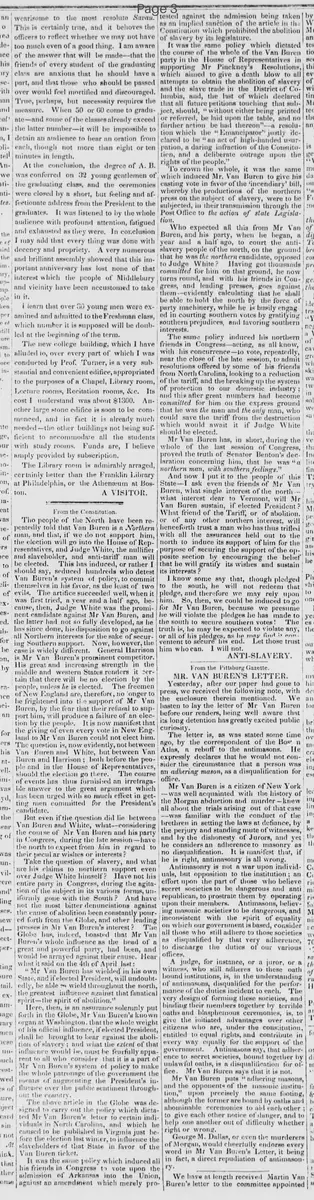
From the Constitution.
The people of the North have been repeatedly told that Van Buren is a Northern man, and that, if we do not support him, the election will go into the House of Representatives, and Judge White, the nullifier and slaveholder, and anti-tariff man will be elected. This has induced, or rather I should say, seduced hundreds who detest Van Buren's system of policy, to commit themselves in his favor, as the least of two evils. The artifice succeeded well, when it was first tried, a year and a half ago, because, then, Judge White was the prominent candidate against Mr Van Buren, and the latter had not so fully developed, as he has since done, his disposition to go against all Northern interests for the sake of securing Southern support. Now, however, the case is widely different. General Harrison is Mr Van Buren's prominent competitor. His great and increasing strength in the middle and western States renders it certain that there will be no election by the people, unless he is elected. The freemen of New England are therefore, no longer to be frightened into the support of Mr Van Buren, by the fear that their refusal to support him, will produce a failure of an election by the people. It is now manifest that the giving of even every vote in New England to Mr Van Buren could not elect him. The question is, now evidently, not between Van Buren and White, but between Van Buren and Harrison: both before the people and in the House of Representatives, should the election go there. The course of events has thus furnished an irrefragable answer to the great argument which has been urged with so much effect in getting men committed for the President's candidate.
But even if the question did lie between Van Buren and White, what--considering the course of Mr Van Buren and his party in Congress, during the late session--have the north to expect from him in regard to their peculiar wishes or interests?
Take the question of slavery, and what are his claims to northern support even over Judge White himself? Have not his entire party in Congress, during the agitation of the subject in its various forms, uniformly gone with the South? And have not the most bitter denunciations against the cause of abolition been constantly poured forth from the Globe, and other leading presses in Mr Van Buren's interest? The Globe has, indeed, boasted that Mr Van Buren's whole influence as the head of a great and powerful party, had been, and would be arrayed against their cause. Hear what it said on the 4th of April last:
"Mr Van Buren has wielded in his own State, and if elected President, will undoubtedly, be able to wield throughout the north, the greatest influence against that fanatical spirit--the spirit of abolition."
Here, then, is an assurance solemnly put forth in the Globe, Mr Van Buren's known organ at Washington, that the whole weight of his official influence, if elected President, shall be brought to bear against the abolition of slavery; and what the extent of that influence would be, must be fearfully apparent to all who consider that it is a part of Mr Van Buren's system of policy to make the whole patronage of the government the means of augmenting the President's influence over the public sentiment throughout the country.
The above article in the Globe was designed to carry out the policy which dictated Mr Van Buren's letter to certain individuals in North Carolina, and which he caused to be published in Virginia just before the election last winter, to influence the slaveholders of that State in favor of the Van Buren ticket.
It was the same policy which induced all his friends in Congress to vote upon the admission of Arkansas into the Union, against an amendment which merely protested against the admission being taken as an implied sanction of the article in the Constitution which prohibited the abolition of slavery by its legislature.
It was the same policy which dictated the course of the whole of the Van Buren party in the House of Representatives in supporting Mr Pinckney's Resolutions, which aimed to give a death blow to all attempts to obtain the abolition of slavery and the slave trade in the District of Columbia, and, the last of which declared that all future petitions touching that subject, should, "without either being printed or referred, be laid upon the table, and no further action be had thereon"--a resolution which the "Emancipator" justly declared to be "an act of high-handed usurpation, a daring infraction of the Constitution, and a deliberate outrage upon the rights of the people."
To crown the whole, it was the same which induced Mr. Van Buren to give his casting vote in favor of the 'incendiary' bill, whereby the productions of the northern press on the subject of slavery, were to be subjected, in their transmission through the Post Office to the action of state Legislation.
Who expected all this from Mr Van Buren, and his party, when he began, a year and a half ago, to court the anti-slavery people of the north, on the ground that he was the northern candidate, opposed to Judge White? Having got thousands committed for him on that ground, he now turns round, and with his friends in Congress, and leading presses, goes against them--evidently calculating that he shall be able to hold the north by the force of party machinery, while he is busily engaged in courting southern votes by gratifying southern prejudices, and favoring southern interests.
The same policy induced his northern friends in Congress--acting, as all know, with his concurrence--to vote, repeatedly, near the close of the late session, to admit resolutions offered by some of his friends from North Carolina, looking to a reduction of the tariff, and the breaking up the system of protection to our domestic industry; and this after great numbers had become committed for him on the express ground that he was the man and the only man, who could save the tariff from the destruction which would await it if Judge White should be elected.
Mr Van Buren has, in short, during the whole of the last session of Congress, proved the truth of Senator Benton's declaration concerning him, that he was "a northern man, with southern feelings."
And now I put it to the people of this State--I ask even the friends of Mr Van Buren, what single interest of the north--what interest dear to Vermont, will Mr Van Buren sustain, if elected President? What friend of the Tariff, or of abolition, or of any other northern interest, will henceforth trust a man who has thus trifled with all the assurances held out to the north to induce its support of him for the purpose of securing the support of the opposite section by encouraging the belief that he will gratify its wishes and sustain its interests?
I know some say that, though pledged to the south, he will not redeem that pledge, and therefore we may rely upon him." So, then, we could be induced to go for Mr Van Buren, because we presume he will violate the pledges he has made to the south to secure southern votes! The truth is, he may be expected to violate any, or all of his pledges, as he may find it convenient to secure his end. Let those trust him who can. I will not.
ANTI-SLAVERY.
The people of the North have been repeatedly told that Van Buren is a Northern man, and that, if we do not support him, the election will go into the House of Representatives, and Judge White, the nullifier and slaveholder, and anti-tariff man will be elected. This has induced, or rather I should say, seduced hundreds who detest Van Buren's system of policy, to commit themselves in his favor, as the least of two evils. The artifice succeeded well, when it was first tried, a year and a half ago, because, then, Judge White was the prominent candidate against Mr Van Buren, and the latter had not so fully developed, as he has since done, his disposition to go against all Northern interests for the sake of securing Southern support. Now, however, the case is widely different. General Harrison is Mr Van Buren's prominent competitor. His great and increasing strength in the middle and western States renders it certain that there will be no election by the people, unless he is elected. The freemen of New England are therefore, no longer to be frightened into the support of Mr Van Buren, by the fear that their refusal to support him, will produce a failure of an election by the people. It is now manifest that the giving of even every vote in New England to Mr Van Buren could not elect him. The question is, now evidently, not between Van Buren and White, but between Van Buren and Harrison: both before the people and in the House of Representatives, should the election go there. The course of events has thus furnished an irrefragable answer to the great argument which has been urged with so much effect in getting men committed for the President's candidate.
But even if the question did lie between Van Buren and White, what--considering the course of Mr Van Buren and his party in Congress, during the late session--have the north to expect from him in regard to their peculiar wishes or interests?
Take the question of slavery, and what are his claims to northern support even over Judge White himself? Have not his entire party in Congress, during the agitation of the subject in its various forms, uniformly gone with the South? And have not the most bitter denunciations against the cause of abolition been constantly poured forth from the Globe, and other leading presses in Mr Van Buren's interest? The Globe has, indeed, boasted that Mr Van Buren's whole influence as the head of a great and powerful party, had been, and would be arrayed against their cause. Hear what it said on the 4th of April last:
"Mr Van Buren has wielded in his own State, and if elected President, will undoubtedly, be able to wield throughout the north, the greatest influence against that fanatical spirit--the spirit of abolition."
Here, then, is an assurance solemnly put forth in the Globe, Mr Van Buren's known organ at Washington, that the whole weight of his official influence, if elected President, shall be brought to bear against the abolition of slavery; and what the extent of that influence would be, must be fearfully apparent to all who consider that it is a part of Mr Van Buren's system of policy to make the whole patronage of the government the means of augmenting the President's influence over the public sentiment throughout the country.
The above article in the Globe was designed to carry out the policy which dictated Mr Van Buren's letter to certain individuals in North Carolina, and which he caused to be published in Virginia just before the election last winter, to influence the slaveholders of that State in favor of the Van Buren ticket.
It was the same policy which induced all his friends in Congress to vote upon the admission of Arkansas into the Union, against an amendment which merely protested against the admission being taken as an implied sanction of the article in the Constitution which prohibited the abolition of slavery by its legislature.
It was the same policy which dictated the course of the whole of the Van Buren party in the House of Representatives in supporting Mr Pinckney's Resolutions, which aimed to give a death blow to all attempts to obtain the abolition of slavery and the slave trade in the District of Columbia, and, the last of which declared that all future petitions touching that subject, should, "without either being printed or referred, be laid upon the table, and no further action be had thereon"--a resolution which the "Emancipator" justly declared to be "an act of high-handed usurpation, a daring infraction of the Constitution, and a deliberate outrage upon the rights of the people."
To crown the whole, it was the same which induced Mr. Van Buren to give his casting vote in favor of the 'incendiary' bill, whereby the productions of the northern press on the subject of slavery, were to be subjected, in their transmission through the Post Office to the action of state Legislation.
Who expected all this from Mr Van Buren, and his party, when he began, a year and a half ago, to court the anti-slavery people of the north, on the ground that he was the northern candidate, opposed to Judge White? Having got thousands committed for him on that ground, he now turns round, and with his friends in Congress, and leading presses, goes against them--evidently calculating that he shall be able to hold the north by the force of party machinery, while he is busily engaged in courting southern votes by gratifying southern prejudices, and favoring southern interests.
The same policy induced his northern friends in Congress--acting, as all know, with his concurrence--to vote, repeatedly, near the close of the late session, to admit resolutions offered by some of his friends from North Carolina, looking to a reduction of the tariff, and the breaking up the system of protection to our domestic industry; and this after great numbers had become committed for him on the express ground that he was the man and the only man, who could save the tariff from the destruction which would await it if Judge White should be elected.
Mr Van Buren has, in short, during the whole of the last session of Congress, proved the truth of Senator Benton's declaration concerning him, that he was "a northern man, with southern feelings."
And now I put it to the people of this State--I ask even the friends of Mr Van Buren, what single interest of the north--what interest dear to Vermont, will Mr Van Buren sustain, if elected President? What friend of the Tariff, or of abolition, or of any other northern interest, will henceforth trust a man who has thus trifled with all the assurances held out to the north to induce its support of him for the purpose of securing the support of the opposite section by encouraging the belief that he will gratify its wishes and sustain its interests?
I know some say that, though pledged to the south, he will not redeem that pledge, and therefore we may rely upon him." So, then, we could be induced to go for Mr Van Buren, because we presume he will violate the pledges he has made to the south to secure southern votes! The truth is, he may be expected to violate any, or all of his pledges, as he may find it convenient to secure his end. Let those trust him who can. I will not.
ANTI-SLAVERY.
What sub-type of article is it?
Partisan Politics
Slavery Abolition
Economic Policy
What keywords are associated?
Van Buren Criticism
Anti Slavery
Tariff Protection
Northern Interests
Southern Support
Presidential Election
Abolition Suppression
What entities or persons were involved?
Van Buren
Judge White
General Harrison
Senator Benton
The Globe
Mr Pinckney
Editorial Details
Primary Topic
Criticism Of Van Buren For Favoring Southern Interests On Slavery And Tariffs
Stance / Tone
Strongly Anti Van Buren, Pro Northern Interests And Anti Slavery
Key Figures
Van Buren
Judge White
General Harrison
Senator Benton
The Globe
Mr Pinckney
Key Arguments
Van Buren's Support For Southern Positions On Slavery Undermines Northern Anti Slavery Efforts
Van Buren Party's Votes Against Abolition Petitions And For Pinckney's Resolutions Suppress Anti Slavery Movement
Van Buren's Casting Vote For The 'Incendiary' Bill Restricts Northern Press On Slavery
Van Buren Allies Support Tariff Reduction, Betraying Northern Protectionist Interests
Election Now Between Van Buren And Harrison, Not White, Removing Fear Based Support For Van Buren
Van Buren Described As 'Northern Man With Southern Feelings' By Benton