Thank you for visiting SNEWPapers!
Sign up free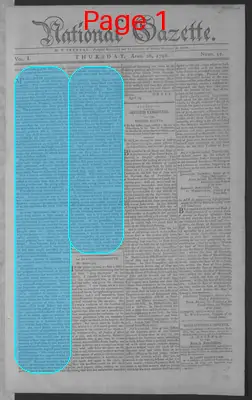
Story
April 26, 1792
National Gazette
Philadelphia, Philadelphia County, Pennsylvania
What is this article about?
In the US House, R. Baldwin opposes a bill to permanently increase import duties for funding a temporary military expedition against Indians, arguing it mortgages future revenues unnecessarily and burdens the public unexpectedly, preferring loans and future consideration.
Clipping
OCR Quality
95%
Excellent
Full Text
On the third reading of the Bill for the further increase of the duties on Imports.
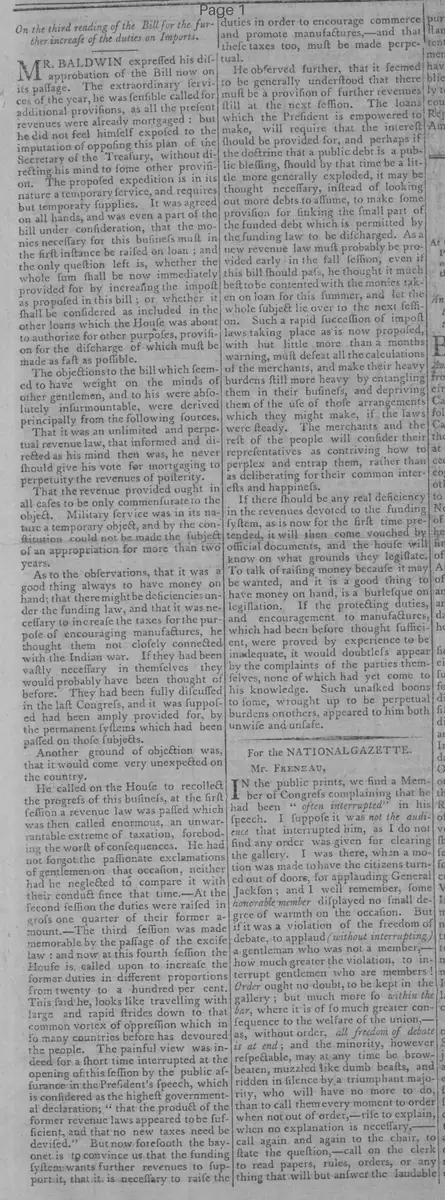
R. BALDWIN expressed his disapprobation of the Bill now on its passage. The extraordinary services of the year, he was sensible called for additional provisions, as all the present revenues were already mortgaged: but he did not feel himself exposed to the imputation of opposing this plan of the Secretary of the Treasury, without distinction. The proposed expedition is in its nature a temporary service, and requires but temporary supplies. It was agreed on all hands, and was even a part of the bill under consideration, that the monies necessary for this business must in the first instance be raised on loan: and the only question left is, whether the whole sum shall be now immediately provided for by increasing the impost as proposed in this bill; or whether it shall be considered as included in the other loans which the House was about to authorize for other purposes, provision for the discharge of which must be made as fast as possible.
The objections to the bill which seemed to have weight on the minds of other gentlemen, and to his were absolutely insurmountable, were derived principally from the following sources. That it was an unlimited and perpetual revenue law, that informed and directed as his mind then was, he never should give his vote for mortgaging to perpetuity the revenues of posterity. That the revenue provided ought in all cases to be only commensurate to the object. Military service was in its nature a temporary object, and by the constitution could not be made the subject of an appropriation for more than two years.
As to the observations, that it was a good thing always to have money on hand; that there might be deficiencies under the funding law, and that it was necessary to increase the taxes for the purpose of encouraging manufactures. he thought them not closely connected with the Indian war. If they had been vastly necessary in themselves they would probably have been thought of before. They had been fully discussed in the last Congress, and it was supposed had been amply provided for, by the permanent systems which had been passed on those subjects.
Another ground of objection was, that it would come very unexpected on the country. He called on the House to recollect the progress of this business. at the first session a revenue law was passed which was then called enormous, an unwarrantable extreme of taxation, foreboding the worst of consequences. He had not forgot the passionate exclamations of gentlemen on that occasion, neither had he neglected to compare it with their conduct since that time.-At the second session the duties were raised in gross one quarter of their former amount.--The third session was made memorable by the passage of the excise law : and now at this fourth session the House is. called upon to increase the former duties in different proportions from twenty to a hundred per cent. This said he, looks like travelling with large and rapid strides down to that common vortex of oppression which in so many countries before has devoured the people. The painful view was indeed for a short time interrupted at the opening of this session by the public assurance in the President's speech, which is considered as the highest governmental declaration; " that the product of the former revenue laws appeared to be sufficient, and that no new taxes need be devised." But now forsooth the bayonet is to convince us that the funding system wants further revenues to support it, that. it. is. necessary to raise the duties in order to encourage commerce and promote manufactures,-and that these taxes too, must be made perpetual.
He observed further, that it seemed to be generally understood that there must be a provision of further revenues still at the next session. The loans which the President is empowered to make, will require that the interest should be provided for, and perhaps if the doctrine that a public debt is a public blessing, should by that time be a little more generally exploded, it may be thought necessary, instead of looking out more debts to assume, to make some provision for sinking the small part of the funded debt which is permitted by the funding law to be discharged. As a new revenue law must probably be provided early in the fall session, even if this bill should pass, he thought it much better to be contented with the monies taken on loan for this summer, and let the whole subject lie over to the next session.
Such a rapid succession of impost laws taking place as is now proposed, with but little more than a months warning, must defeat all the calculations of the merchants, and make their heavy burdens still more heavy by entangling them in their business, and depriving them of the use of those arrangements which they might make, if the laws were steady. The merchants and the rest of the people will consider their representatives as contriving how to perplex and entrap them, rather than as deliberating for their common interests and happiness.
If there should be any real deficiency in the revenues devoted to the funding system, as is now for the first time pretended, it will then come vouched by official documents, and the house will know on what grounds they legislate. To talk of raising money because it may be wanted, and it is a good thing to have money on hand, is a burlesque on legislation. If the protecting duties, and encouragement to manufactures. which had been before thought sufficient, were proved by experience to be inadequate, it would doubtless appear by the complaints of the parties themselves, none of which had yet come to his knowledge. Such unasked boons to some, wrought up to be perpetual burdens on others, appeared to him both unwise and unsafe.
R. BALDWIN expressed his disapprobation of the Bill now on its passage. The extraordinary services of the year, he was sensible called for additional provisions, as all the present revenues were already mortgaged: but he did not feel himself exposed to the imputation of opposing this plan of the Secretary of the Treasury, without distinction. The proposed expedition is in its nature a temporary service, and requires but temporary supplies. It was agreed on all hands, and was even a part of the bill under consideration, that the monies necessary for this business must in the first instance be raised on loan: and the only question left is, whether the whole sum shall be now immediately provided for by increasing the impost as proposed in this bill; or whether it shall be considered as included in the other loans which the House was about to authorize for other purposes, provision for the discharge of which must be made as fast as possible.
The objections to the bill which seemed to have weight on the minds of other gentlemen, and to his were absolutely insurmountable, were derived principally from the following sources. That it was an unlimited and perpetual revenue law, that informed and directed as his mind then was, he never should give his vote for mortgaging to perpetuity the revenues of posterity. That the revenue provided ought in all cases to be only commensurate to the object. Military service was in its nature a temporary object, and by the constitution could not be made the subject of an appropriation for more than two years.
As to the observations, that it was a good thing always to have money on hand; that there might be deficiencies under the funding law, and that it was necessary to increase the taxes for the purpose of encouraging manufactures. he thought them not closely connected with the Indian war. If they had been vastly necessary in themselves they would probably have been thought of before. They had been fully discussed in the last Congress, and it was supposed had been amply provided for, by the permanent systems which had been passed on those subjects.
Another ground of objection was, that it would come very unexpected on the country. He called on the House to recollect the progress of this business. at the first session a revenue law was passed which was then called enormous, an unwarrantable extreme of taxation, foreboding the worst of consequences. He had not forgot the passionate exclamations of gentlemen on that occasion, neither had he neglected to compare it with their conduct since that time.-At the second session the duties were raised in gross one quarter of their former amount.--The third session was made memorable by the passage of the excise law : and now at this fourth session the House is. called upon to increase the former duties in different proportions from twenty to a hundred per cent. This said he, looks like travelling with large and rapid strides down to that common vortex of oppression which in so many countries before has devoured the people. The painful view was indeed for a short time interrupted at the opening of this session by the public assurance in the President's speech, which is considered as the highest governmental declaration; " that the product of the former revenue laws appeared to be sufficient, and that no new taxes need be devised." But now forsooth the bayonet is to convince us that the funding system wants further revenues to support it, that. it. is. necessary to raise the duties in order to encourage commerce and promote manufactures,-and that these taxes too, must be made perpetual.
He observed further, that it seemed to be generally understood that there must be a provision of further revenues still at the next session. The loans which the President is empowered to make, will require that the interest should be provided for, and perhaps if the doctrine that a public debt is a public blessing, should by that time be a little more generally exploded, it may be thought necessary, instead of looking out more debts to assume, to make some provision for sinking the small part of the funded debt which is permitted by the funding law to be discharged. As a new revenue law must probably be provided early in the fall session, even if this bill should pass, he thought it much better to be contented with the monies taken on loan for this summer, and let the whole subject lie over to the next session.
Such a rapid succession of impost laws taking place as is now proposed, with but little more than a months warning, must defeat all the calculations of the merchants, and make their heavy burdens still more heavy by entangling them in their business, and depriving them of the use of those arrangements which they might make, if the laws were steady. The merchants and the rest of the people will consider their representatives as contriving how to perplex and entrap them, rather than as deliberating for their common interests and happiness.
If there should be any real deficiency in the revenues devoted to the funding system, as is now for the first time pretended, it will then come vouched by official documents, and the house will know on what grounds they legislate. To talk of raising money because it may be wanted, and it is a good thing to have money on hand, is a burlesque on legislation. If the protecting duties, and encouragement to manufactures. which had been before thought sufficient, were proved by experience to be inadequate, it would doubtless appear by the complaints of the parties themselves, none of which had yet come to his knowledge. Such unasked boons to some, wrought up to be perpetual burdens on others, appeared to him both unwise and unsafe.
What sub-type of article is it?
Historical Event
What themes does it cover?
Justice
Moral Virtue
What keywords are associated?
Import Duties
Revenue Bill
Indian War
Funding System
Congressional Debate
Taxation Opposition
Perpetual Revenue
What entities or persons were involved?
R. Baldwin
Where did it happen?
House
Story Details
Key Persons
R. Baldwin
Location
House
Event Date
Fourth Session
Story Details
R. Baldwin opposes the bill increasing import duties permanently for temporary military funding, citing constitutional limits, unexpected burdens on merchants, prior assurances of sufficient revenues, and preference for loans over perpetual taxes.