Thank you for visiting SNEWPapers!
Sign up free
Editorial
January 22, 1871
New York Dispatch
New York, New York County, New York
What is this article about?
Editorial critiques short New York legislative sessions at Albany and warns that restricting legislative power shifts it to judiciary or permanent departments, citing New York City's reforms and historical examples like Charles I, leading to despotism.
Clipping
OCR Quality
98%
Excellent
Full Text
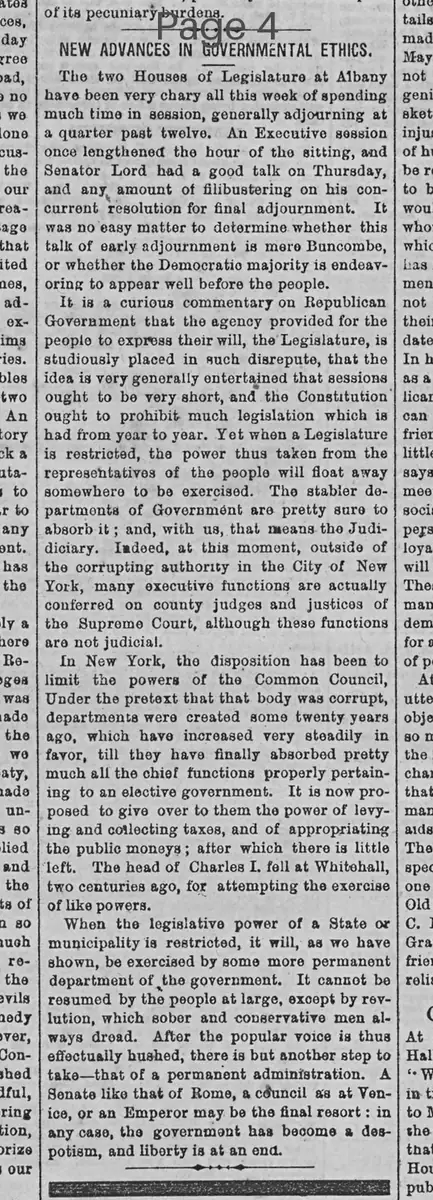
NEW ADVANCES IN GOVERNMENTAL ETHICS.
The two Houses of Legislature at Albany have been very chary all this week of spending much time in session, generally adjourning at a quarter past twelve. An Executive session once lengthened the hour of the sitting, and Senator Lord had a good talk on Thursday, and any amount of filibustering on his concurrent resolution for final adjournment. It was no easy matter to determine whether this talk of early adjournment is mere Buncombe, or whether the Democratic majority is endeavoring to appear well before the people. It is a curious commentary on Republican Government that the agency provided for the people to express their will, the Legislature, is studiously placed in such disrepute, that the idea is very generally entertained that sessions ought to be very short, and the Constitution ought to prohibit much legislation which is had from year to year. Yet when a Legislature is restricted, the power thus taken from the representatives of the people will float away somewhere to be exercised. The stabler departments of Government are pretty sure to absorb it; and, with us, that means the Judiciary. Indeed, at this moment, outside of the corrupting authority in the City of New York, many executive functions are actually conferred on county judges and justices of the Supreme Court, although these functions are not judicial. In New York, the disposition has been to limit the powers of the Common Council. Under the pretext that that body was corrupt, departments were created some twenty years ago, which have increased very steadily in favor, till they have finally absorbed pretty much all the chief functions properly pertaining to an elective government. It is now proposed to give over to them the power of levying and collecting taxes, and of appropriating the public moneys; after which there is little left. The head of Charles I. fell at Whitehall, two centuries ago, for attempting the exercise of like powers. When the legislative power of a State or municipality is restricted, it will, as we have shown, be exercised by some more permanent department of the government. It cannot be resumed by the people at large, except by revolution, which sober and conservative men always dread. After the popular voice is thus effectually hushed, there is but another step to take-that of a permanent administration. A Senate like that of Rome, a council as at Venice, or an Emperor may be the final resort; in any case, the government has become a despotism, and liberty is at an end.
The two Houses of Legislature at Albany have been very chary all this week of spending much time in session, generally adjourning at a quarter past twelve. An Executive session once lengthened the hour of the sitting, and Senator Lord had a good talk on Thursday, and any amount of filibustering on his concurrent resolution for final adjournment. It was no easy matter to determine whether this talk of early adjournment is mere Buncombe, or whether the Democratic majority is endeavoring to appear well before the people. It is a curious commentary on Republican Government that the agency provided for the people to express their will, the Legislature, is studiously placed in such disrepute, that the idea is very generally entertained that sessions ought to be very short, and the Constitution ought to prohibit much legislation which is had from year to year. Yet when a Legislature is restricted, the power thus taken from the representatives of the people will float away somewhere to be exercised. The stabler departments of Government are pretty sure to absorb it; and, with us, that means the Judiciary. Indeed, at this moment, outside of the corrupting authority in the City of New York, many executive functions are actually conferred on county judges and justices of the Supreme Court, although these functions are not judicial. In New York, the disposition has been to limit the powers of the Common Council. Under the pretext that that body was corrupt, departments were created some twenty years ago, which have increased very steadily in favor, till they have finally absorbed pretty much all the chief functions properly pertaining to an elective government. It is now proposed to give over to them the power of levying and collecting taxes, and of appropriating the public moneys; after which there is little left. The head of Charles I. fell at Whitehall, two centuries ago, for attempting the exercise of like powers. When the legislative power of a State or municipality is restricted, it will, as we have shown, be exercised by some more permanent department of the government. It cannot be resumed by the people at large, except by revolution, which sober and conservative men always dread. After the popular voice is thus effectually hushed, there is but another step to take-that of a permanent administration. A Senate like that of Rome, a council as at Venice, or an Emperor may be the final resort; in any case, the government has become a despotism, and liberty is at an end.
What sub-type of article is it?
Constitutional
Legal Reform
What keywords are associated?
Governmental Ethics
Legislature Adjournment
Republican Government
Judicial Power
New York City Corruption
Despotism Risk
What entities or persons were involved?
Legislature At Albany
Senator Lord
Common Council
Charles I
Senate Of Rome
Council At Venice
Editorial Details
Primary Topic
Critique Of Legislative Restrictions Leading To Power Shifts And Despotism
Stance / Tone
Critical Warning Against Restricting Legislative Power
Key Figures
Legislature At Albany
Senator Lord
Common Council
Charles I
Senate Of Rome
Council At Venice
Key Arguments
Legislature Sessions Are Short, Possibly For Show
Restricting Legislature Shifts Power To Judiciary Or Executive Departments
In New York City, Departments Have Absorbed Functions From The Corrupt Common Council
Proposing To Give Tax And Appropriation Powers To These Departments
Historical Parallel To Charles I's Execution For Similar Power Grabs
Such Shifts Lead To Permanent Administration And Despotism, Ending Liberty