Thank you for visiting SNEWPapers!
Sign up free
Alexandria Gazette
Alexandria, Alexandria County, District Of Columbia
What is this article about?
In 1852, Negro Jane and her child petitioned for freedom in Alexandria County Court under Maryland's 1796 anti-slave import act and a DC compromise act, claiming illegal trafficking by dealer B.O. Shekels. The jury ruled against them; the decision was affirmed on appeal by Judge John Webb Tyler.
Clipping
OCR Quality
Full Text
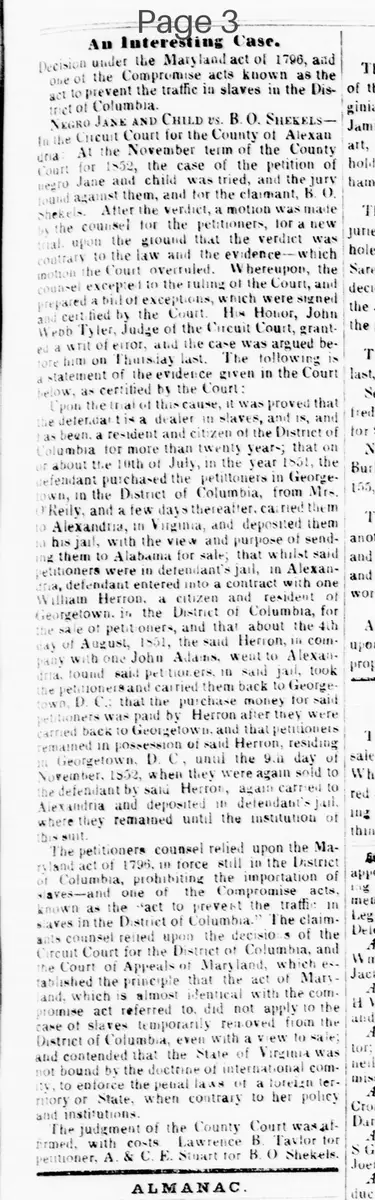
Decision under the Maryland act known as one of the Compromise acts known as the act to prevent the traffic in slaves in the District of Columbia.
NEGRO JANE AND CHILD VS. B.O. SHEKELS.
In the Circuit Court for the County of Alexandria.
At the November term of the County court for 1852, the case of the petition of negro Jane and child was tried, and the jury found against them, and for the claimant, B. O. Shekels. After the verdict, a motion was made by the counsel for the petitioners, for a new trial upon the ground that the verdict was contrary to the law and the evidence-which motion the Court overruled. Whereupon, the counsel excepted to the ruling of the Court, and prepared a bill of exceptions, which were signed and certified by the Court. His Honor, John Webb Tyler, Judge of the Circuit Court, granted a writ of error, and the case was argued before him on Thursday last. The following is a statement of the evidence given in the Court below, as certified by the Court:
Upon the trial of this cause, it was proved that the defendant is a dealer in slaves, and is, and has been, a resident and citizen of the District of Columbia for more than twenty years; that on or about the 10th of July, in the year 1851, the defendant purchased the petitioners in Georgetown, in the District of Columbia, from Mrs. Reilly, and a few days thereafter, carried them to Alexandria, in Virginia, and deposited them in his jail, with the view and purpose of sending them to Alabama for sale, that whilst said petitioners were in defendant's jail, in Alexandria, defendant entered into a contract with one William Herron, a citizen and resident of Georgetown, in the District of Columbia, for the sale of petitioners, and that about the 4th day of August, 1851, the said Herron, in company with one John Adams, went to Alexandria, found said petitioners, in said jail, took the petitioners and carried them back to Georgetown, D.C. that the purchase money for said petitioners was paid by Herron after they were carried back to Georgetown, and that petitioners remained in possession of said Herron, residing Georgetown, D.C., until the 9th day of November, 1852, when they were again sold to the defendant by said Herron, again carried to Alexandria and deposited in defendant's jail, where they remained until the institution of this suit.
The petitioners' counsel relied upon the Maryland act of 1796, still in force in the District of Columbia, prohibiting the importation of slaves-and one of the Compromise acts, known as the "act to prevent the traffic in slaves in the District of Columbia." The claimant's counsel relied upon the decisions of the Circuit Court for the District of Columbia, and the Court of Appeals of Maryland, which established the principle that the act of Maryland, which is almost identical with the compromise act referred to, did not apply to the case of slaves temporarily removed from the District of Columbia, even with a view to sale; and contended that the State of Virginia was not bound by the doctrine of international comity, to enforce the penal laws of a foreign territory or State, when contrary to her policy and institutions.
The judgment of the County Court was affirmed, with costs. Lawrence B. Taylor for Petitioner, A. & C. E. Stuart for B. O. Shekels.
What sub-type of article is it?
What themes does it cover?
What keywords are associated?
What entities or persons were involved?
Where did it happen?
Story Details
Key Persons
Location
District Of Columbia, Alexandria, Virginia; Georgetown, D.C.
Event Date
November 1852; Events July August 1851 And November 1852
Story Details
Slave dealer B.O. Shekels purchased Negro Jane and child in Georgetown, DC, moved them to Alexandria, VA for sale to Alabama. They were sold to William Herron, returned to DC, then resold to Shekels in 1852. Petitioners sued for freedom under anti-slave traffic laws; court ruled against them, affirmed on appeal.