Thank you for visiting SNEWPapers!
Sign up free
Story
April 2, 1891
Lewiston Teller
Lewiston, Nez Perce County, Idaho
What is this article about?
Telegraph operators use Morse code to laugh ('ha' or 'hi') and express surprise ('hm') during remote conversations, particularly at night to alleviate loneliness. The laughter is deliberate rather than spontaneous.
Clipping
OCR Quality
98%
Excellent
Full Text
Long Distance Laughter.
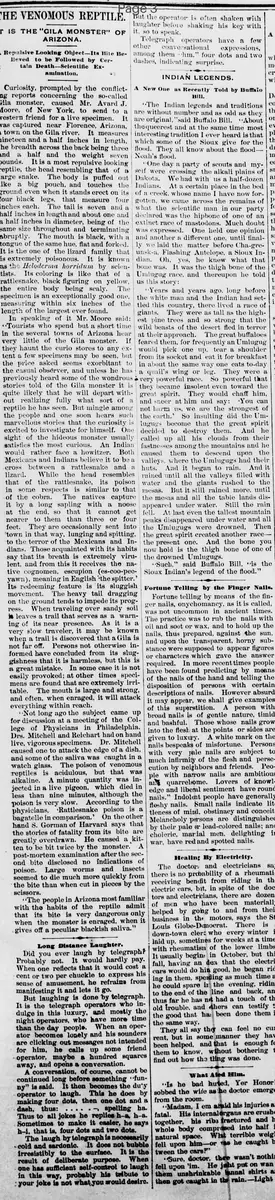
Did you ever laugh by telegraph? Probably not. It would hardly pay. When one reflects that it would cost a cent or two per chuckle to express his sense of amusement, he refrains from manifesting it and lets it go. But laughing is done by telegraph. It is the telegraph operators who indulge in this luxury, and mostly the night operators, who have more time than the day people. When an operator becomes lonely and his sounders are clicking out messages not intended for him, he calls up some friend operator, maybe a hundred squares away, and opens a conversation. A conversation, of course, cannot be continued long before something 'funny' is said. It then becomes the duty of the operator to laugh. This he does by making four dots, then one dot and a dash, thus: .... .-, spelling ha. Thus to all jokes he replies h-a, h-a. Sometimes to make it easier, he says h-i, that is, four dots and two dots. The laugh by telegraph is necessarily cold and sardonic. It does not bubble irresistibly to the surface. It is the result of deliberate purpose. When one has sufficient self-control to laugh in this way, probably his tribute to your joke is not what you would desire. But the operator is often shaken with laughter before shaking his key with it, so to speak. Telegraph operators have a few other conversational expressions, among them 'hm,' four dots and two dashes, indicating surprise.
Did you ever laugh by telegraph? Probably not. It would hardly pay. When one reflects that it would cost a cent or two per chuckle to express his sense of amusement, he refrains from manifesting it and lets it go. But laughing is done by telegraph. It is the telegraph operators who indulge in this luxury, and mostly the night operators, who have more time than the day people. When an operator becomes lonely and his sounders are clicking out messages not intended for him, he calls up some friend operator, maybe a hundred squares away, and opens a conversation. A conversation, of course, cannot be continued long before something 'funny' is said. It then becomes the duty of the operator to laugh. This he does by making four dots, then one dot and a dash, thus: .... .-, spelling ha. Thus to all jokes he replies h-a, h-a. Sometimes to make it easier, he says h-i, that is, four dots and two dots. The laugh by telegraph is necessarily cold and sardonic. It does not bubble irresistibly to the surface. It is the result of deliberate purpose. When one has sufficient self-control to laugh in this way, probably his tribute to your joke is not what you would desire. But the operator is often shaken with laughter before shaking his key with it, so to speak. Telegraph operators have a few other conversational expressions, among them 'hm,' four dots and two dashes, indicating surprise.
What sub-type of article is it?
Curiosity
What themes does it cover?
Social Manners
What keywords are associated?
Telegraph Laughter
Morse Code
Night Operators
Loneliness
Conversational Expressions
Story Details
Story Details
Telegraph operators, especially night ones, combat loneliness by conversing with distant colleagues via Morse code. They express laughter using 'ha' (.... .-) or 'hi' (.... ..), and surprise with 'hm' (.... --). The laughter is deliberate and sardonic.