Thank you for visiting SNEWPapers!
Sign up free
Literary
November 5, 1828
The Hillsborough Recorder
Hillsboro, Orange County, North Carolina
What is this article about?
An essay critiquing superstition as distinct from true piety, using thunder storms as an example. It challenges Bishop Horne's view of storms as divine displeasure, advocating parents teach children natural causes and God's love to avoid vain terrors.
Clipping
OCR Quality
95%
Excellent
Full Text
Among the useful articles in the last number of the Christian Observer, we select the following, which is inserted in that work as a communication, with the title—
"SUPERSTITION IS NOT PIETY."
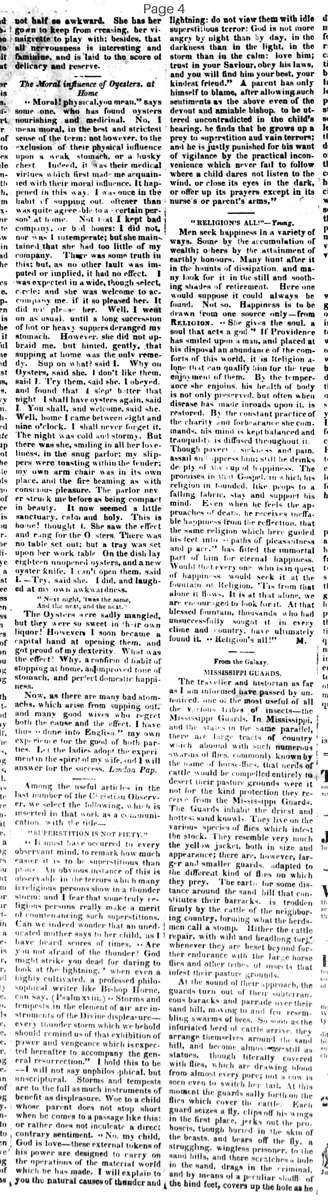
It must have occurred to every observant mind, to remark how much easier it is to be superstitious than pious. An obvious instance of this is observable in the terrors which many irreligious persons show in a thunder storm: and I fear that some truly religious persons really make a merit of countenancing such superstitions. Can we indeed wonder that an uneducated mother says to her child, as I have heard scores of times, "Are you not afraid of the thunder? God might strike you dead for daring to look at the lightning," when even a highly cultivated, a professed philosophical writer like Bishop Horne, can say, (Psalm xviii.) "Storms and tempests in the element of air are instruments of the Divine displeasure—every thunder storm which we behold should remind us of that exhibition of power and vengeance which is expected hereafter to accompany the general resurrection." I hold this to be—I will not say unphilosophical, but unscriptural. Storms and tempests are to the full as much instruments of benefit as displeasure. Woe to a child whose parent does not stop short when he comes to a passage like this: or rather does not inculcate a direct contrary sentiment. "No, my child, God is love—these external tokens of his power are designed to carry on the operations of the material world which he has made. I will explain to you the natural causes of thunder and lightning: do not view them with idle superstitious terror: God is not more angry by night than by day, in the darkness than in the light, in the storm than in the calm: love him; trust in your Saviour, obey his laws, and you will find him your best, your kindest friend." A parent has only himself to blame, after allowing such sentiments as the above even of the devout and amiable bishop, to be uttered uncontradicted in the child's hearing, he finds that he grows up a prey to superstition and vain terrors; and he is justly punished for his want of vigilance by the practical inconvenience which never fail to follow where a child dares not listen to the wind, or close its eyes in the dark, or offer up its prayers except in its nurse's or parent's arms.
"SUPERSTITION IS NOT PIETY."
It must have occurred to every observant mind, to remark how much easier it is to be superstitious than pious. An obvious instance of this is observable in the terrors which many irreligious persons show in a thunder storm: and I fear that some truly religious persons really make a merit of countenancing such superstitions. Can we indeed wonder that an uneducated mother says to her child, as I have heard scores of times, "Are you not afraid of the thunder? God might strike you dead for daring to look at the lightning," when even a highly cultivated, a professed philosophical writer like Bishop Horne, can say, (Psalm xviii.) "Storms and tempests in the element of air are instruments of the Divine displeasure—every thunder storm which we behold should remind us of that exhibition of power and vengeance which is expected hereafter to accompany the general resurrection." I hold this to be—I will not say unphilosophical, but unscriptural. Storms and tempests are to the full as much instruments of benefit as displeasure. Woe to a child whose parent does not stop short when he comes to a passage like this: or rather does not inculcate a direct contrary sentiment. "No, my child, God is love—these external tokens of his power are designed to carry on the operations of the material world which he has made. I will explain to you the natural causes of thunder and lightning: do not view them with idle superstitious terror: God is not more angry by night than by day, in the darkness than in the light, in the storm than in the calm: love him; trust in your Saviour, obey his laws, and you will find him your best, your kindest friend." A parent has only himself to blame, after allowing such sentiments as the above even of the devout and amiable bishop, to be uttered uncontradicted in the child's hearing, he finds that he grows up a prey to superstition and vain terrors; and he is justly punished for his want of vigilance by the practical inconvenience which never fail to follow where a child dares not listen to the wind, or close its eyes in the dark, or offer up its prayers except in its nurse's or parent's arms.
What sub-type of article is it?
Essay
What themes does it cover?
Religious
Moral Virtue
What keywords are associated?
Superstition
Piety
Thunder Storm
Religious Education
Bishop Horne
Divine Displeasure
Literary Details
Title
Superstition Is Not Piety.
Key Lines
It Must Have Occurred To Every Observant Mind, To Remark How Much Easier It Is To Be Superstitious Than Pious.
"No, My Child, God Is Love—These External Tokens Of His Power Are Designed To Carry On The Operations Of The Material World Which He Has Made."