Thank you for visiting SNEWPapers!
Sign up free
Gazette Of The United States And Daily Evening Advertiser
Philadelphia, Philadelphia County, Pennsylvania
What is this article about?
In the House of Representatives on January 16, debate continued on a plan to reduce the public debt. Mr. S. Smith opposed taxing protected manufactures and argued against excise duties. Mr. Madison advocated for a direct tax on property over a broad system of excises, suggesting temporary taxes for temporary purposes.
Merged-components note: Continuation of congressional debate on public debt reduction across pages 2 and 3
Clippings
1 of 2
OCR Quality
Full Text
HOUSE OF REPRESENTATIVES.
Friday, January 16.
Debate on the reported plan for reducing the public debt.
Continued.
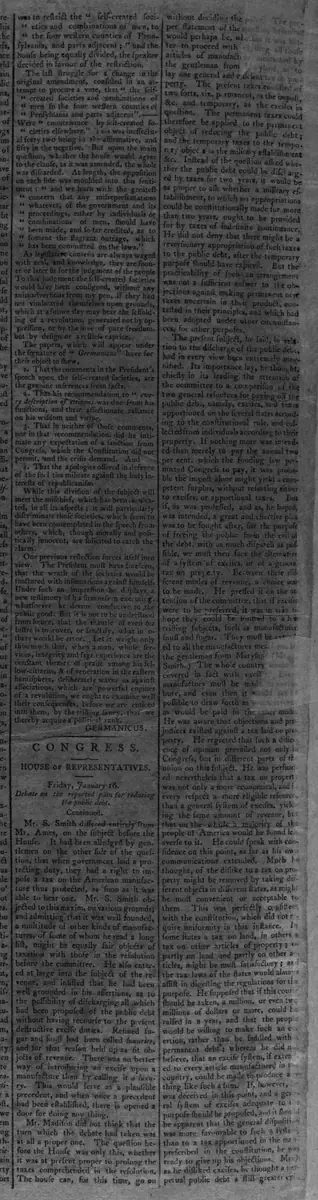
Mr. S. Smith differed--entirely from Mr. Ames, on the subject before the House. It had been alledged by gentlemen on the other side of the question, that when government laid a protecting duty, they had a right to impose a tax on the American manufacture thus protected, as soon as it was able to bear one. Mr. S. Smith objected to this maxim, on various grounds: and admitting that it was well founded, a multitude of other kinds of manufactures, of some of which he read a long list, might be equally fair objects of taxation with those in the resolution before the committee. He also entered at large into the subject of the revenue, and insisted that he had been well grounded in his assertions, as to the possibility of discharging all which had been proposed of the public debt without having recourse to the present destructive excise duties. Refined sugar and rum had been called luxuries, and for that reason held up as fit objects of revenue. There was no better way of introducing an excise upon a manufacture than by calling it a luxury. This would serve as a plausible precedent, and when once a precedent had been established, there is opened a door for doing any thing.
Mr. Madison did not think that the turn which the debate had taken was at all a proper one. The question before the House was only this, whether it was at present proper to prolong the taxes comprehended in the resolution. The house can, for this time, go on without deciding the point. The present statement of the question hereafter would perhaps be, whether it was better to proceed with excising all such articles of manufactory mentioned by the gentleman from Maryland, or to lay one general and efficient tax on property. The present taxes consisted of two sorts, viz. permanent, as the impost, &c. and temporary, as the excises in question. The permanent taxes could therefore be applied to the permanent object of reducing the public debt; and the temporary taxes to the temporary objects as the military establishment &c. Instead of the question asked whether the public debt could be discharged by taxes for two years, it would be as proper to ask whether a military establishment, to which no appropriations could be constitutionally made for more than two years, ought to be provided for by taxes of indefinite continuance. He did not deny that there might be a reversionary appropriation of such taxes to the public debt, after the temporary purpose should have expired. But the practicability of such an arrangement was not a sufficient answer to the objections against making permanent new taxes uncertain in their product, contested in their principles, and which had been adopted under other circumstances, for other purposes.
The present subject, he said, in relation to the discharge of the public debt, had in every view been extremely magnified. Its importance lay, he thought, chiefly in its leading the attention of the committee to a comparison of the two general resources for paying off the public debt, namely, excises, and taxes apportioned on the several states according to the constitutional rule, and collected from individuals according to their property. If nothing more was intended than merely to pay the annual two per cent. which the funding law permitted Congress to pay, it was probable the impost alone might yield a competent surplus, without resorting either to excises, or apportion al taxes. But if, as was professed, and as, he hoped, was intended, a great and effective plan was to be sought after, for the purpose of freeing the public from the evil of the debt, with as much dispatch as possible, we must then face the alternative of a system of excises, or of a general tax on property. Between these different modes of revenue, a choice was to be made. He pressed it on the attention of the committee, that if excises were to be preferred, it was in vain to hope they could be limited to a few trifling subjects, such as manufactures of snuff and sugar. They must be extended to all the manufactures mentioned by the gentleman from Maryland (Mr. Smith.) The whole country would be covered in fact with excise. Every manufactory must be made to contribute, and even then it failed not possible to draw forth as much revenue as would be paid in the other mode.
He was aware that objections and prejudices existed against a tax laid on property. He regretted that such a difference of opinion prevailed not only in Congress, but in different parts of the union on this subject. He was persuaded nevertheless that a tax on property was not only a more economical, and in every respect a more eligible resource, than a general system of excises, yielding the same amount of revenue, but that on the whole a majority of the people of America would be found less averse to it. He could speak with confidence on this point, as far as his own communications extended. Much, he thought, of the dislike to a tax on property might be removed by taking different objects in different states, as might be most convenient or acceptable to them. This was perfectly consistent with the constitution, which did not require uniformity in this instance. In some states a tax on land, in others a tax on other articles of property; partly on land and partly on other articles, might be most satisfactory; and the tax laws of the states would always aid in digesting the regulations for this purpose. He supposed that if this course should be taken, a million, or even two millions of dollars or more, could be raised in a year, and that the people would be willing to make such an exertion, rather than be saddled with a permanent debt; whereas he did not believe, that an excise system, if extended to every article manufactured in the country, could be made to produce any thing like such a sum. If, however, he was deceived in this point, and a general system of excises adequate to the purpose should be proposed, and it should be apparent that the general disposition was more favourable to such a system than to a tax apportioned in the manner prescribed in the constitution, he was ready to give up his objections. Much as he disliked excises, he thought a perpetual public debt a still greater evil.
But he should much prefer another system, and he repeated the caution, that the alternative was not between a tax on property, and the petty excises in question, which could not be felt in the work of sinking the debt; but between such a tax and excises spread over a sufficient number of manufactures to produce an equal sum of revenue. He again suggested to the attention of the committee that the question was not whether the laws should be repealed, but whether they should remain as they stood, till their merit could be better known, and the whole subject be more fully taken up; and that all that was at this time aimed at with respect to the debt, would be attained by allotting the temporary part of the revenue to temporary purposes.
What sub-type of article is it?
What keywords are associated?
What entities or persons were involved?
Domestic News Details
Event Date
Friday, January 16.
Key Persons
Outcome
debate continued without resolution; focus on alternatives to excise taxes for debt reduction.
Event Details
Debate in the House of Representatives on prolonging taxes for public debt reduction. Mr. S. Smith opposed taxing protected manufactures and argued excise duties could be avoided. Mr. Madison emphasized distinguishing permanent and temporary taxes, advocated for property taxes over broad excises, and suggested state-specific implementations.