Thank you for visiting SNEWPapers!
Sign up free
Literary
September 8, 1853
The Religious Herald
Hartford, Hartford County, Connecticut
What is this article about?
Reflective prose on the cricket's cheerful song in the wall, questioning insect life and nature's lessons, evoking childhood memories by the fireside and the loss of family to time and death, ending with a quoted verse on scattering and graves.
Clipping
OCR Quality
95%
Excellent
Full Text
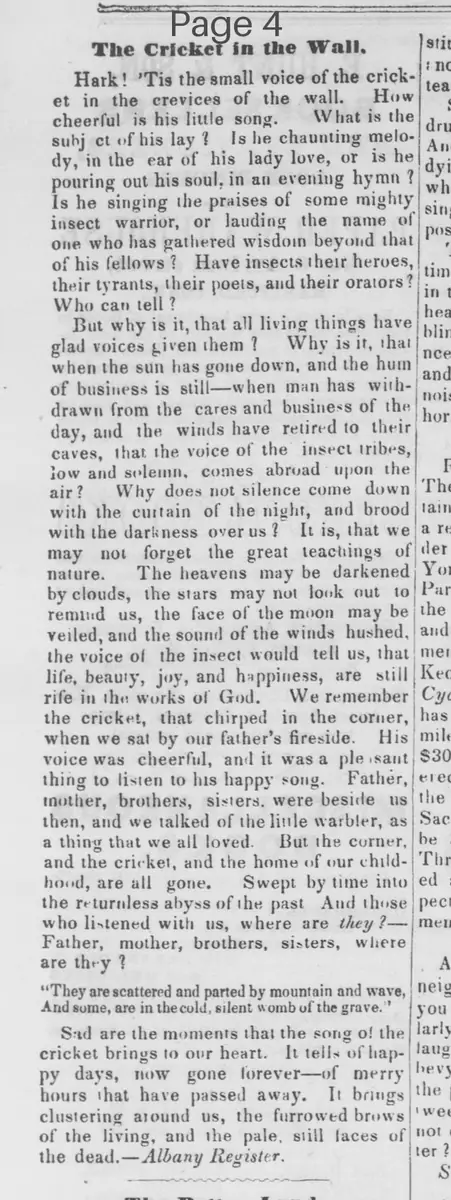
The Cricket in the Wall.
Hark! 'Tis the small voice of the cricket in the crevices of the wall. How cheerful is his little song. What is the subject of his lay? Is he chanting melody, in the ear of his lady love, or is he pouring out his soul, in an evening hymn? Is he singing the praises of some mighty insect warrior, or lauding the name of one who has gathered wisdom beyond that of his fellows? Have insects their heroes, their tyrants, their poets, and their orators? Who can tell?
But why is it, that all living things have glad voices? Even them? Why is it, that when the sun has gone down, and the hum of business is still—when man has withdrawn from the cares and business of the day, and the winds have retired to their caves, that the voice of the insect tribes, low and solemn, comes abroad upon the air? Why does not silence come down with the curtain of the night, and brood with the darkness over us? It is, that we may not forget the great teachings of nature. The heavens may be darkened by clouds, the stars may not look out to remind us, the face of the moon may be veiled, and the sound of the winds hushed. The voice of the insect would tell us, that life, beauty, joy, and happiness, are still rife in the works of God. We remember the cricket, that chirped in the corner, when we sat by our father's fireside. His voice was cheerful, and it was a pleasant thing to listen to his happy song. Father, mother, brothers, sisters, were beside us then, and we talked of the little warbler, as a thing that we all loved. But the corner, and the cricket, and the home of our childhood, are all gone. Swept by time into the returnless abyss of the past. And those who listened with us, where are they?—Father, mother, brothers, sisters, where are they?
"They are scattered and parted by mountain and wave
And some, are in the cold, silent womb of the grave."
Sad are the moments that the song of the cricket brings to our heart. It tells of happy days, now gone forever—of merry hours that have passed away. It brings clustering around us, the furrowed brows of the living, and the pale, still faces of the dead.—Albany Register.
Hark! 'Tis the small voice of the cricket in the crevices of the wall. How cheerful is his little song. What is the subject of his lay? Is he chanting melody, in the ear of his lady love, or is he pouring out his soul, in an evening hymn? Is he singing the praises of some mighty insect warrior, or lauding the name of one who has gathered wisdom beyond that of his fellows? Have insects their heroes, their tyrants, their poets, and their orators? Who can tell?
But why is it, that all living things have glad voices? Even them? Why is it, that when the sun has gone down, and the hum of business is still—when man has withdrawn from the cares and business of the day, and the winds have retired to their caves, that the voice of the insect tribes, low and solemn, comes abroad upon the air? Why does not silence come down with the curtain of the night, and brood with the darkness over us? It is, that we may not forget the great teachings of nature. The heavens may be darkened by clouds, the stars may not look out to remind us, the face of the moon may be veiled, and the sound of the winds hushed. The voice of the insect would tell us, that life, beauty, joy, and happiness, are still rife in the works of God. We remember the cricket, that chirped in the corner, when we sat by our father's fireside. His voice was cheerful, and it was a pleasant thing to listen to his happy song. Father, mother, brothers, sisters, were beside us then, and we talked of the little warbler, as a thing that we all loved. But the corner, and the cricket, and the home of our childhood, are all gone. Swept by time into the returnless abyss of the past. And those who listened with us, where are they?—Father, mother, brothers, sisters, where are they?
"They are scattered and parted by mountain and wave
And some, are in the cold, silent womb of the grave."
Sad are the moments that the song of the cricket brings to our heart. It tells of happy days, now gone forever—of merry hours that have passed away. It brings clustering around us, the furrowed brows of the living, and the pale, still faces of the dead.—Albany Register.
What sub-type of article is it?
Essay
What themes does it cover?
Nature
Death Mortality
Religious
What keywords are associated?
Cricket Song
Nature Lessons
Childhood Memories
Family Loss
Insect Voices
Works Of God
What entities or persons were involved?
Albany Register
Literary Details
Title
The Cricket In The Wall.
Author
Albany Register
Key Lines
Hark! 'Tis The Small Voice Of The Cricket In The Crevices Of The Wall. How Cheerful Is His Little Song.
The Voice Of The Insect Would Tell Us, That Life, Beauty, Joy, And Happiness, Are Still Rife In The Works Of God.
We Remember The Cricket, That Chirped In The Corner, When We Sat By Our Father's Fireside.
"They Are Scattered And Parted By Mountain And Wave
And Some, Are In The Cold, Silent Womb Of The Grave."
Sad Are The Moments That The Song Of The Cricket Brings To Our Heart.