Thank you for visiting SNEWPapers!
Sign up free
Literary
September 28, 1803
The National Intelligencer And Washington Advertiser
Washington, District Of Columbia
What is this article about?
This essay, the fifth letter in a defense of republican governments, argues that republics secure inalienable rights like life, liberty, property, freedom of thought, and expression, promoting greater happiness than monarchies, which foster tyranny and persecution. It cites historical examples and quotes from Price, Montesquieu, Hume, and Milton.
Clipping
OCR Quality
95%
Excellent
Full Text
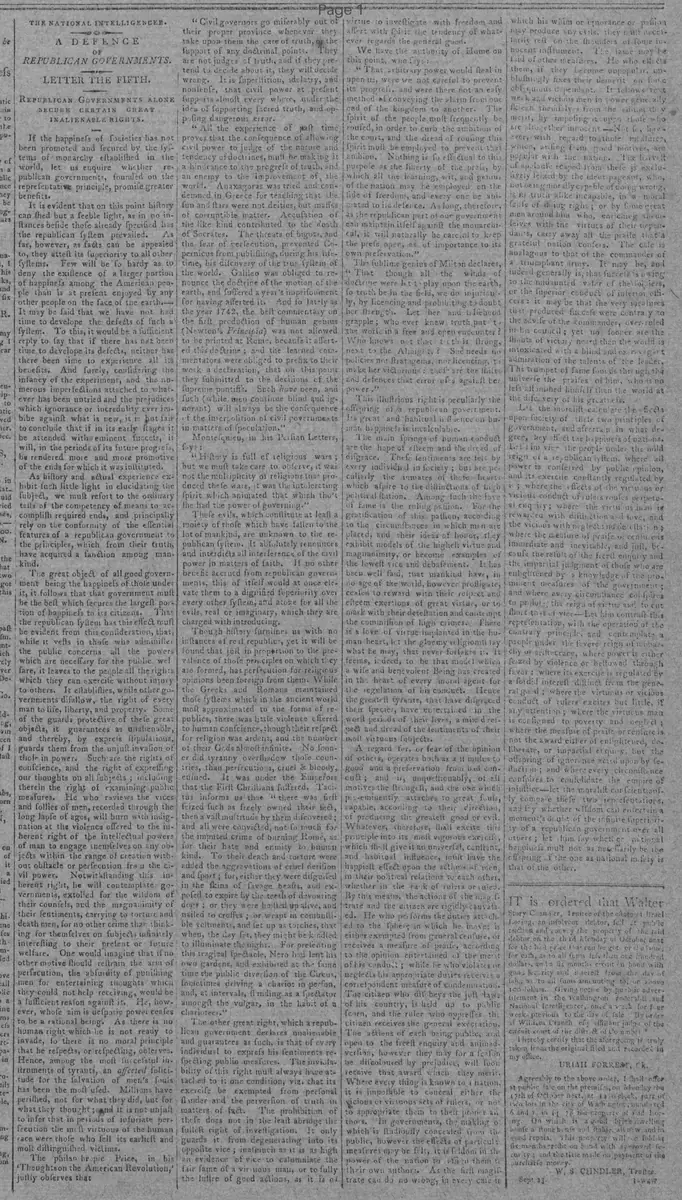
THE NATIONAL INTELLIGENCER.
A DEFENCE OF REPUBLICAN GOVERNMENTS.
LETTER THE FIFTH.
Republican GOVERNMENTS Alone SECURE CERTAIN GREAT INALIENABLE RIGHTS.
If the happiness of societies has not been promoted and secured by the systems of monarchy established in the world, let us enquire whether republican governments, founded on the representative principle, promise greater benefits.
It is evident that on this point history can shed but a feeble light, as in no instances beside those already specified has the republican system prevailed. As far, however, as facts can be appealed to, they attest its superiority to all other systems. Few will be so hardy as to deny the existence of a larger portion of happiness among the American people than is at present enjoyed by any other people on the face of the earth.
It may be said that we have not had time to develope the defects of such a system. To this, it would be a sufficient reply to say that if there has not been time to develope its defects, neither has there been time to experience all its benefits. And surely, considering the infancy of the experiment, and the numerous imperfections attached to whatever has been untried and the prejudices which ignorance or incredulity ever imbibe against what is new, it is but fair to conclude that if in its early stages it be attended with eminent success, it will, in the periods of its future progress, be rendered more and more promotive of the ends for which it was instituted.
As history and actual experience exhibit such little light in elucidating the subject, we must resort to the ordinary tests of the competency of means to accomplish required ends, and principally rely on the conformity of the essential features of a republican government to the principles, which from their truth have acquired a sanction among mankind.
The great object of all good government being the happiness of those under it, it follows that that government must be the best which secures the largest portion of happiness to its citizens. That the republican system has this effect must be evident from this consideration, that, while it vests in those who administer the public concerns all the powers which are necessary for the public welfare, it leaves to the people all the rights which they can exercise without injury to others. It establishes, while other governments disallow, the right of every man to life, liberty, and property. Some of the guards protective of these great objects, it guarantees as unalienable, and thereby, by express stipulations, guards them from the unjust invasion of those in power. Such are the rights of conscience, and the right of expressing our thoughts on all subjects; including therein the right of examining public measures. He who reviews the vices and follies of men, recorded through the long lapse of ages, will burn with indignation at the violence offered to the inherent right of the intellectual powers of man to engage themselves on any objects within the range of creation without obstacle or persecution from the civil power. Notwithstanding this inherent right, he will contemplate governments, extolled for the wisdom of their counsels, and the magnanimity of their sentiments, carrying to torture and death men, for no other crime than thinking for themselves on subjects infinitely interesting to their present or future welfare. One would imagine that if no other motive should restrain the arm of persecution, the absurdity of punishing men for entertaining thoughts which they could not help receiving, would be a sufficient reason against it. He, however, whose aim is despotic power ceases to be a rational being. As there is no human right which he is not ready to invade, so there is no moral principle that he respects, or respecting, observes.
Hence, among the most successful instruments of tyrants, an affected solicitude for the salvation of men's souls has been the most used. Millions have perished, not for what they did, but for what they thought; and it is not unjust to infer that in periods of infuriate persecution the most virtuous of the human race were those who fell its earliest and most distinguished victims.
The philanthropic Price, in his Thoughts on the American Revolution, justly observes that
"Civil governors go miserably out of their proper province whenever they take upon them the care of truth, or the support of any doctrinal points. They are not judges of truth, and if they pretend to decide about it, they will decide wrong. It is superstition, idolatry, and nonsense, that civil power at present supports almost every where, under the idea of supporting sacred truth, and opposing dangerous error.
All the experience of past time proves that the consequence of allowing civil power to judge of the nature and tendency of doctrines, must be making it a hindrance to the progress of truth, and an enemy to the improvement of the world. Anaxagoras was tried and condemned in Greece for teaching that the sun and stars were not deities, but masses of corruptible matter. Accusations of the like kind contributed to the death of Socrates. The threats of bigots, and the fear of persecution, prevented Copernicus from publishing, during his life-time, his discovery of the true system of the world. Galileo was obliged to renounce the doctrine of the motion of the earth, and suffered a year's imprisonment for having asserted it. And so lately as the year 1742, the best commentary on the first production of human genius (Newton's Principia) was not allowed to be printed at Rome, because it asserted this doctrine; and the learned commentators were obliged to prefix to their work a declaration, that on this point they submitted to the decisions of the supreme pontiff. Such have been, and such (while men continue blind and ignorant) will always be the consequence of the interposition of civil governments in matters of speculation."
Montesquieu, in his Persian Letters, says:
"History is full of religious wars; but we must take care to observe, it was not the multiplicity of religions that produced these wars. It was the intolerant spirit which animated that which thought itself had the power of governing."
These evils, which constitute at least a moiety of those which have fallen to the lot of mankind, are unknown to the republican system. It absolutely renounces and interdicts all interference of the civil power in matters of faith. If no other benefit accrued from republican governments, this of itself would at once elevate them to a dignified superiority over every other system, and atone for all the evils, real or imaginary, which they are charged with introducing.
Though history furnishes us with no instances of real republics, yet it will be found that just in proportion to the prevalence of those principles on which they are formed, has persecution for religious opinions been foreign from them. While the Greeks and Romans maintained those systems which in the ancient world most approximated to the forms of republics, there was little violence offered to human conscience. Though their respect for religion was ardent, and the number of their Gods almost infinite. No sooner did tyranny overshadow those countries, than persecutious, cruel & bloody, ensued. It was under the Emperors that the First Christians suffered. Tacitus informs us that "there was first seized such as freely owned their sect, then a vast multitude by them discovered; and all were convicted, not so much for the imputed crime of burning Rome, as for their hate and enmity to human kind. To their death and torture were added the aggravations of cruel derision and sport; for, either they were disfigured in the skins of savage beasts, and exposed to expire by the teeth of devouring dogs; or they were hoisted up alive, and nailed to crosses; or wrapt in combustible vestments, and set up as torches, that when the day set, they might be kindled to illuminate the night. For presenting this tragical spectacle, Nero had lent his own gardens, and exhibited at the same time the public diversion of the Circus, oftentimes driving a chariot in person, and, at intervals, treading as a spectator amongst the vulgar, in the habit of a charioteer."
The other great right, which a republican government declares unalienable and guarantees as such, is that of every individual to express his sentiments respecting public measures. The inviolability of this right must always have attached to it one condition, viz. that its exercise be exempted from personal slander and the perversion of truth in matters of fact. The prohibition of these does not in the least abridge the fullest right of investigation. It only guards it from degenerating into its opposite vice; inasmuch as it is as high an evidence of vice to calumniate the fair name of a virtuous man, or to sully the lustre of good actions, as it is of virtue to investigate with freedom and assert with spirit the tendency of whatever regards the general good.
We have the authority of Hume on this point, who says:
"That arbitrary power would steal upon us, were we not careful to prevent its progress, and were there not an easy method of conveying the alarm from one end of the kingdom to another. The spirit of the people must frequently be roused, in order to curb the ambition of the court, and the dread of rousing this spirit must be employed to prevent that ambition. Nothing is so effectual to this purpose as the liberty of the press, by which all the learning, wit, and genius of the nation may be employed on the side of freedom, and every one be animated to its defence. As long, therefore, as the republican part of our government can maintain itself against the monarchical, it will naturally be careful to keep the press open, as of importance to its own preservation."
The sublime genius of Milton declares,
"That though all the winds of doctrine were let to play upon the earth, so Truth be in the field, we do injuriously, by licensing and prohibiting to doubt her strength. Let her and Falsehood grapple; who ever knew Truth put to the worse in a free and open encounter? Who knows not that Truth is strong, next to the Almighty? She needs no policies nor stratagems, nor licensing, to make her victorious: those are the shifts and defences that error uses against her power."
This illustrious right is peculiarly the offspring of a republican government. Its great and habitual influence on human happiness is incalculable.
The main springs of human conduct are the hope of esteem and the dread of disgrace. These sentiments are felt by every individual in society; but are peculiarly the inmates of those hearts which aspire to the distinctions of high political station. Among such the love of fame is the ruling passion. For the gratification of this passion, according to the circumstances in which men are placed, and their ideas of honor, they exhibit models of the highest virtue and magnanimity, or become examples of the lowest vice and debasement. It has been well said, that mankind have, in no age of the world, however profligate, ceased to reward with their respect and esteem exertions of great virtue, or to mark with their detestation and contempt the commission of high crimes. There is a love of virtue implanted in the human heart, let the gloomy religionist lay what he may, that never forsakes it. It seems, indeed, to be that model which a wise and benevolent Being has created in the heart of every moral agent for the regulation of his conduct. Hence the greatest tyrants, that have disgraced their species, have entertained in the worst periods of their lives, a mixed reverence and dread of the sentiments of their most virtuous subjects.
A regard for, or fear of the opinion of others, operates both as a stimulus to good and a preservation from bad conduct; and is, unquestionably, of all motives the strongest, and the one which pre-eminently attaches to great souls, capable, according to their direction, of producing the greatest good or evil. Whatever, therefore, shall excite this principle into its most vigorous exercise, which shall give it an universal, constant, and habitual influence, must have the happiest effect upon the actions of men, in their political relations to each other, whether in the rank of rulers or ruled.
By this means, the actions of the magistrate and the citizen are rigidly canvassed. He who performs the duties attached to the sphere in which he moves is either exempted from general censure, or receives a measure of praise, according to the opinion entertained of the merit of his conduct; while he who violates or neglects his appropriate duties receives a correspondent measure of condemnation. The citizen who disobeys the just laws of his country, is held up to public scorn, and the ruler who oppresses the citizen receives the general execration. The actions of each being public, and open to the freest enquiry and animadversion, however they may for a season be discolored by prejudice, will soon receive that award which they merit.
Where every thing is known to a nation, it is impossible to conceal either the vicious or virtuous acts of rulers, or not to appropriate them to their proper authors. In governments, the making of which is studiously concealed from the public, however the effects of particular measures may be felt. it is seldom in the power of the nation to assign them to their own authors. As the first magistrate can do no wrong, in every case in which his whim or ignorance or passion may produce any evils. they must devolve on the shoulders of some innocent instrument. The same may be said of other measures. He who enacts them, if they become unpopular, unblushingly fixes their demerit on some obsequious dependent. It follows next week and vicious men in power generally keep their sway from the contempt by imposing it openly on those who are altogether innocent - however, with regard to those measures, whom, arising from good motives, appear popular with the nation. The harvest of applause reaped from these is exclusively seized by the idiot pageant, who, not being morally capable of doing wrong, is in truth alike incapable, in a moral sense of doing right; or by some great men around him who, enriching themselves with the virtues of their dependent's, carry away all the praise that a grateful nation confers. The case is analogous to that of the commander of a triumphant army. It may be, and indeed generally is, that success is owing to the undaunted valor of the soldiers, or the superior conduct of inferior officers: it may be that the very measures that produced success were contrary to the advice of the commander, over-ruled in his council; yet no sooner are the shouts of victory heard than the world is intoxicated with a blind and enraptured admiration of the talents of the leader. The trumpet of fame sounds through the universe the praises of him, who is no less astonished himself than the world at the discovery of his greatness.
Let the moralist calculate the effects upon society of these two principles of government, and ascertain in what degree, by the first, the happiness of nations. Let him view the people under the mild reign of a republican system. where all power is conferred by public opinion, and its exercise constantly regulated by it; where the acts of the virtuous or vicious conduct of rulers rouses perpetual enquiry; where the virtuous man is rewarded with distinction and love, and the vicious with neglect and detestation; where the measure of praise or censure is immediate and inevitable, and just, because the result of the freest enquiry and the impartial judgment of those who are enlightened by a knowledge of the prominent measures of the government; and where every circumstance conspires to prolong the reign of virtue and to cut short that of vice-Let him contrast this representation, with the operation of the contrary principle, and contemplate a people under the severe reign of monarchy or aristocracy, where power is either seized by violence or bestowed through favor; where its exercise is regulated by a sordid interest distinct from the general good; where the virtuous or vicious conduct of rulers excites but little, if any attention; where the virtuous man is consigned to poverty and neglect; where the measure of praise or censure is not the award either of enlightened, deliberate, or impartial enquiry, but the offspring of ignorance acted upon by seduction; and where every circumstance conspires to consolidate the empire of injustice-let the moralist conscientiously compare these two representations, and say whether wisdom can entertain a moment's doubt of the infinite superiority of a republican government over all others; let him say whether national happiness must not as necessarily be the offspring of the one as national misery is that of the other.
A DEFENCE OF REPUBLICAN GOVERNMENTS.
LETTER THE FIFTH.
Republican GOVERNMENTS Alone SECURE CERTAIN GREAT INALIENABLE RIGHTS.
If the happiness of societies has not been promoted and secured by the systems of monarchy established in the world, let us enquire whether republican governments, founded on the representative principle, promise greater benefits.
It is evident that on this point history can shed but a feeble light, as in no instances beside those already specified has the republican system prevailed. As far, however, as facts can be appealed to, they attest its superiority to all other systems. Few will be so hardy as to deny the existence of a larger portion of happiness among the American people than is at present enjoyed by any other people on the face of the earth.
It may be said that we have not had time to develope the defects of such a system. To this, it would be a sufficient reply to say that if there has not been time to develope its defects, neither has there been time to experience all its benefits. And surely, considering the infancy of the experiment, and the numerous imperfections attached to whatever has been untried and the prejudices which ignorance or incredulity ever imbibe against what is new, it is but fair to conclude that if in its early stages it be attended with eminent success, it will, in the periods of its future progress, be rendered more and more promotive of the ends for which it was instituted.
As history and actual experience exhibit such little light in elucidating the subject, we must resort to the ordinary tests of the competency of means to accomplish required ends, and principally rely on the conformity of the essential features of a republican government to the principles, which from their truth have acquired a sanction among mankind.
The great object of all good government being the happiness of those under it, it follows that that government must be the best which secures the largest portion of happiness to its citizens. That the republican system has this effect must be evident from this consideration, that, while it vests in those who administer the public concerns all the powers which are necessary for the public welfare, it leaves to the people all the rights which they can exercise without injury to others. It establishes, while other governments disallow, the right of every man to life, liberty, and property. Some of the guards protective of these great objects, it guarantees as unalienable, and thereby, by express stipulations, guards them from the unjust invasion of those in power. Such are the rights of conscience, and the right of expressing our thoughts on all subjects; including therein the right of examining public measures. He who reviews the vices and follies of men, recorded through the long lapse of ages, will burn with indignation at the violence offered to the inherent right of the intellectual powers of man to engage themselves on any objects within the range of creation without obstacle or persecution from the civil power. Notwithstanding this inherent right, he will contemplate governments, extolled for the wisdom of their counsels, and the magnanimity of their sentiments, carrying to torture and death men, for no other crime than thinking for themselves on subjects infinitely interesting to their present or future welfare. One would imagine that if no other motive should restrain the arm of persecution, the absurdity of punishing men for entertaining thoughts which they could not help receiving, would be a sufficient reason against it. He, however, whose aim is despotic power ceases to be a rational being. As there is no human right which he is not ready to invade, so there is no moral principle that he respects, or respecting, observes.
Hence, among the most successful instruments of tyrants, an affected solicitude for the salvation of men's souls has been the most used. Millions have perished, not for what they did, but for what they thought; and it is not unjust to infer that in periods of infuriate persecution the most virtuous of the human race were those who fell its earliest and most distinguished victims.
The philanthropic Price, in his Thoughts on the American Revolution, justly observes that
"Civil governors go miserably out of their proper province whenever they take upon them the care of truth, or the support of any doctrinal points. They are not judges of truth, and if they pretend to decide about it, they will decide wrong. It is superstition, idolatry, and nonsense, that civil power at present supports almost every where, under the idea of supporting sacred truth, and opposing dangerous error.
All the experience of past time proves that the consequence of allowing civil power to judge of the nature and tendency of doctrines, must be making it a hindrance to the progress of truth, and an enemy to the improvement of the world. Anaxagoras was tried and condemned in Greece for teaching that the sun and stars were not deities, but masses of corruptible matter. Accusations of the like kind contributed to the death of Socrates. The threats of bigots, and the fear of persecution, prevented Copernicus from publishing, during his life-time, his discovery of the true system of the world. Galileo was obliged to renounce the doctrine of the motion of the earth, and suffered a year's imprisonment for having asserted it. And so lately as the year 1742, the best commentary on the first production of human genius (Newton's Principia) was not allowed to be printed at Rome, because it asserted this doctrine; and the learned commentators were obliged to prefix to their work a declaration, that on this point they submitted to the decisions of the supreme pontiff. Such have been, and such (while men continue blind and ignorant) will always be the consequence of the interposition of civil governments in matters of speculation."
Montesquieu, in his Persian Letters, says:
"History is full of religious wars; but we must take care to observe, it was not the multiplicity of religions that produced these wars. It was the intolerant spirit which animated that which thought itself had the power of governing."
These evils, which constitute at least a moiety of those which have fallen to the lot of mankind, are unknown to the republican system. It absolutely renounces and interdicts all interference of the civil power in matters of faith. If no other benefit accrued from republican governments, this of itself would at once elevate them to a dignified superiority over every other system, and atone for all the evils, real or imaginary, which they are charged with introducing.
Though history furnishes us with no instances of real republics, yet it will be found that just in proportion to the prevalence of those principles on which they are formed, has persecution for religious opinions been foreign from them. While the Greeks and Romans maintained those systems which in the ancient world most approximated to the forms of republics, there was little violence offered to human conscience. Though their respect for religion was ardent, and the number of their Gods almost infinite. No sooner did tyranny overshadow those countries, than persecutious, cruel & bloody, ensued. It was under the Emperors that the First Christians suffered. Tacitus informs us that "there was first seized such as freely owned their sect, then a vast multitude by them discovered; and all were convicted, not so much for the imputed crime of burning Rome, as for their hate and enmity to human kind. To their death and torture were added the aggravations of cruel derision and sport; for, either they were disfigured in the skins of savage beasts, and exposed to expire by the teeth of devouring dogs; or they were hoisted up alive, and nailed to crosses; or wrapt in combustible vestments, and set up as torches, that when the day set, they might be kindled to illuminate the night. For presenting this tragical spectacle, Nero had lent his own gardens, and exhibited at the same time the public diversion of the Circus, oftentimes driving a chariot in person, and, at intervals, treading as a spectator amongst the vulgar, in the habit of a charioteer."
The other great right, which a republican government declares unalienable and guarantees as such, is that of every individual to express his sentiments respecting public measures. The inviolability of this right must always have attached to it one condition, viz. that its exercise be exempted from personal slander and the perversion of truth in matters of fact. The prohibition of these does not in the least abridge the fullest right of investigation. It only guards it from degenerating into its opposite vice; inasmuch as it is as high an evidence of vice to calumniate the fair name of a virtuous man, or to sully the lustre of good actions, as it is of virtue to investigate with freedom and assert with spirit the tendency of whatever regards the general good.
We have the authority of Hume on this point, who says:
"That arbitrary power would steal upon us, were we not careful to prevent its progress, and were there not an easy method of conveying the alarm from one end of the kingdom to another. The spirit of the people must frequently be roused, in order to curb the ambition of the court, and the dread of rousing this spirit must be employed to prevent that ambition. Nothing is so effectual to this purpose as the liberty of the press, by which all the learning, wit, and genius of the nation may be employed on the side of freedom, and every one be animated to its defence. As long, therefore, as the republican part of our government can maintain itself against the monarchical, it will naturally be careful to keep the press open, as of importance to its own preservation."
The sublime genius of Milton declares,
"That though all the winds of doctrine were let to play upon the earth, so Truth be in the field, we do injuriously, by licensing and prohibiting to doubt her strength. Let her and Falsehood grapple; who ever knew Truth put to the worse in a free and open encounter? Who knows not that Truth is strong, next to the Almighty? She needs no policies nor stratagems, nor licensing, to make her victorious: those are the shifts and defences that error uses against her power."
This illustrious right is peculiarly the offspring of a republican government. Its great and habitual influence on human happiness is incalculable.
The main springs of human conduct are the hope of esteem and the dread of disgrace. These sentiments are felt by every individual in society; but are peculiarly the inmates of those hearts which aspire to the distinctions of high political station. Among such the love of fame is the ruling passion. For the gratification of this passion, according to the circumstances in which men are placed, and their ideas of honor, they exhibit models of the highest virtue and magnanimity, or become examples of the lowest vice and debasement. It has been well said, that mankind have, in no age of the world, however profligate, ceased to reward with their respect and esteem exertions of great virtue, or to mark with their detestation and contempt the commission of high crimes. There is a love of virtue implanted in the human heart, let the gloomy religionist lay what he may, that never forsakes it. It seems, indeed, to be that model which a wise and benevolent Being has created in the heart of every moral agent for the regulation of his conduct. Hence the greatest tyrants, that have disgraced their species, have entertained in the worst periods of their lives, a mixed reverence and dread of the sentiments of their most virtuous subjects.
A regard for, or fear of the opinion of others, operates both as a stimulus to good and a preservation from bad conduct; and is, unquestionably, of all motives the strongest, and the one which pre-eminently attaches to great souls, capable, according to their direction, of producing the greatest good or evil. Whatever, therefore, shall excite this principle into its most vigorous exercise, which shall give it an universal, constant, and habitual influence, must have the happiest effect upon the actions of men, in their political relations to each other, whether in the rank of rulers or ruled.
By this means, the actions of the magistrate and the citizen are rigidly canvassed. He who performs the duties attached to the sphere in which he moves is either exempted from general censure, or receives a measure of praise, according to the opinion entertained of the merit of his conduct; while he who violates or neglects his appropriate duties receives a correspondent measure of condemnation. The citizen who disobeys the just laws of his country, is held up to public scorn, and the ruler who oppresses the citizen receives the general execration. The actions of each being public, and open to the freest enquiry and animadversion, however they may for a season be discolored by prejudice, will soon receive that award which they merit.
Where every thing is known to a nation, it is impossible to conceal either the vicious or virtuous acts of rulers, or not to appropriate them to their proper authors. In governments, the making of which is studiously concealed from the public, however the effects of particular measures may be felt. it is seldom in the power of the nation to assign them to their own authors. As the first magistrate can do no wrong, in every case in which his whim or ignorance or passion may produce any evils. they must devolve on the shoulders of some innocent instrument. The same may be said of other measures. He who enacts them, if they become unpopular, unblushingly fixes their demerit on some obsequious dependent. It follows next week and vicious men in power generally keep their sway from the contempt by imposing it openly on those who are altogether innocent - however, with regard to those measures, whom, arising from good motives, appear popular with the nation. The harvest of applause reaped from these is exclusively seized by the idiot pageant, who, not being morally capable of doing wrong, is in truth alike incapable, in a moral sense of doing right; or by some great men around him who, enriching themselves with the virtues of their dependent's, carry away all the praise that a grateful nation confers. The case is analogous to that of the commander of a triumphant army. It may be, and indeed generally is, that success is owing to the undaunted valor of the soldiers, or the superior conduct of inferior officers: it may be that the very measures that produced success were contrary to the advice of the commander, over-ruled in his council; yet no sooner are the shouts of victory heard than the world is intoxicated with a blind and enraptured admiration of the talents of the leader. The trumpet of fame sounds through the universe the praises of him, who is no less astonished himself than the world at the discovery of his greatness.
Let the moralist calculate the effects upon society of these two principles of government, and ascertain in what degree, by the first, the happiness of nations. Let him view the people under the mild reign of a republican system. where all power is conferred by public opinion, and its exercise constantly regulated by it; where the acts of the virtuous or vicious conduct of rulers rouses perpetual enquiry; where the virtuous man is rewarded with distinction and love, and the vicious with neglect and detestation; where the measure of praise or censure is immediate and inevitable, and just, because the result of the freest enquiry and the impartial judgment of those who are enlightened by a knowledge of the prominent measures of the government; and where every circumstance conspires to prolong the reign of virtue and to cut short that of vice-Let him contrast this representation, with the operation of the contrary principle, and contemplate a people under the severe reign of monarchy or aristocracy, where power is either seized by violence or bestowed through favor; where its exercise is regulated by a sordid interest distinct from the general good; where the virtuous or vicious conduct of rulers excites but little, if any attention; where the virtuous man is consigned to poverty and neglect; where the measure of praise or censure is not the award either of enlightened, deliberate, or impartial enquiry, but the offspring of ignorance acted upon by seduction; and where every circumstance conspires to consolidate the empire of injustice-let the moralist conscientiously compare these two representations, and say whether wisdom can entertain a moment's doubt of the infinite superiority of a republican government over all others; let him say whether national happiness must not as necessarily be the offspring of the one as national misery is that of the other.
What sub-type of article is it?
Essay
What themes does it cover?
Political
Liberty Freedom
Moral Virtue
What keywords are associated?
Republican Government
Liberty
Freedom Of Conscience
Freedom Of Expression
Tyranny
Persecution
National Happiness
Literary Details
Title
A Defence Of Republican Governments. Letter The Fifth.
Subject
Republican Governments Alone Secure Certain Great Inalienable Rights.
Key Lines
If The Happiness Of Societies Has Not Been Promoted And Secured By The Systems Of Monarchy Established In The World, Let Us Enquire Whether Republican Governments, Founded On The Representative Principle, Promise Greater Benefits.
The Great Object Of All Good Government Being The Happiness Of Those Under It, It Follows That That Government Must Be The Best Which Secures The Largest Portion Of Happiness To Its Citizens.
It Establishes, While Other Governments Disallow, The Right Of Every Man To Life, Liberty, And Property.
Civil Governors Go Miserably Out Of Their Proper Province Whenever They Take Upon Them The Care Of Truth, Or The Support Of Any Doctrinal Points.
Let The Moralist Conscientiously Compare These Two Representations, And Say Whether Wisdom Can Entertain A Moment's Doubt Of The Infinite Superiority Of A Republican Government Over All Others.