Thank you for visiting SNEWPapers!
Sign up free
Letter to Editor
September 12, 1850
Glasgow Weekly Times
Glasgow, Howard County, Missouri
What is this article about?
A traveler recounts a journey from Boston through Massachusetts, New Hampshire, Vermont, Lake Champlain, Montreal, and along the St. Lawrence to Niagara Falls, describing scenic beauty, historical sites like battles in 1776 and 1812, and the sublime spectacle of the falls. Signed Clopton from Niagara Falls, Aug. 27, 1850.
Clipping
OCR Quality
95%
Excellent
Full Text
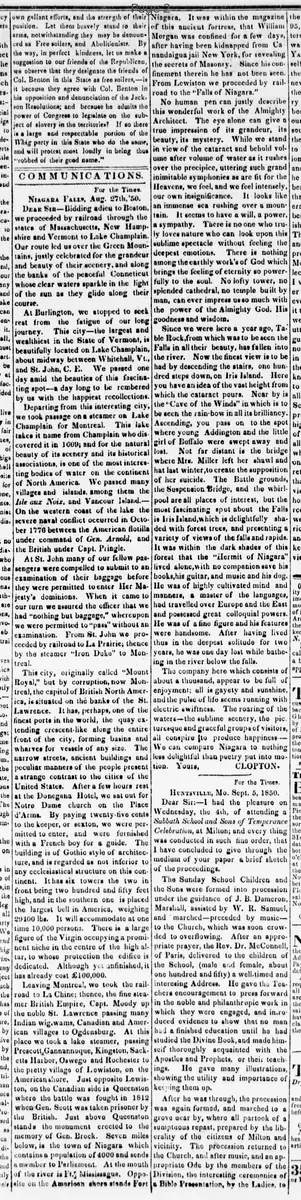
COMMUNICATIONS.
For the Times.
Niagara Falls, Aug. 27th, '50.
Dear Sir—Bidding adieu to Boston, we proceeded by railroad through the states of Massachusetts, New Hampshire and Vermont to Lake Champlain. Our route led us over the Green Mountains, justly celebrated for the grandeur and beauty of their scenery, and along the banks of the peaceful Connecticut whose clear waters sparkle in the light of the sun as they glide along their course.
At Burlington, we stopped to seek rest from the fatigue of our long journey. This city—the largest and wealthiest in the State of Vermont, is beautifully located on Lake Champlain, about midway between Whitehall, Vt. and St. John, C. E. We passed one day amid the beauties of this fascinating spot—a day long to be remembered by us with the happiest recollections.
Departing from this interesting city, we took passage on a steamer on Lake Champlain for Montreal. This lake takes its name from Champlain who discovered it in 1609; and for the natural beauty of its scenery and its historical associations, is one of the most interesting bodies of water on the continent of North America. We passed many villages and islands, among them the Isle aux Noix, and Valcour Island. On the western coast of the lake the severe naval conflict occurred in October 1776 between the American flotilla under command of Gen. Arnold, and the British under Capt. Pringle.
At St. John many of our fellow passengers were compelled to submit to an examination of their baggage before they were permitted to enter Her Majesty's dominions. When it came to our turn we assured the officer that we had 'nothing but baggage,' whereupon we were permitted to 'pass' without an examination. From St. John we proceeded by railroad to La Prairie; thence by the steamer 'Iron Duke' to Montreal.
This city, originally called 'Mount Royal,' but by corruption, now Montreal, the capital of British North America, is situated on the banks of the St. Lawrence. It has, perhaps, one of the finest ports in the world, the quay extending crescent-like along the entire front of the city, forming basins and wharves for vessels of any size. The narrow streets, ancient buildings and peculiar manners of the people present a strange contrast to the cities of the United States. After a few hours rest at the Donegana Hotel, we set out for Notre Dame church on the Place d'Armes. By paying twenty-five cents to the keeper, or sexton, we were permitted to enter, and were furnished with a French boy for a guide. The building is of Gothic style of architecture, and is regarded as not inferior to any ecclesiastical structure on this continent. It has six towers the two in front being two hundred and fifty feet high, and in the southern one is placed the largest bell in America, weighing 29,100 lbs. It will accommodate at one time 10,000 persons. There is a large figure of the Virgin occupying a prominent niche in the centre of the high altar, to whose protection the edifice is dedicated. Although yet unfinished, it has already cost £100,000.
Leaving Montreal, we took the railroad to La Chine; thence, the fine steamer British Empire, Capt. Moody up the noble St. Lawrence passing many Indian wigwams, Canadian and American villages to Ogdensburg. At this place we took a lake steamer, passing Prescott, Gananoque, Kingston, Sackett's Harbor, Oswego and Rochester to the pretty village of Lewiston, on the American shore. Just opposite Lewiston, on the Canadian side is Queenston where the battle was fought in 1812 when Gen. Scott was taken prisoner by the British. Just above Queenston stands the monument erected to the memory of Gen. Brock. Seven miles below, is the town of Niagara which contains a population of 4000 and sends a member to Parliament. At the mouth of the river is Ft. Mississagua. Opposite on the American shore stands Fort Niagara, It was within the magazine of this ancient fortress, that William Morgan was confined for a few days after having been kidnapped from Canandaigua jail New York, for revealing the secrets of Masonry. Since his confinement therein he has not been seen
From Lewiston we proceeded by railroad to the 'Falls of Niagara.' No human pen can justly describe this wonderful work of the Almighty Architect. The eye alone can give a true impression of its grandeur, its beauty, its mystery. While we stand in view of the cataract and behold volume after volume of water as it rushes over the precipice, uttering such grand inimitable symphonies as are fit for the Heavens, we feel, and we feel intensely, our own insignificance. It looks like an immense sea rushing over a mountain. It seems to have a will, a power, a sympathy. There is no one who truly loves nature who can look upon this sublime spectacle without feeling the deepest emotions. There is nothing among the earthly works of God which brings the feeling of eternity so potently to the soul. No lofty tower, no splendid cathedral, no temple built by man, can ever impress us so much with the power of the Almighty God. His goodness and wisdom.
Since we were here a year ago, Table Rock, from which was to be seen the Falls in all their beauty, has fallen into the river. Now the finest view is to be had by descending the stairs, one hundred steps down, on Iris Island. Here you have an idea of the vast height from which the cataract pours. Near by is the 'Cave of the Winds' in which is to be seen the rain-bow in all its brilliancy. Ascending, you pass on to the spot where young Addington and the little girl of Buffalo were swept away and lost. Not far distant is the bridge where Mrs. Miller left her shawl and hat last winter, to create the supposition of her suicide. The Battle grounds, the Suspension Bridge, and the whirlpool are all places of interest, but the most fascinating spot about the Falls is Iris Island, which is delightfully shaded with forest trees, and presenting a variety of views of the falls and rapids It was within the dark shades of this forest that the 'Hermit of Niagara' lived alone, with no companion save his books, his guitar and music and his dog He was of highly cultivated mind and manners, a master of the languages had travelled over Europe and the East and possessed great colloquial powers He was of a fine figure and his features were handsome. After having lived thus in the deepest solitude for two years, he was one day lost while bathing in the river below the falls.
The company here which consists of about a thousand, appear to be full of enjoyment; all is gayety and sunshine and the pulse of life seems running with electric swiftness. The roaring of the waters—the sublime scenery, the picturesque and graceful groups of visitors, all conspire to produce happiness.— We can compare Niagara to nothing less delightful than poetry put into motion.
Yours,
CLOPTON.
For the Times.
Niagara Falls, Aug. 27th, '50.
Dear Sir—Bidding adieu to Boston, we proceeded by railroad through the states of Massachusetts, New Hampshire and Vermont to Lake Champlain. Our route led us over the Green Mountains, justly celebrated for the grandeur and beauty of their scenery, and along the banks of the peaceful Connecticut whose clear waters sparkle in the light of the sun as they glide along their course.
At Burlington, we stopped to seek rest from the fatigue of our long journey. This city—the largest and wealthiest in the State of Vermont, is beautifully located on Lake Champlain, about midway between Whitehall, Vt. and St. John, C. E. We passed one day amid the beauties of this fascinating spot—a day long to be remembered by us with the happiest recollections.
Departing from this interesting city, we took passage on a steamer on Lake Champlain for Montreal. This lake takes its name from Champlain who discovered it in 1609; and for the natural beauty of its scenery and its historical associations, is one of the most interesting bodies of water on the continent of North America. We passed many villages and islands, among them the Isle aux Noix, and Valcour Island. On the western coast of the lake the severe naval conflict occurred in October 1776 between the American flotilla under command of Gen. Arnold, and the British under Capt. Pringle.
At St. John many of our fellow passengers were compelled to submit to an examination of their baggage before they were permitted to enter Her Majesty's dominions. When it came to our turn we assured the officer that we had 'nothing but baggage,' whereupon we were permitted to 'pass' without an examination. From St. John we proceeded by railroad to La Prairie; thence by the steamer 'Iron Duke' to Montreal.
This city, originally called 'Mount Royal,' but by corruption, now Montreal, the capital of British North America, is situated on the banks of the St. Lawrence. It has, perhaps, one of the finest ports in the world, the quay extending crescent-like along the entire front of the city, forming basins and wharves for vessels of any size. The narrow streets, ancient buildings and peculiar manners of the people present a strange contrast to the cities of the United States. After a few hours rest at the Donegana Hotel, we set out for Notre Dame church on the Place d'Armes. By paying twenty-five cents to the keeper, or sexton, we were permitted to enter, and were furnished with a French boy for a guide. The building is of Gothic style of architecture, and is regarded as not inferior to any ecclesiastical structure on this continent. It has six towers the two in front being two hundred and fifty feet high, and in the southern one is placed the largest bell in America, weighing 29,100 lbs. It will accommodate at one time 10,000 persons. There is a large figure of the Virgin occupying a prominent niche in the centre of the high altar, to whose protection the edifice is dedicated. Although yet unfinished, it has already cost £100,000.
Leaving Montreal, we took the railroad to La Chine; thence, the fine steamer British Empire, Capt. Moody up the noble St. Lawrence passing many Indian wigwams, Canadian and American villages to Ogdensburg. At this place we took a lake steamer, passing Prescott, Gananoque, Kingston, Sackett's Harbor, Oswego and Rochester to the pretty village of Lewiston, on the American shore. Just opposite Lewiston, on the Canadian side is Queenston where the battle was fought in 1812 when Gen. Scott was taken prisoner by the British. Just above Queenston stands the monument erected to the memory of Gen. Brock. Seven miles below, is the town of Niagara which contains a population of 4000 and sends a member to Parliament. At the mouth of the river is Ft. Mississagua. Opposite on the American shore stands Fort Niagara, It was within the magazine of this ancient fortress, that William Morgan was confined for a few days after having been kidnapped from Canandaigua jail New York, for revealing the secrets of Masonry. Since his confinement therein he has not been seen
From Lewiston we proceeded by railroad to the 'Falls of Niagara.' No human pen can justly describe this wonderful work of the Almighty Architect. The eye alone can give a true impression of its grandeur, its beauty, its mystery. While we stand in view of the cataract and behold volume after volume of water as it rushes over the precipice, uttering such grand inimitable symphonies as are fit for the Heavens, we feel, and we feel intensely, our own insignificance. It looks like an immense sea rushing over a mountain. It seems to have a will, a power, a sympathy. There is no one who truly loves nature who can look upon this sublime spectacle without feeling the deepest emotions. There is nothing among the earthly works of God which brings the feeling of eternity so potently to the soul. No lofty tower, no splendid cathedral, no temple built by man, can ever impress us so much with the power of the Almighty God. His goodness and wisdom.
Since we were here a year ago, Table Rock, from which was to be seen the Falls in all their beauty, has fallen into the river. Now the finest view is to be had by descending the stairs, one hundred steps down, on Iris Island. Here you have an idea of the vast height from which the cataract pours. Near by is the 'Cave of the Winds' in which is to be seen the rain-bow in all its brilliancy. Ascending, you pass on to the spot where young Addington and the little girl of Buffalo were swept away and lost. Not far distant is the bridge where Mrs. Miller left her shawl and hat last winter, to create the supposition of her suicide. The Battle grounds, the Suspension Bridge, and the whirlpool are all places of interest, but the most fascinating spot about the Falls is Iris Island, which is delightfully shaded with forest trees, and presenting a variety of views of the falls and rapids It was within the dark shades of this forest that the 'Hermit of Niagara' lived alone, with no companion save his books, his guitar and music and his dog He was of highly cultivated mind and manners, a master of the languages had travelled over Europe and the East and possessed great colloquial powers He was of a fine figure and his features were handsome. After having lived thus in the deepest solitude for two years, he was one day lost while bathing in the river below the falls.
The company here which consists of about a thousand, appear to be full of enjoyment; all is gayety and sunshine and the pulse of life seems running with electric swiftness. The roaring of the waters—the sublime scenery, the picturesque and graceful groups of visitors, all conspire to produce happiness.— We can compare Niagara to nothing less delightful than poetry put into motion.
Yours,
CLOPTON.
What sub-type of article is it?
Informative
Reflective
Poetic
What themes does it cover?
Science Nature
Military War
Religion
What keywords are associated?
Niagara Falls
Lake Champlain
Montreal
St Lawrence River
Travel Journey
Historical Battles
Natural Scenery
Hermit Of Niagara
What entities or persons were involved?
Clopton
Dear Sir
Letter to Editor Details
Author
Clopton
Recipient
Dear Sir
Main Argument
the journey from boston to niagara falls offers breathtaking scenery, rich historical associations, and a profound spiritual experience at the falls, evoking awe at nature's power and god's creation.
Notable Details
Discovered Lake Champlain In 1609 By Champlain
Naval Battle October 1776 Gen. Arnold Vs. Capt. Pringle
Battle Of Queenston 1812 Gen. Scott Captured
Monument To Gen. Brock
William Morgan Confined In Fort Niagara For Masonry Secrets
Table Rock Fallen Since Last Year
Hermit Of Niagara Lived In Solitude On Iris Island
Notre Dame Church Details: Gothic, Largest Bell 29,100 Lbs, Costs £100,000