Thank you for visiting SNEWPapers!
Sign up free
The New Hampshire Gazette
Portsmouth, Rockingham County, New Hampshire
What is this article about?
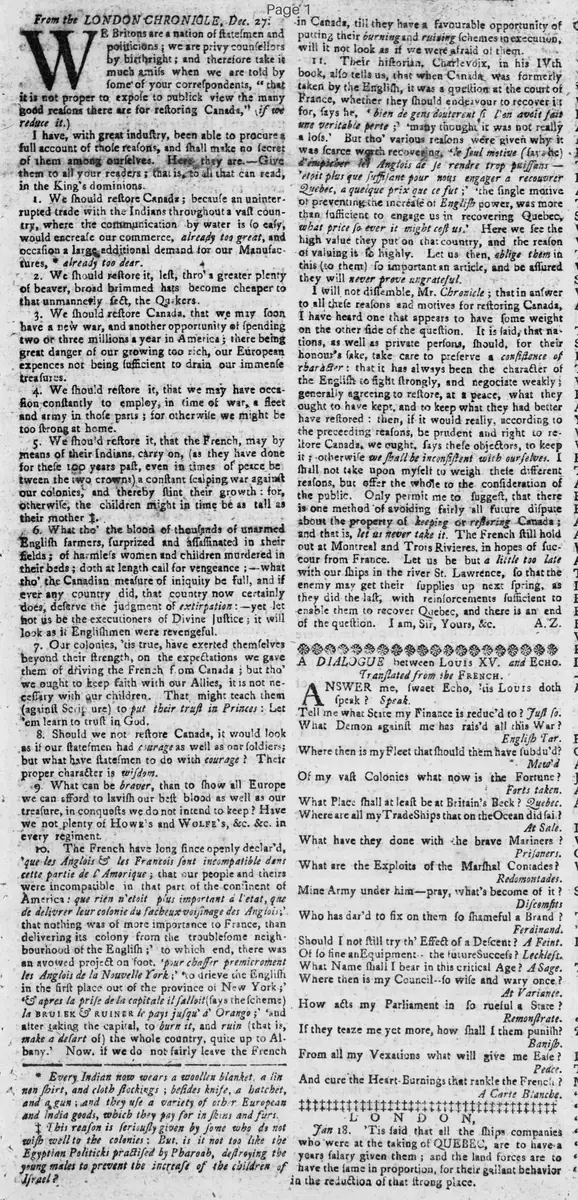
A satirical letter in the London Chronicle from December 27 argues against restoring Canada to France after its conquest in the Seven Years' War, listing ironic reasons for restoration and highlighting strategic benefits of retention to protect British colonies from French and Indian threats.
Clipping
OCR Quality
Full Text
Britons are a nation of statesmen and politicians; we are privy counsellors by birthright; and therefore take it much amiss when we are told by some of your correspondents, "that it is not proper to expose to publick view the many good reasons there are for restoring Canada," if we reduce it.
I have, with great industry, been able to procure a full account of those reasons, and shall make no secret of them amongst ourselves. Here they are. Give them to all your readers; that is to all that can read, in the King's dominions.
I. We should restore Canada; because an uninterrupted trade with the Indians throughout a vast country, where the communication by water is so easy, would encrease our commerce, already too great, and occasion a large additional demand for our Manufactures, already too dear.
2. We should restore it, lest, thro' a greater plenty of beaver, broad brimmed hats become cheaper to that unmannerly sect the Quakers.
3. We should restore Canada, that we may soon have a new war, and another opportunity of spending two or three millions a year in America; there being great danger of our growing too rich, our European expences not being sufficient to drain our immense treasures.
4. We should restore it, that we may have occasion constantly to employ, in time of war, a fleet and army in those parts; for otherwise we might be too strong at home.
5. We should restore it, that the French, may by means of their Indians, carry on, (as they have done for these 100 years past, even in times of peace between the two crowns) a constant scalping war against our colonies, and thereby stint their growth: for, otherwise, the children might in time be as tall as their mother.
6. What tho' the blood of thousands of unarmed English farmers, surprized and assassinated in their fields; of harmless women and children murdered in their beds; doth at length call for vengeance;--what tho' the Canadian measure of iniquity be full, and if ever any country did, that country now certainly does deserve the judgment of extirpation:--yet let us not be the executioners of Divine Justice: it will look as if Englishmen were revengeful.
7. Our colonies, 'tis true, have exerted themselves beyond their strength, on the expectations we gave them of driving the French from Canada; but tho' we ought to keep faith with our Allies, it is not necessary with our children. That might teach them (against Scripture) to put their trust in Princes: Let 'em learn to trust in God.
8. Should we not restore Canada, it would look as if our statesmen had courage as well as our soldiers: but what have statesmen to do with courage? Their proper character is wisdom.
9. What can be braver, than to shew all Europe we can afford to lavish our best blood as well as our treasure, in conquests we do not intend to keep? Have we not plenty of Howe's and Wolfe's, &c. &c. in every regiment.
10. The French have long since openly declar'd, que les Anglois & les Francois sont incompatible dans cette partie de l'Amerique; that our people and theirs were incompatible in that part of the continent of America: que rien n'etoit plus important a l'etat, que de delivrer leur colonie du fascheux voisinage des Anglois; that nothing was of more importance to France, than delivering its colony from the troublesome neighbourhood of the English; to which end, there was an avowed project on foot, pour chasser premierement les Anglois de la Nouvelle York; to drive the English in the first place out of the province of New York.; & apres la prise de la capitale il falloit (says the scheme) la brusler & ruiner le pays jusqu'a Albany; and after taking the capital, to burn it, and ruin (that is, make a desert of) the whole country, quite up to Albany. Now, if we do not fairly leave the French
Every Indian now wears a woollen blanket: a linen shirt, and cloth stockings; besides knife, a hatchet, and a gun: and they use a variety of other European and India goods, which they pay for in skins and furs.
This reason is seriously given by some who do not wish well to the colonies: But, is it not too like the Egyptian Politick practised by Pharaoh, destroying the young males to prevent the increase of the children of Israel?
in Canada, till they have a favourable opportunity of putting their burning and ruining schemes in execution, will it not look as if we were afraid of them.
It. Their historian, Charlevoix, in his IVth book, also tells us, that when Canada was formerly taken by the English, it was a question at the court of France, whether they should endeavour to recover it: for, says he, bien de gens douterent l'on avoit fait une veritable perte; many thought it was not really a loss. But tho' various reasons were given why it was scarce worth recovering, ce seul motif (says he) d'empecher les Anglois de se rendre trop puissans -- etoit plus que suffisant pour nous engager a recouvrer Quebec, a quelque prix que ce fut; the single motive of preventing the increase of English power, was more than sufficient to engage us in recovering Quebec, what price so ever it might cost us. Here we see the high value they put on that country, and the reason of valuing it highly. Let us then, oblige them in this (to them) so important an article, and be assured they will never prove ungrateful.
I will not dissemble, Mr. Chronicle: that in answer to all these reasons and motives for restoring Canada, I have heard one that appears to have some weight on the other side of the question. It is said, that nations, as well as private persons, should, for their honour's sake, take care to preserve a consistency of character: that it has always been the character of the English to fight strongly, and negotiate weakly; generally agreeing to restore, at a peace, what they ought to have kept, and to keep what they had better have restored: then, if it would really, according to the preceding reasons, be prudent and right to restore Canada, we ought, says these objectors, to keep it;--otherwise we shall be inconsistent with ourselves. I shall not take upon myself to weigh these different reasons, but offer the whole to the consideration of the public. Only permit me to suggest, that there is one method of avoiding fairly all future dispute about the property of keeping or restoring Canada; and that is, let us never take it. The French still hold out at Montreal and Trois Rivieres, in hopes of succour from France. Let us be but a little too late with our ships in the river St. Lawrence, so that the enemy may get their supplies up next spring, as they did the last, with reinforcements sufficient to enable them to recover Quebec, and there is an end of the question. I am, Sir, Yours, &c.
A.Z.
What sub-type of article is it?
What keywords are associated?
What entities or persons were involved?
Where did it happen?
Foreign News Details
Primary Location
Canada
Event Date
Dec. 27
Key Persons
Outcome
satirical advocacy against restoring canada to france, emphasizing past massacres of english settlers and strategic need to retain it to prevent future french aggression.
Event Details
A satirical letter lists ten ironic reasons for restoring conquered Canada to France, countering pro-restoration arguments with sarcasm about trade, war expenses, and French threats, while advocating retention for colonial security and consistency in British policy.