Thank you for visiting SNEWPapers!
Sign up free
The Virginia Gazette
Richmond, Williamsburg, Richmond County, Virginia
What is this article about?
The Massachusetts Bay House of Representatives passed unanimous resolutions on January 1, 1770, affirming loyalty to King George III, opposing taxation without representation, criticizing Governor Bernard's actions and letters, condemning standing armies without consent, and defending local rights against external interference.
Clipping
OCR Quality
Full Text
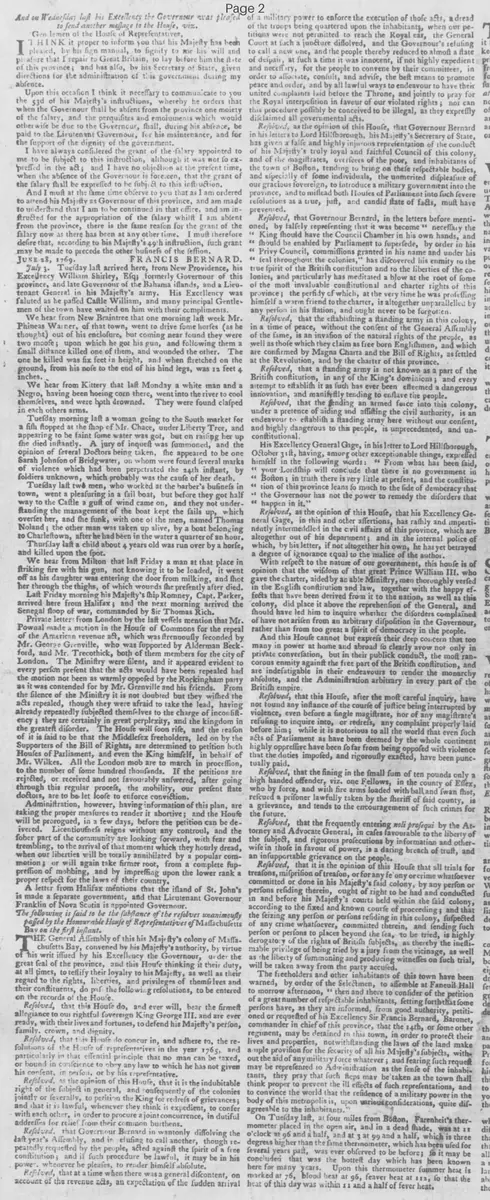
THE General Assembly of this his Majesty's colony of Massachusetts Bay, convened by his Majesty's authority, by virtue of his writ issued by his Excellency the Governour, under the great seal of the province, and this House thinking it their duty, at all times, to testify their loyalty to his Majesty, as well as their regard to the rights, liberties, and privileges of themselves and their constituents, do pass the following resolutions, to be entered on the records of the House.
Resolved, that this House do, and ever will, bear the firmest allegiance to our rightful sovereign King George III. and are ever ready, with their lives and fortunes, to defend his Majesty's person, family, crown, and dignity.
Resolved, that this House do concur in, and adhere to, the resolutions of the House of representatives in the year 1765, and particularly in that essential principle that no man can be taxed, or bound in conscience to obey any law to which he has not given his consent, in person, or by his representative.
Resolved, the opinion of this House, that it is the indubitable right of the subject in general, and consequently of the colonies jointly or severally, to petition the King for redress of grievances; and that it is lawful, whenever they think it expedient, to confer with each other, in order to procure a joint concurrence, in dutiful addresses for relief from their common burthens.
Resolved, that Governour Bernard in wantonly dissolving the last year's Assembly, and refusing to call another, though repeatedly requested by the people, acted against the spirit of a free constitution; and if such procedure be lawful, it may be in his power, whenever he pleases, to render himself absolute.
Resolved, that at a time when there was a general discontent, on account of the revenue acts, an expectation of the sudden arrival of a military power to enforce the execution of those acts, a dread of the troops being quartered upon the inhabitants, when our petitions were not permitted to reach the Royal ear, the General Court at such a juncture dissolved, and the Governour's refusing to call a new one, and the people thereby reduced to almost a state of despair, at such a time it was innocent, if not highly expedient and necessary, for the people to convene by their committees, in order to associate, consult, and advise, the best means to promote peace and order, and by all lawful ways to endeavour to have their united complaints laid before the Throne, and jointly to pray for the Royal interposition in favour of our violated rights; nor can this procedure possibly be conceived to be illegal, as they expressly disclaimed all governmental acts.
Resolved, as the opinion of this House, that Governour Bernard in his letters to Lord Hillsborough, his Majesty's Secretary of State, has given a false and highly injurious representation of the conduct of his Majesty's truly loyal and faithful Council of this colony, and of the magistrates, overseers of the poor, and inhabitants of the town of Boston, tending to bring on these respectable bodies, and especially of some individuals, the unmerited displeasure of our gracious sovereign, to introduce a military government into the province, and to mislead both Houses of Parliament into such severe resolutions as a true, just, and candid state of facts must have prevented.
Resolved, that Governour Bernard, in the letters before mentioned, by falsely representing that it was become "necessary the King should have the Council Chamber in his own hands, and should be enabled by Parliament to supersede, by order in his Privy Council, commissions granted in his name and under his seal throughout the colonies," has discovered his enmity to the true spirit of the British constitution and to the liberties of the colonies, and particularly has meditated a blow at the root of some of the most invaluable constitutional and charter rights of this province; the perfidy of which, at the very time he was professing himself a warm friend to the charter, is altogether unparalleled by any person in his station, and ought never to be forgotten.
Resolved, that the establishing a standing army in this colony, in a time of peace, without the consent of the General Assembly of the same, is an invasion of the natural rights of the people, as well as those which they claim as free born Englishmen, and which are confirmed by Magna Charta and the Bill of Rights, as settled at the Revolution, and by the charter of this province.
Resolved, that a standing army is not known as a part of the British constitution, in any of the King's dominions; and every attempt to establish it as such has ever been esteemed a dangerous innovation, and manifestly tending to enslave the people.
Resolved, that the sending an armed force into this colony, under a pretence of aiding and assisting the civil authority, is an endeavour to establish a standing army here without our consent, and highly dangerous to this people, is unprecedented, and unconstitutional.
His Excellency General Gage, in his letter to Lord Hillsborough, October 31st, having, among other exceptionable things, expressed himself in the following words: "From what has been said, your Lordship will conclude that there is no government in Boston; in truth there is very little at present, and the constitution of this province leans so much to the side of democracy that the Governour has not the power to remedy the disorders that happen in it."
Resolved, as the opinion of this House, that his Excellency General Gage, in this and other assertions, has rashly and impertinently intermeddled in the civil affairs of this province, which are altogether out of his department; and in the internal police of which, by his letter, if not altogether his own, he has yet betrayed a degree of ignorance equal to the malice of the author.
With respect to the nature of our government, this house is of opinion that the wisdom of that great Prince William III. who gave the charter, aided by an able Ministry, men thoroughly versed in the English constitution and law, together with the happy effects that have been derived from it to the nation, as well as this colony, did place it above the reprehension of the General, and should have led him to inquire whether the disorders complained of have not arisen from an arbitrary disposition in the Governour, rather than from too great a spirit of democracy in the people.
And this House cannot but express their deep concern that too many in power at home and abroad so clearly avow not only in private conversation, but in their publick conduct, the most rancorous enmity against the free part of the British constitution, and are indefatigable in their endeavours to render the monarchy absolute, and the Administration arbitrary in every part of the British empire.
Resolved, that this House, after the most careful inquiry, have not found any instance of the course of justice being interrupted by violence, even before a single magistrate, nor of any magistrate refusing to inquire into, or redress, any complaint properly laid before him; while it is notorious to all the world that even such acts of Parliament as have been deemed by the whole continent highly oppresive have been so far from being opposed with violence that the duties imposed, and rigorously exacted, have been punctually paid.
Resolved, that the fining in the small sum of ten pounds only a high handed offender, viz. one Fellows, in the county of Essex, who by force, and with fire arms loaded with ball and swan shot, rescued a prisoner lawfully taken by the sheriff of said county, is a grievance, and tends to the encouragement of such crimes for the future.
Resolved, that the frequently entering noli prosequi by the Attorney and Advocate General, in cases favourable to the liberty of the subject, and rigorous prosecutions by information and otherwise in those in favour of power, is a daring breach of trust, and an insupportable grievance on the people.
Resolved, that it is the opinion of this House that all trials for treasons, misprision of treason, or for any felony or crime whatsoever committed or done in his Majesty's said colony, by any person or persons residing therein, ought of right to be had and conducted in and before his Majesty's courts held within the said colony, according to the fixed and known course of proceeding; and that the seizing any person or persons residing in this colony, suspected of any crime whatsoever, committed therein, and sending such person or persons to places beyond the sea, to be tried, is highly derogatory of the rights of British subjects, as thereby the inestimable privilege of being tried by a jury from the vicinage, as well as the liberty of summoning and producing witnesses on such trial, will be taken away from the party accused.
What sub-type of article is it?
What keywords are associated?
What entities or persons were involved?
Where did it happen?
Domestic News Details
Primary Location
Massachusetts Bay
Event Date
On The First Instant
Key Persons
Outcome
unanimous passage of resolutions criticizing colonial governance, affirming rights, and opposing standing armies and external trials.
Event Details
The House of Representatives passed a series of resolutions expressing loyalty to the King, adhering to 1765 principles against taxation without consent, defending rights to petition and convene, condemning Governor Bernard's dissolution of the assembly and misleading letters, opposing standing armies without consent, criticizing General Gage's interference, and asserting local trial rights.