Thank you for visiting SNEWPapers!
Sign up free
Editorial
December 13, 1799
Gazette Of The United States, & Philadelphia Daily Advertiser
Philadelphia, Philadelphia County, Pennsylvania
What is this article about?
The editorial philosophically examines the conflict between human passions and societal duties, arguing that law and government are essential to restrain them. It critiques the French Revolution as an example of revolutionary principles (Jacobinism) degrading human nature by elevating passions over duties, leading to violence and chaos.
Clipping
OCR Quality
95%
Excellent
Full Text
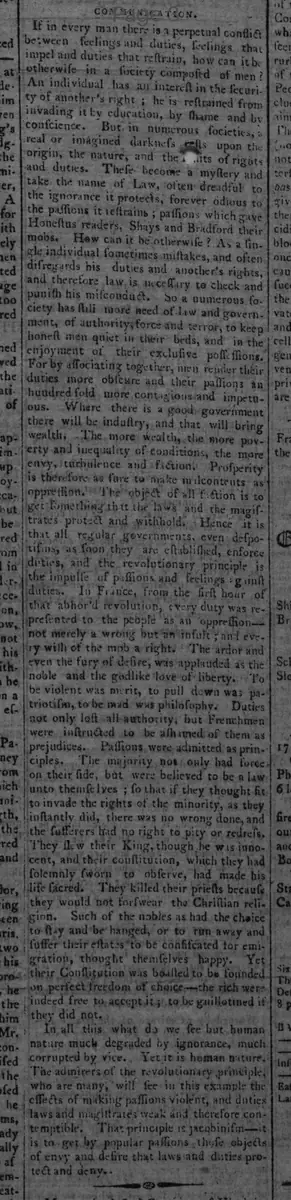
If in every man there is a perpetual conflict between feelings and duties, feelings that impel and duties that restrain, how can it be otherwise in a society composed of men? An individual has an interest in the security of another's right; he is restrained from invading it by education, by habit and by conscience. But, in numerous societies, real or imagined darkness rests upon the origin, the nature, and the limits of rights and duties. These become a mystery and take the name of Law, often dreadful to the ignorance it protects, forever odious to the passions it restrains; passions which gave honest readers Shays and Bradford their mobs. How can it be otherwise? As a single individual sometimes mistakes, and often disregards his duties and another's rights, and therefore law is necessary to check and punish his misconduct. So a numerous society has still more need of law and government, of authority, force and terror, to keep honest men quiet in their beds, and in the enjoyment of their exclusive possessions. For by associating together, men render their duties more obscure and their passions a hundred fold more contagious and impetuous. Where there is a good government there will be industry, and that will bring wealth. The more wealth, the more poverty and inequality of conditions, the more envy, turbulence and faction. Prosperity is therefore as sure to make malcontents as oppression. The object of all faction is to get something that the laws and the magistrates protect and withhold. Hence it is that all regular governments, even despotisms, as soon as they are established, enforce duties, and the revolutionary principle is the impulse of passions and feelings against duties. In France, from the first hour of that abhorr'd revolution, every duty was represented to the people as an oppression—not merely a wrong but an insult; and every wish of the mob a right. The ardor and even the fury of desire, was applauded as the noble and the godlike love of liberty. To be violent was merit, to pull down was patriotism, to be mad was philosophy. Duties not only lost all authority, but Frenchmen were instructed to be ashamed of them as prejudices. Passions were admitted as principles. The majority not only had force on their side, but were believed to be a law unto themselves; so that if they thought it to invade the rights of the minority, as they instantly did, there was no wrong done, and the sufferers had no right to pity or redress. They slew their King, though he was innocent, and their constitution, which they had solemnly sworn to observe, had made his life sacred. They killed their priests because they would not forswear the Christian religion. Such of the nobles as had the choice to stay and be hanged, or to run away and suffer their estates to be confiscated for emigration, thought themselves happy. Yet their Constitution was boasted to be founded on perfect freedom of choice the rich were indeed free to accept it; or to be guillotined if they did not.
In all this what do we see but human nature much degraded by ignorance, much corrupted by vice. Yet it is human nature. The admirers of the revolutionary principle, who are many, will see in this example the effects of making passions violent, and duties laws and magistrates weak and therefore contemptible. That principle is Jacobinism—it is to get by popular passions the objects of envy and desire that laws and duties protect and deny.
In all this what do we see but human nature much degraded by ignorance, much corrupted by vice. Yet it is human nature. The admirers of the revolutionary principle, who are many, will see in this example the effects of making passions violent, and duties laws and magistrates weak and therefore contemptible. That principle is Jacobinism—it is to get by popular passions the objects of envy and desire that laws and duties protect and deny.
What sub-type of article is it?
Moral Or Religious
Constitutional
Foreign Affairs
What keywords are associated?
Human Nature
Passions Vs Duties
Law And Government
French Revolution
Jacobinism
Shays Rebellion
Social Inequality
Revolutionary Violence
What entities or persons were involved?
Shays
Bradford
France
French Revolution
Jacobinism
King
Priests
Nobles
Editorial Details
Primary Topic
Conflict Between Passions And Duties In Society And Critique Of Revolutionary Principles
Stance / Tone
Anti Revolutionary, Pro Law And Government
Key Figures
Shays
Bradford
France
French Revolution
Jacobinism
King
Priests
Nobles
Key Arguments
Perpetual Conflict Between Individual Feelings And Duties Extends To Society
Law Is Necessary To Restrain Passions And Protect Rights In Large Societies
Association Amplifies Passions And Obscures Duties
Prosperity Breeds Envy And Faction As Much As Oppression
Revolutionary Principle Elevates Passions Over Duties
In France, Duties Were Portrayed As Oppression And Passions As Liberty
French Revolution Led To Violence Against King, Priests, And Nobles
Jacobinism Weakens Laws And Magistrates Through Popular Passions