Thank you for visiting SNEWPapers!
Sign up free
The Enquirer
Richmond, Henrico County, Virginia
What is this article about?
This essay explores commerce opportunities in western America, focusing on Pacific coast fur trade with natives, historical New England ventures, profits from furs sold in China, debates on colonization at Columbia River amid European rivalries, and the strategic value of Lewis and Clark's expedition for trade routes and native relations.
Merged-components note: Merging the 'Tour to the West' article with its accompanying tables on vessels and ships, as the tables provide supporting data for the narrative on Pacific trade.
Clipping
OCR Quality
Full Text
NO II.
That part of America, which lies to the west of the United States, presents us with two different branches of commerce: that which we may carry on with the coasts of the Pacific Ocean, and that which we may find in the interior territory that lies between us and the coast.
These will furnish different articles of traffic: and they will probably point out different routes to the enterprising trader.
In all probability, the present tour of discovery is designed by a sagacious administration to extend the one, to establish the other, and to place both upon a systematic and certain foundation.
Trade to the Pacific.—Many years have elapsed since the New-England states formed a communication with the western coast of America, and entitled themselves to that distinguished compliment for their intrepidity and skill which Mr. Burke paid them in the year 1775.
"No sea (exclaimed that orator) but what is vexed by their fisheries. No climate that is not witness to their toils. Neither the perseverance of Holland. nor the activity of France. nor the dexterous and firm sagacity of English enterprise. ever carried this most perilous mode of hard industry to the extent to which it has been pushed by this recent people; a people who are still. as it were, but in the gristle, and not yet hardened into the bone of manhood."
What is here said of their fisheries may be also extended to their commerce with the natives.
If any merit is to be acquired by plunging amidst the ices of the north, and encountering the monstrous tenants of the ocean. not less is due to them for establishing a new perilous intercourse with the savage inhabitants of the land, and exchanging with them the mutual produce of their industry.
This trade has hitherto been confined to one important branch. We must not look among such savage nations for the rich productions of the arts: for the diversified produce of the soil. nor for those articles which a foreign carrying trade will frequently supply a nation with, which has neither arts nor land of its own. All that we can seek among them is the spontaneous produce of nature, acquired without much knowledge and manufactured without much labour.
From such nations we may expect to receive the hides of the animals which they have killed for food, or the furs of such as they have taken in the chase for the purposes of cloathing. When the Spaniards first visited Peru, they found a vast field of commerce in the first; and it is the last which has prompted the natives of N. England to prosecute an intercourse with the coasts of the Pacific.
The Furs obtained among them are those of the sea-otter, raccoon, pine-martin, land beaver, sea otters, mammoth &c. These are obtained in exchange for articles of no great value to our merchants, such as pieces of iron, nails, beads, pen knives and other trifling trinkets. Their return cargoes are not conveyed to the United States, but to China, where they are sold and vested in Tea and other articles of the east. What has been the immense profit of this trade will appear from the following statement of vessels that had visited China from the N. W. coast down to Feb. 1802, with the number of their furs and the estimate of their value:
1700 Skins imported by the 7 Spaniards, unsold valued
It requires little sagacity to foresee that such an immense profit must insensibly draw a greater number of nations, and more vessels from each, into this trade: that their increasing competition will gradually augment the avidity of the natives; that European commodities will grow into less, and their peltry into greater value; and that, in fine, this lucrative branch of trade, may from this cause alone be expected to become less or at every season. Still other causes should be recollected, which may counterbalance this effect. As yet a comparatively small strip of the coast only has been visited, by the enterprising trader, and scarcely a single river has been explored even at its mouth. Whoever would form an idea of the treasures of this commerce must place before him the vast extent of coast which stretches from the straits of Behring to the mouth of the Columbia, with all the sounds and islands which lie within that compass; he must place before him the innumerable streams in all their windings and ramifications which empty into that sea: he must view the vast extent of country not washed by these rivers, but so contiguous to their banks, as to invite the natives to approach them, when they once presented the vessels of the trader and the means of traffic.
He must recollect too, how much even of the present trade is lost by the want of established settlements, and constant, known methods of buying and selling; How much is left behind by the trader who touches at a place for the acquisition of furs, and waits no longer than while its immediate or contiguous inhabitants shall have collected together what accident and care may have preserved from destruction. Let the time once arrive, when the Americans shall establish a fort and a colony at the mouth of the Columbia river; when instead of occasionally touching at the coast, they shall open a market ready at all seasons of the year for the reception of Indian peltries: when they shall even send their canoes and smaller vessels up the river to collect the produce of Indian toil; then will the industry of the natives be stimulated by their interest: the chase will be more eagerly pursued: deeper forests will be ransacked in search of game; and though individual profit may be lessened by the increased competition. the profit of the whole trade will be incalculably augmented.
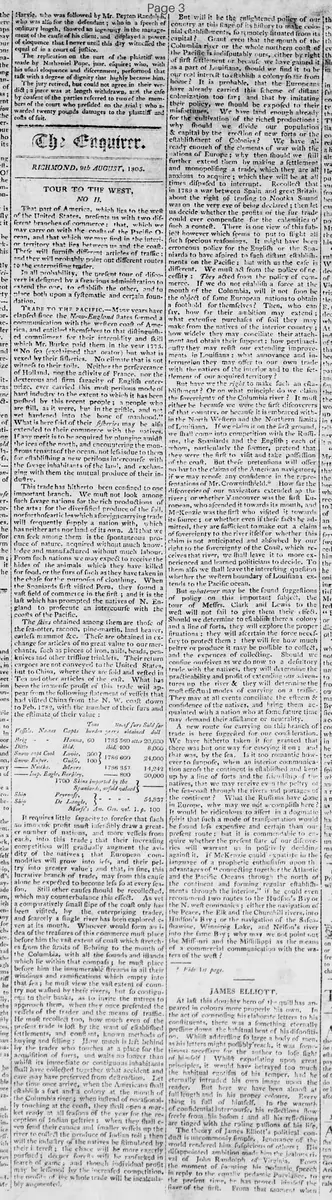
| Vessels. | Names | Capts | Tons burden years | No. of furs Sold for obtained | doll |
| Brig - | - | Hanna, 60 | 1785 | 560 | 20,600 |
| Ditto | - | ibid. | ibid. | 400 | 8,000 |
| Snow capt Cook | Snow | Lo lie, 300 | 1786 | 600 | 24,000 |
| Snow Exper. | Snow | Guise, 100 | 1786 | 357 | 14,242 |
| —- Nootka. | —- | Meares | —- | 800 | 30,000 |
| —- Iap. Eagle, Berkley, |
| Ship | Peyrouse, | 54,837 |
| Ship | De Langle, | 54,837 |
| Morse's Am. Geo. vol. 1. p. 100 |
But will it be the enlightened policy of our country at this stage of its history to make colonial establishments, so remotely situated from its capital? Grant even that the mouth of the Columbia river or the whole northern coast of the Pacific is indisputably ours, either by right of first settlement or because we have gained it as a part of Louisiana, Should we find it to be our real interest to establish a colony so far from home? It is probable, that the Europeans have already carried this scheme of distant colonization too far; and that by imitating their policy, we should be exposed to their misfortunes. We have land enough already for the cultivation of the richest productions: why should we divide our population & capital by the erection of new forts or the establishment of Colonies? We have already enough of the elements of war with the nations of Europe; why then should we still further extend them by making a settlement and monopolising a trade, which they are all anxious to acquire: which they will be at all times disposed to interrupt. Recollect that in 1789 a war between Spain and great Britain about the right of trading to Nootka Sound was on the very eve of being declared: then let us decide whether the profits of the fur trade could ever compensate for the calamities of such a contest. There is one view of this subject however which seems to put to flight all such specious reasonings. It might have been erroneous policy for the English or the Spaniards to have aspired to such distant establishments on the Pacific: but with us the case is different. We must act from the policy of necessity: They acted from the policy of commerce. If we do not establish a force at the mouth of the Columbia, will it not soon be the object of some European nations to obtain a foothold for themselves? Then, who can say, how far their ambition may extend; what extensive purchases of soil they may make from the natives of the interior country; how widely they may conciliate their attachment and obtain their support: how pertinaciously they may resist our extending improvements in Louisiana: what annoyance and interruption they may offer to our own trade with the natives of the interior and to the settlement of our acquired territory?
But have we the right to make such an establishment? Or on what principle do we claim the sovereignty of the Columbia river? It must either be because we were the first discoverers of that country. or because it is embraced within the North Western and the Northern limits of Louisiana. If we claim it on the first ground, we shall come into competition with the Russians, the Spaniards and the English; each of whom, particularly the former, pretend that they were the first to visit and take possession of the coast. But these pretensions will offer no bar to the claims of the American navigators, if we may repose any confidence in the representations of Mr. Crowninshield.* How far the discoveries of our navigators extended up the river; or whether Vancouver was the first European, who ascended it towards its mouth, and McKenzie was the first who visited it towards its source: or whether even if these facts be admitted, they are sufficient to make out a claim of sovereignty to the river itself or whether this claim is not anticipated and absorbed by our right to the sovereignty of the Coast, which receives that river, we shall leave it to more experienced and learned politicians to decide. To them also we shall leave the interesting question whether the western boundary of Louisiana extends to the Pacific ocean.
But whatever may be the sound suggestions of policy on this important subject, the tour of Messrs. Clark and Lewis to the west will not fail to give them their effect. Should we determine to establish there a colony and a line of forts, they will explore the proper situations: they will ascertain the force necessary to protect them: they will see how much peltry or produce it may be possible to collect, and the expenses of collecting. Should we confine ourselves as we do now to a desultory trade with the natives, they will determine the practicability and profit of extending our adventures up the river & they will determine the most effectual modes of carrying on a traffic.
They may at all events conciliate the esteem & confidence of the natives, and bring them acquainted with a nation who at some future time may demand their assistance or neutrality.
A new route for carrying on this branch of trade is here suggested for our consideration. We have hitherto taken it for granted that there was but one way for carrying it on: and that was, by the sea. Is it too romantic however to suppose, when an interior communication across the continent is established and kept up by a line of forts and the friendship of the natives, that we may receive even the peltry of the sea-coast through the rivers and portages of the continent? What the Russians have done in Europe, why may we not accomplish here: It would be ridiculous to assert in a dogmatic spirit that such a mode of transportation would be found less expensive and certain than our present route: but it is commendable to enquire whether the present state of our discoveries will warrant us in positively deciding against it. If McKenzie could expatiate in the language of a prophetic enthusiasm upon the advantages of "connecting together the Atlantic and the Pacific Oceans through the north of the continent and forming regular establishments through the interior," if he could even recommend two routes to the Hudson's Bay or the N. west companies: either the navigation of the Peace, the Elk and the Churchill rivers, into Hudson's Bay: or the navigation of the Saskatchewan, Winnipeg Lake, and Nelson's river into the same Bay: why may we not point out the Missouri and the Mississippi as the means of a commercial communication with the waters of the west?
Vide 1st page.
What sub-type of article is it?
What themes does it cover?
What keywords are associated?
Literary Details
Title
Tour To The West, No Ii.
Subject
On Pacific And Interior Commerce, Colonization Policy, And The Lewis And Clark Expedition
Key Lines