Thank you for visiting SNEWPapers!
Sign up free
The Liberator
Boston, Suffolk County, Massachusetts
What is this article about?
Massachusetts Senate committee report on Feb. 23, 1839, responds to anti-slavery petitions, affirming Congress's power to end slavery in D.C., territories, and interstate trade, but recommends no new action as issues already addressed.
Clipping
OCR Quality
Full Text
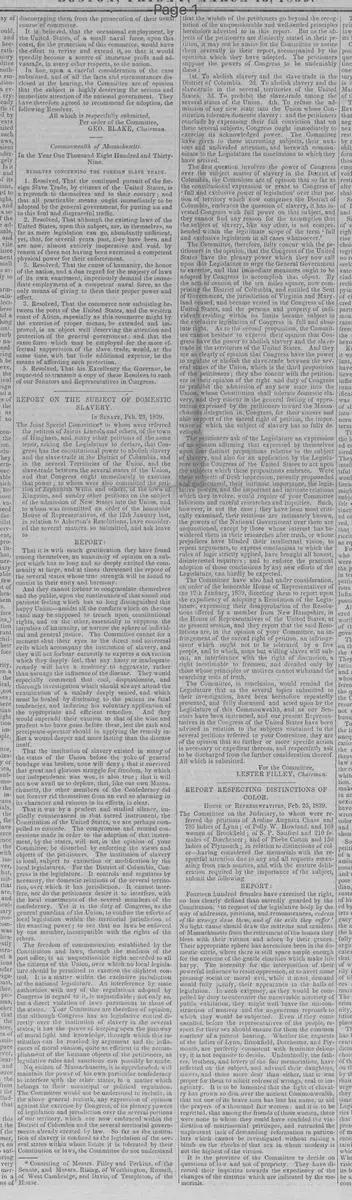
SLAVERY.
In Senate, Feb. 23, 1839.
The Joint Special Committee* to whom were referred
the petition of Jairus Lincoln and others, of the town
of Hingham, and many other petitions of the same
tenor, asking the Legislature to declare, that Con-
gress has the constitutional power to abolish slavery
and the slave-trade in the District of Columbia, and
in the several Territories of the Union, and the
slave-trade between the several states of the Union,
and that Congress ought immediately to exercise
that power; to whom were also committed the peti-
tion of Zephaniah Willis and others, of the town of
Kingston, and sundry other petitions on the subject
of the admission of New States into the Union, and
to whom was committed an order of the honorable
House of Representatives, of the 12th January last,
in relation to Atherton's Resolutions, have consider-
ed the several matters, so submitted, and ask leave
to
REPORT:
That it is with much gratification they have found
among themselves, an unanimity of opinion on a sub-
ject which has so long and so deeply excited the com-
munity at large, and at times threatened the repose of
the several states whose true strength will be found to
consist in their unity and harmony.
And they cannot forbear to congratulate themselves
and the public, upon the continuance of that sound and
patriotic feeling which has so long distinguished this
happy Union—amidst all the conflicts which on the one
hand may be supposed to trench upon constitutional
rights, and on the other, essentially to suppress the
impulses of humanity, or narrow the sphere of individ-
ual and general justice. The Committee cannot for a
moment shut their eyes to the direct and universal
evils which accompany the institution of slavery, and
they will not forbear earnestly to express a conviction
which they deeply feel, that any hasty or inadequate
remedy will have a tendency to aggravate, rather
than assuage the influence of the disease. They would
especially commend that cool, dispassionate, and
thorough investigation which should always attend the
examination of a malady deeply seated, and which
must be healed by disclosing to the patient its fatal
tendencies, and inducing his voluntary application of
the appropriate and efficient remedies. And they
would superadd their caution to that of the wise and
prudent who have gone before them, lest the rash and
precipitate operator should in applying the remedy in-
flict a wound deeper and more lasting than the disease
itself.
That the institution of slavery existed in many of
the states of the Union before the yoke of general
bondage was broken, none will deny; that it survived
that great and glorious struggle for freedom, by which
our independence was won, is also true; that it will
not now avail us to deplore, that, like our own Massa-
chusetts, the other members of the Confederacy did
not forever rid themselves from an evil so alarming in
its character and ruinous in its effects, is clear.
That it was by a prudent and studied silence, im-
pliedly countenanced in that sacred instrument, the
Constitution of the United States, we are perhaps com-
pelled to concede. The compromise and mutual con-
cessions made in order to the adoption of that instru-
ment, by the states, will not, in the opinion of your
Committee, be disturbed by enforcing the views and
objects of the petitioners. The institution of slavery
is local, subject to extinction or modification by the
local legislatures. For the District of Columbia, Con-
gress is the legislature. It controls and regulates by
necessity, the domestic relations of the several territo-
ries, over which it has jurisdiction. It cannot inter-
fer, nor do the petitioners desire it to interfere, with
the local enactments of the several members of the
confederacy. Yet it is the duty of Congress, as the
general guardian of the Union, to confine the effects of
local legislation within the territorial jurisdiction of
the enacting power; to see that no laws be enforced
by one member, incompatible with the rights of the
others.
The freedom of communication established by the
Constitution and laws, through the medium of the
post office, is an unquestionable right accorded to all
the citizens of the Union, over which no local legisla-
ture should be permitted to exercise the slightest con-
trol. It is a matter within the exclusive jurisdiction
of the national legislature. An interference by state
authorities with any of the regulations adopted by
Congress in regard to it, is unjustifiable; not only so,
but a direct violation of laws paramount to those of
the states. Your Committee are therefore of opinion,
that although Congress has no legislative control di-
rectly over the institution of slavery in the several
states, it has the power of keeping open the pathway
of moral light and knowledge, through which this in-
stitution can be reached by argument and the influ-
ences of moral suasion, quite as efficient in the accom-
plishment of the humane objects of the petitioners, as
legislative rules and sanctions can possibly be made.
No citizen of Massachusetts, it is apprehended, will
maintain the power of his own particular confederacy
to interfere with the other states, in a matter which
belongs to their municipal or political regulation.
The Committee would not be understood to include, in
the above general remark, any expression of opinion
against the exercise by Congress, of its plenary powers
of legislation and jurisdiction over the several portions
of our territory, which are now embraced within the
District of Columbia and the several territorial govern-
ments already created by law. So far as the institu-
tion of slavery is confined to the legislation of the sev-
eral states within whose limits it is tolerated by their
Constitution or laws, the Committee do not understand
that the wishes of the petitioners go beyond the recog-
nition of the unquestionable and well-settled principles
heretofore adverted to in this report. But as the ob-
jects of the petitioners are distinctly stated in their pe-
tition, it may not be amiss for the Committee to notice
them severally in their report, accompanied by the
opinions which they have adopted. The petitioners
suppose the powers of Congress to be undeniably
these:
1st. To abolish slavery and the slave-trade in the
District of Columbia. 2d. To abolish slavery and the
slave-trade in the several territories of the United
States, 3d. To prohibit the slave-trade among the
several states of the Union. 4th. To refuse the ad-
mission of any new state into the Union whose Con-
stitution tolerates domestic slavery: and the petition-
ers conclude by expressing their full conviction that on
these several subjects, Congress ought immediately to
exercise its acknowledged power. The Committee
have given to these interesting subjects, their anx-
ious and undivided attention, and herewith commu-
nicate to the Legislature the conclusions to which they
have arrived.
The first question involves the power of Congress
over the subject matter of slavery in the District of
Columbia, the Committee are of opinion that so far as
the constitutional expression or grant to Congress of
'full and exclusive power of legislation' over that por-
tion of territory which now comprises the District of
Columbia, embraces the question of slavery, it has in-
vested Congress with full power on that subject, and
they cannot find any reason for the assumption that
the subject of slavery, like any other, is not compre-
hended within the legitimate scope of the term 'full
and exclusive legislation in all cases whatsoever.'
The Committee, therefore, fully concur with the pe-
titioners in the opinion, that the Congress of the United
States have the plenary power which they now call
upon this Legislature to urge the General Government
to exercise, and that immediate measures ought to be
adopted by Congress to accomplish that object. By
the acts of cession of the ten miles square, now com-
prising the District of Columbia, and entitled the Seat
of Government, the jurisdiction of Virginia and Mary-
land ceased, and became vested in the Congress of the
United States, and the persons and property of indi-
viduals residing within its limits became subject to
the exclusive legislation of Congress in full and abso-
lute right. As to the second proposition, the Commit-
ttee cannot hesitate to express their opinion that Con-
gress have the power to abolish slavery and the slave-
trade in the territories of the United States. And they
are as clearly of opinion that Congress have the power
to regulate or abolish the slave-trade between the sev-
eral states of the Union, which is the third proposition
of the petitioners; they also concur with the petition-
ners in their opinion of the right and duty of Congress
to prohibit the admission of any new state into the
Union, whose Constitution shall tolerate domestic sla-
very, and they concur in the general feeling of appro-
bation expressed by the petitioners toward the Massa-
chusetts delegation in Congress, for their sincere and
able support of the sacred right of petition, the impor-
tance of which the subject of slavery has so fully de-
veloped.
The petitioners ask of the Legislature an expression
of an opinion affirming that expressed by themselves
upon four distinct propositions relative to the subject
of slavery, and also for an application by the Legisla-
ture to the Congress of the United States to act upon
the subjects which these propositions embrace. Were
these subjects of fresh impression, recently propounded
and undiscussed, their intrinsic importance, the legis-
lative powers, and the important and intricate relations
which they involve, would require of your Committee
laborious and careful researches and inquiries. Such,
however, is not the case: they have been most criti-
cally examined, their relations are intimately known,
the powers of the National Government over them are
unquestioned, except by those whose interest has be-
wildered them in their researches after truth, or whose
prejudices have blinded their intellectual vision, to
repeat arguments, to express conclusions to which the
rules of logic strictly applied, have brought all honest,
disinterested inquirers; and to enforce the practical
adoption of those conclusions by any new efforts of the
Legislature, can hardly be expected.
The Committee have also had under consideration,
an order of the honorable House of Representatives of
the 12th January, 1839, directing them to report upon
the expediency of adopting a Resolution of the Legis-
lature, expressing their disapprobation of the Resolu-
tions offered by a member from New Hampshire, in
the House of Representatives of the United States, at
its present session, and they report that the said Reso-
lutions are, in the opinion of your Committee, an in-
fringement of the sacred right of petition, an infringe-
ment which ought not to be tolerated by a free
people, and to which, none but willing slaves will sub-
mit, an interference with the right of discussion, a
right inestimable to freemen, and dreaded only by
those whose principles or motives cannot withstand the
searching tests of truth.
The Committee, in conclusion, would remind the
Legislature that as the several topics submitted to
their investigation, have been heretofore repeatedly
presented, and fully discussed and acted upon by the
Legislature of this Commonwealth, and as our Sen-
atars have been instructed, and our present Represen-
tatives in the Congress of the United States have been
advised in relation to the subjects contained in the
several petitions referred to your Committee, they are
of the opinion that no further or more specific action
is necessary or expedient thereon, and respectfully ask
to be discharged from the further consideration thereof.
All which is submitted.
For the Committee,
LESTER FILLEY, Chairman.
What sub-type of article is it?
What keywords are associated?
What entities or persons were involved?
Where did it happen?
Domestic News Details
Primary Location
Massachusetts
Event Date
Feb. 23, 1839
Key Persons
Outcome
committee recommends no further action necessary; asks to be discharged from further consideration.
Event Details
Joint Special Committee reports on petitions urging Congress to abolish slavery in District of Columbia, territories, and interstate slave-trade, and to refuse new states with slavery. Committee concurs Congress has power but deems further legislative action unnecessary as topics previously discussed.