Thank you for visiting SNEWPapers!
Sign up free
The Prince George's Enquirer And Southern Maryland Advertiser
Upper Marlboro, Prince George's County, Maryland
What is this article about?
The Maryland Court of Appeals reversed the Baltimore City Court's decision, allowing the city to collect 1893 taxes on property omitted from assessment books until after the levy date, in the case of City Collector Lewis N. Hopkins vs. executors of Harriet E. Van Wyck's estate. Judge McSherry's opinion clarified that such omissions do not exempt property from taxation.
Clipping
OCR Quality
Full Text
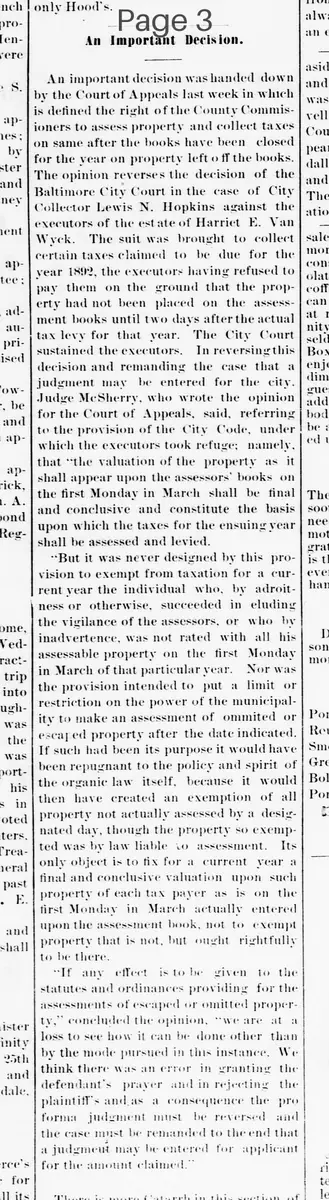
An important decision was handed down by the Court of Appeals last week in which is defined the right of the County Commissioners to assess property and collect taxes on same after the books have been closed for the year on property left off the books.
The opinion reverses the decision of the Baltimore City Court in the case of City Collector Lewis N. Hopkins against the executors of the estate of Harriet E. Van Wyck. The suit was brought to collect certain taxes claimed to be due for the year 1893, the executors having refused to pay them on the ground that the property had not been placed on the assessment books until two days after the actual tax levy for that year. The City Court sustained the executors. In reversing this decision and remanding the case that a judgment may be entered for the city.
Judge McSherry, who wrote the opinion for the Court of Appeals, said, referring to the provision of the City Code, under which the executors took refuge; namely that "the valuation of the property as it shall appear upon the assessors' books on the first Monday in March shall be final and conclusive and constitute the basis upon which the taxes for the ensuing year shall be assessed and levied."
"But it was never designed by this provision to exempt from taxation for a current year the individual who, by adroitness or otherwise, succeeded in eluding the vigilance of the assessors, or who by inadvertence, was not rated with all his assessable property on the first Monday in March of that particular year. Nor was the provision intended to put a limit or restriction on the power of the municipality to make an assessment of omitted or escaped property after the date indicated. If such had been its purpose it would have been repugnant to the policy and spirit of the organic law itself, because it would then have created an exemption of all property not actually assessed by a designated day, though the property so exempted was by law liable to assessment. Its only object is to fix for a current year a final and conclusive valuation upon such property of each tax payer as is on the first Monday in March actually entered upon the assessment book, not to exempt property that is not, but ought rightfully to be there.
"If any effect is to be given to the statutes and ordinances providing for the assessments of escaped or omitted property," concluded the opinion, "we are at a loss to see how it can be done other than by the mode pursued in this instance. We think there was an error in granting the defendant's prayer and in rejecting the plaintiff's and as a consequence the pro forma judgment must be reversed and the case must be remanded to the end that a judgment may be entered for applicant for the amount claimed."
What sub-type of article is it?
What themes does it cover?
What keywords are associated?
What entities or persons were involved?
Where did it happen?
Story Details
Key Persons
Location
Baltimore
Event Date
1893
Story Details
The Court of Appeals reversed the Baltimore City Court's ruling in favor of the executors of Harriet E. Van Wyck's estate, who refused to pay 1893 taxes on property assessed two days after the levy. Judge McSherry's opinion held that omitted property can still be assessed and taxed, remanding for judgment in favor of the city collector.