Thank you for visiting SNEWPapers!
Sign up free
Story
February 3, 1947
The Wilmington Morning Star
Wilmington, New Hanover County, North Carolina
What is this article about?
In Washington on Feb. 3., Dr. Richard H. Fleming, U.S. Navy oceanographer, suggests sea serpents could lurk in deep oceans, possibly resembling ribbon fish, while doubting specific sightings at Loch Ness and British Columbia.
Clipping
OCR Quality
100%
Excellent
Full Text
SCIENTIST SAYS
SEA SERPENTS MAY
STILL ROAM OCEAN
WASHINGTON, Feb. 3. -(P)
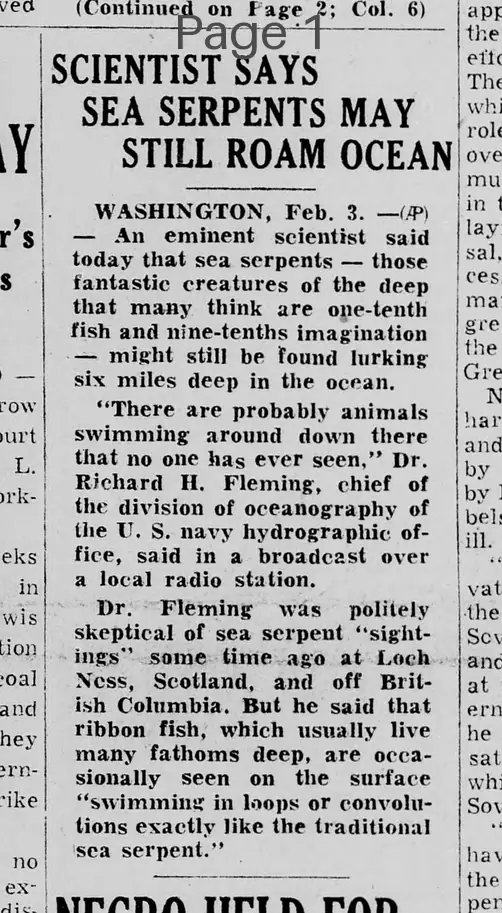
An eminent scientist said today that sea serpents - those fantastic creatures of the deep that many think are one-tenth fish and nine-tenths imagination - might still be found lurking six miles deep in the ocean.
"There are probably animals swimming around down there that no one has ever seen," Dr. Richard H. Fleming, chief of the division of oceanography of the U. S. navy hydrographic office, said in a broadcast over a local radio station.
Dr. Fleming was politely skeptical of sea serpent "sightings" some time ago at Loch Ness, Scotland, and off British Columbia. But he said that ribbon fish, which usually live many fathoms deep, are occasionally seen on the surface "swimming in loops or convolutions exactly like the traditional sea serpent."
SEA SERPENTS MAY
STILL ROAM OCEAN
WASHINGTON, Feb. 3. -(P)
An eminent scientist said today that sea serpents - those fantastic creatures of the deep that many think are one-tenth fish and nine-tenths imagination - might still be found lurking six miles deep in the ocean.
"There are probably animals swimming around down there that no one has ever seen," Dr. Richard H. Fleming, chief of the division of oceanography of the U. S. navy hydrographic office, said in a broadcast over a local radio station.
Dr. Fleming was politely skeptical of sea serpent "sightings" some time ago at Loch Ness, Scotland, and off British Columbia. But he said that ribbon fish, which usually live many fathoms deep, are occasionally seen on the surface "swimming in loops or convolutions exactly like the traditional sea serpent."
What sub-type of article is it?
Curiosity
Extraordinary Event
What themes does it cover?
Nature
What keywords are associated?
Sea Serpents
Ocean Depths
Ribbon Fish
Loch Ness Sighting
British Columbia Sighting
What entities or persons were involved?
Dr. Richard H. Fleming
Where did it happen?
Washington
Story Details
Key Persons
Dr. Richard H. Fleming
Location
Washington
Event Date
Feb. 3.
Story Details
Dr. Richard H. Fleming states that sea serpents might exist in the deep ocean, citing unseen animals and ribbon fish that resemble traditional sea serpent descriptions. He is skeptical of sightings at Loch Ness and off British Columbia.