Thank you for visiting SNEWPapers!
Sign up free
Literary
May 16, 1894
The Maryville Times
Maryville, Blount County, Tennessee
What is this article about?
In this excerpt from H. Rider Haggard's 'Cleopatra,' Harmachis, an Egyptian royal claimant, arrives in Alexandria, witnesses Cleopatra's procession, fights and defeats a Nubian guard, meets the queen, and later confers with his cousin Charmion on a plot to assassinate Cleopatra and seize power in Egypt.
Clipping
OCR Quality
95%
Excellent
Full Text
CLEOPATRA
Account of the Fall and Rise of Harmachis, the Royal Egyptian.
WRITTEN BY HIS OWN HAND.
Rider Haggard,
Author of "King Solomon's Mines,"
"Allan Quatermain,"
Etc., Etc., Etc.
It is well. Mount, then, thy throne, that in the presence of these thy subjects I may name thee Pharaoh."
I mounted upon the throne, whereof the footstool is a sphinx, and the canopy the overshadowing wings of Ma. Then did Amenemhat once again draw nigh and place upon my brow the Pshent, and on my head the Double Crown, and about my shoulders the Royal Robe, and in my hands the Scepter and the Scourge.
"Royal Harmachis," he cried, "by these outward signs and tokens, I, the High Priest of the temple of Ra-Men-Ma at Abouthis, crown thee Pharaoh of the Upper and Lower Land. Reign and prosper, O Hope of Khemi!"
Light like the light of the sun blazed out across the waters of the harbor to guide mariners on their way across the wine-dark sea. The vessel, for it was night, having been most cautiously made fast to the quay, I disembarked and stood wondering at the vast mass of houses, and confused by the clamor of many tongues. For here all peoples seemed to be gathered together, each speaking after the fashion of his own land. And as I stood a young man came and touched me on the shoulder, asking me if I was from Abouthis and named Harmachis.
I said, "Yea." Thereon, bending over me, he whispered the secret password into mine ear, and, beckoning to two slaves, bade them bring my apparel from the ship. This they did, fighting their way through the crowd of porters who were clamoring for hire. Then I followed him adown the quay, which was bordered with drinking places, where all sorts of men were gathered, tippling wine and watching the dancing of women, some of whom were but scantily arrayed, and some not arrayed at all. And so we went through the lamp-lit houses, till at last we reached the shore of the great harbor, and turned to the right along a wide way paved with granite and bordered by strong houses, having cloisters in front of them, the like of which I had never seen. Turning once more to the right, we came to a quieter portion of the city, where, save for parties of strolling revelers, the streets were still. Presently my guide halted at a house built of white stone. We passed in, and, crossing a small courtyard, entered a chamber where there was a light. And here at last I found my uncle Sepa, most glad to see me safe.
When I had washed and eaten he told me that all things went well, and that as yet there was no thought of civil at the Court. Further, he said, it having come to the ears of the Queen that the Priest of On was sojourning at Alexandria, she sent for him and closely questioned him—not as to any plot, for of that she never thought, but as to the rumor which had reached her that there was treasure hid in the Great Pyramid that is by On. For, being ever wasteful, she was over in want of money, and had bethought her of opening the Pyramid. But he laughed at her, telling her the Pyramid was the burying place of the Divine Chufu, and that naught knew he of its secrets. Then she was angered, and swore that so surely as she ruled in Egypt she would tear it down, stone by stone, and discover the secret at its heart. Again he laughed, and in the words of the proverb which they have here at Alexandria, told her that "Mountains live longer than Kings." Thereon she smiled at his ready answer and let him go. Also my uncle Sepa told me that on the morrow I should see this Cleopatra. For it was her birthday (as, indeed, it was also mine), and, dressed as the Holy Isis, she would pass in state from her palace on the Lochias to the Serapeum to offer a sacrifice at the shrine of the false God who sits therein. And he said thereafter that the fashion whereby I should gain entrance to the household of the Queen should be contrived.
Then, being very weary, I went to rest; but could sleep little for the strangeness of the place, the noises in the streets, and the thought of the morrow. While it was yet dark, I rose, climbed the stair to the roof of the house, and waited. Presently the sun's rays shot out like arrows, and lit upon the white wonder of the marble Pharos, whereof the light instantly sank and died, as though, indeed, the sun had killed it. Now the rays fell upon the marble palaces of the Lochias where Cleopatra lay, and lit them up till they flamed like a jewel set on the dark, cool bosom of the sea. Away the light flew, kissing the Soma's sacred dome, wherein Alexander sleeps, touching the high tops of a thousand palaces and temples; past the porticoes of the great museum that loomed near at hand, striking the lofty shrine where, carven of ivory, is the image of the false God Serapis, and at last seeming to lose itself in the vast and gloomy Necropolis. Then, as the dawn gathered into day, the great flood of brightness overbrimming the bowl of night flowed into the lower lands and streets, and showed Alexandria red in the sunrise as the mantle of a king, and shaped as a mantle. The Etesian wind came up from the north and swept away the vapor from the harbors, so that I saw their blue waters rocking a thousand ships. I saw, too, that mighty mole of the Heptastadium; I saw the hundreds of streets, the countless houses, the innumerable wealth and splendor of Alexandria, set like a queen betwixt Mareotis and the ocean, and dominating both, and I was filled with wonder. This, then, was one city in my heritage of lands and cities! Well, it was worth the grasping. And having looked my fill and fed my heart, as it were, with the sight of splendor, I communed with the Holy Isis and came down from the roof.
In the chamber beneath was my uncle Sepa. I told him that I had been watching the sun rise over the city of Alexandria.
"So!" he said, looking at me from beneath his shaggy eyebrows; "and what thinkest thou of Alexandria?"
"I think it is like some city of the Gods," I answered.
"Ay!" he replied, fiercely. "a city of the infernal Gods—a sink of corruption, a bubbling well of iniquity, a home of false faith springing from false hearts! I would that not one stone of it were left upon another stone, and that its wealth lay deep beneath yonder waters! I would that the gulls were screaming across its site, and that the wind, untainted by a Grecian breath, swept through its ruins from ocean to Mareotis! O Royal Harmachis, let not the luxury and beauty of Alexandria poison thy sense; for in their deadly air Faith perishes and Religion cannot spread her Heavenly wings. When the hour comes for thee to rule, Harmachis, cast down this accursed city, and, as thy fathers did, set up thy throne in the white walls of Memphis. For I tell thee that for Egypt Alexandria is but a splendid gate of ruin, and while it endures all nations of the earth shall march through it to the plunder of the land, and all false faiths shall nestle in it and breed the overthrow of Egypt's Gods."
I made no answer, for there was truth in his words. And yet to me the city seemed very fair to look on. After we had eaten, my uncle told me it was now time to set out to view the march of Cleopatra, as she went in triumph to the shrine of Serapis. For although she would not pass till within two hours of the midday, yet these people of Alexandria have so great a love of shows and idling that had we not presently set forth by no means could we have come through the press of the multitudes who were already gathering along the highways where the Queen must ride. So we went out to take our place upon a stand, fashioned of timber, that had been built at the side of the great road which pierces through the city, even to the Canopic Gate. For therein my uncle had purchased a right to enter, and that dearly.
And with much struggle we won our way through the great crowds that were already gathered in the streets, till we reached the scaffolding of timber, which was roofed in with an awning and gayly hung with scarlet cloths. Here we seated ourselves upon a bench and waited for some hours, watching the multitude press past, shouting, singing and talking loudly in many tongues. At length came soldiers to clear the road, clad, after the Roman fashion, in coats of chain armor. After them marched heralds enjoining silence (whereat the populace sang and shouted all the more loudly), and crying that Cleopatra, the Queen, was coming. Then followed a thousand Cilician skirmishers, a thousand Thracians, a thousand Macedonians, and a thousand Gauls, each armed after the fashion of their own country. Then passed five hundred men of those who are called the Fenced Horsemen, for both men and horses were altogether covered with armor. Next came youths and maidens sumptuously draped and wearing golden crowns, and with them images symbolizing Day and Night, Morning and Noon, the Heavens and the Earth. After these came many fair women pouring perfumes on the road, and others scattering blooming flowers. Now there rose a great shout of "Cleopatra! Cleopatra!" and I held my breath and bent forward to see her who dared to put on the robes of Isis.
But at that moment the multitude so gathered and thickened in front of where I was that I could no longer clearly see. So in my eagerness I leapt over the barrier of the scaffolding, and, being very strong, pushed my way through the crowd till I reached the foremost rank. And, as I did so, Nubian slaves armed with thick staves and crowned with ivy leaves ran up, striking the people. One man more especially, for he was a giant, and, being strong, was insolent beyond measure, smiting the people without cause, as, indeed, is the wont of low persons set in authority. For nigh to me stood a woman, an Egyptian by her face, bearing a child in her arms, whom the man, seeing that she was weak, struck on the head with his rod so that she fell prone, and the people murmured. But my blood rushed of a sudden through my veins at the sight, and drowned my reason. In my hand I held a staff of olive wood from Cyprus, and as the black brute laughed at the sight of the stricken woman and her babe rolling on the ground, I swung the staff aloft and smote. So shrewdly did I strike that the tough rod split upon the giant's shoulders and the blood spurted forth, staining his trailing leaves of ivy.
Then, with a shriek of pain and fury—for those who smite love not that they be smitten—did he turn and spring at me! And all the people round gave back, save only the woman who could not rise, leaving us twain in a ring, as it were. On he came with a rush, and, as he came, being now mad, I smote him with my clenched fist between the eyes, having naught else wherewith to smite, and he staggered like an ox beneath the first blow of the priest's axe. Thereat the people shouted, for they love to see a fight, and the man was known to them as a gladiator victorious in the games. Gathering up his strength, the knave came on with an oath, and, whirling his heavy staff on high, struck at me in such a fashion that, had I not by nimbleness avoided the blow, I had surely been slain. But as it chanced, the staff hit upon the ground, and so heavily that it flew in fragments. Thereon again the multitude shouted, and the great man, blind with fury, rushed at me to smite me down. But with a cry I sprang straight at his throat—for he was so heavy a man that I knew I could not hope to throw him by strength—ay, and gripped it. There I clung, though his fists battered me like bludgeons, driving my thumbs into his throat. Round and round we turned, till at length he flung himself to the earth, trusting thus to shake me off. But I held on fast as we rolled over and over on the ground, till at last he grew faint for want of breath. Then I, being uppermost, drave my knee down upon his chest, and, as I believe, should thus have slain him in my rage, had not my uncle and others there gathered fallen upon me and dragged me from him.
And meanwhile, though I knew it not, the chariot wherein sat the Queen, with elephants going before and lions led after it, had come even to the spot, and—because of the tumult—had been halted. I looked up, and thus torn, panting, my white garments stained with the blood that had rushed from the mouth and nostrils of the mighty Nubian, I for the first time saw Cleopatra face to face. Her chariot was all of gold, and drawn by milk-white steeds. Therein she sat with two fair girls, clad in Greek attire, standing on either side fanning her with glittering fans. There she sat in the splendid car. On her head was the covering of Isis, the golden horns between which rested the moon's round disk and the emblem of Osiris' throne, with the uraeus twined around. Beneath the covering was the vulture cap of gold, the blue enameled wings, and the vulture head with gemmy eyes, under which her long, dark tresses flowed toward her feet. About her rounded neck was a broad collar of gold studded with emeralds and coral. Round her arms and wrists were bracelets of gold studded with emeralds and coral, and in one hand she held the holy symbol of life (crux ansata) fashioned of crystal, and in the other the golden rod of royalty. Her breast was bare, but under was a garment that glistened like the scaly covering of a snake, everywhere sewn with gems. Beneath this robe was a skirt of golden cloth, half hid by a scarf of the broidered silk of Cos, falling in folds even to the sandals that, fastened with great pearls, adorned her white and tiny feet.
All this I discerned at a glance, as it were. Then I looked upon the face—that face which seduced Cæsar, ruined Egypt and was doomed to give Augustus the scepter of the world. I looked upon the flawless Grecian features, the rounded chin, the full, rich lips, the chiseled nostrils and the ears fashioned like delicate shells. I saw the forehead, low, broad and lovely, the crisped, dark hair falling in heavy waves that sparkled in the sun, the arched eyebrows and the long bent lashes. There before me was the grandeur of her imperial shape. There burnt the wonderful eyes, hued like the Cyprian violet—eyes that seemed to sleep and brood on secret things as night broods upon the desert, and yet as the night to shift, change and be illumined by gleams of sudden splendor born within their starry depths. All those wonders I saw though I have small skill in telling them. But even then I knew that it was not in these charms alone that the might of Cleopatra's beauty lay. Rather was it in a glory and a radiance cast through the fleshy covering from the fierce soul within. For she was a Thing of flame like unto which no woman hath ever been nor ever will be. Even when she brooded, the fire of her quick heart shone through her. But when she woke, and the lightning leapt suddenly from her eyes, and the passion-laden music of her speech chimed upon her lips, ah! then who can tell how Cleopatra seemed? For in her met all the splendors that have been given to woman for her glory, and all the genius which man has drawn from Heaven. And with them dwelt every evil of that greater sort which fearing nothing and making a mock of laws, hath taken empires for its place of play, and, smiling, watered the growth of its desires with the rich blood of men. In her breast they gathered, together fashioning that Cleopatra whom no man may draw, and yet whom no man, having seen, ever can forget. They fashioned her grand as the Spirit of Storm, lovely as Lightning, cruel as Pestilence, yet with a heart; and what she did is known. Woe to the world when such another comes to curse it!
For a moment I met Cleopatra's eyes as she idly bent herself to find the tumult's cause. At first they were somber and dark, as though they saw, indeed, but the brain read naught. Then they awoke, and their very color seemed to change as the color of the sea changes when the water is shaken. First, there was anger written in them; next, an idle noting; then when she looked upon the huge bulk of the man whom I had overcome, and knew him for the gladiator, something, perchance, that was not far from wonder. At the least they softened, though, indeed, her face changed not a wit. But he who would read Cleopatra's mind had need to watch her eyes, for her countenance varied but a little. Turning, she said some words to her guards. They came forward and led me to her, while all the multitude waited silently to see me slain.
I stood before her, my arms folded on my breast. Overcome though I was by the wonder of her loveliness, I hated in my heart this woman who dared to clothe herself in the dress of Isis—this usurper who sat upon my throne, this wanton squandering the wealth of Egypt in chariots and perfumes. When she had looked me over from the head to the feet she spake in a low full voice and in the tongue of Khemi, which she alone had learned of all the Lagidæ:
"And who and what art thou, Egyptian—for Egyptian I see thou art—who darest to smite my slave when I make progress through my city?"
"I am Harmachis," I answered, boldly—“Harmachis the astrologer, adopted son of the High Priest and Governor of Abouthis, who am come hither to seek my fortune. I smote thy slave, O Queen, because for no fault he struck down the woman yonder. Ask of those who saw, Royal Egypt."
"Harmachis!" she said; "the name hath a high sound—and thou hast a high look." And then speaking to a soldier who had seen all, she bade him tell her what had come to pass. This he did truthfully, being friendly disposed toward me, because I had overcome the Nubian. Thereon she turned and spoke with the girl bearing the fan who stood beside her—a woman having curling hair and shy, dark eyes, very beautiful to see. The girl answered somewhat. Then Cleopatra bade them bring the slave to her. So they led forward the giant, who had found his breath again, and with him the woman whom he had smitten down.
"Thou dog!" she said, in the same low voice; "thou coward! who, being strong, didst smite down this woman, and, being a coward, wast overthrown of this young man. See, thou, I will teach thee manners. Henceforth, when thou smitest women, it shall be with thy left arm. Ho, guards, seize this black coward and strike off his right hand."
And her command given, she sank back in her golden chariot, and again the cloud gathered in her eyes. But the guards seized the giant, and, notwithstanding his cries and prayers for mercy, struck off his hand with a sword upon the wood of the scaffolding, and he was carried away groaning. Then the procession moved on again. As it went the fair woman with the fan turned her head, caught my eye, and smiled and nodded as though she rejoiced, whereat I wondered somewhat.
The people cheered also and made jests, saying that I should soon practice astrology in the palace. But as soon as we might I and my uncle escaped, and made our way back to the house. All the while he rated me for my rashness; but when we came within the chamber of the house he embraced me and rejoiced greatly, because with so little hurt to myself I had overthrown the giant.
CHAPTER IX.
OF THE COMING OF CHARMION,
AND OF THE
WRATH OF SEPA.
That same night while we sat at supper in the house, there came a knock upon the door. It was opened, and a woman passed in, wrapped from head to foot in a large dark peplos or cloak in such fashion that her face could not be clearly seen.
My uncle rose, and as he did so the woman uttered the secret word.
"I am come, my father," she said in a sweet, clear voice, "though of a truth it was not easy to escape the revels at the palace. But I told the Queen that the sun and the riot in the streets had made me sick, and she let me go."
"It is well," he answered. "Unveil thyself; here thou art safe."
With a little sigh of weariness she unclasped the peplos and let it slip from her, giving to my sight the face and form of that beauteous girl who had stood to fan Cleopatra in the chariot. For she was very fair and pleasant to look upon, and her Grecian robes clung sweetly about her supple limbs and budding form. Her wayward hair, flowing in a hundred little curls, was bound with a golden fillet, and on her feet were sandals. Her cheeks blushed like a flower, and her dark soft eyes were downcast, as though with modesty, but smiles and dimples trembled about her lips.
My uncle frowned when his eyes fell upon her dress.
"Why comest thou in this garb, Charmion?" he asked, sternly. "Is not the dress thy mothers wore good enough for thee? This is no time or place for woman's vanities. Thou art not here to conquer, but to obey."
"Nay, be not wroth, my father," she answered, softly; "perchance thou knowest not that she whom I serve will have none of our Egyptian dress; it is out of fashion. To wear it would have been to court suspicion—also I came in haste." And as she spoke I saw that all the while she watched me covertly through the long lashes which fringed her modest eyes.
"Well, well," he said, sharply, fixing his keen glance upon her face, "doubtless thou speakest truth, Charmion. Be ever mindful of thy oath, girl, and of the cause to which thou art sworn. Be not light-minded, and I charge thee forget the beauty with which thou hast been cursed. For mark thou this, Charmion: fail us but one jot and vengeance shall fall on thee—the vengeance of man and the vengeance of the Gods! To this service," he continued, lashing himself to anger as he went on, till his great voice rang in the narrow room, "hast thou been bred; to this end hast thou been instructed and placed where thou art, to gain the ear of that wicked wanton whom thou seemest to serve. See thou forget it not; see that the luxury of yonder court does not corrupt thy purity and divert thy aim, Charmion." And his eyes flashed and his small form seemed to grow till it attained to dignity—nay, almost to grandeur. "Charmion," he said, advancing toward her with outstretched finger, "I say to thee that at times I do not trust thee. But two nights gone I dreamed I saw thee standing in the desert. I saw thee laugh and lift thy hand to heaven, and therefrom fell a rain of blood; then the sky sank down on the land of Khem and covered it. Whence came the dream, girl, and what is its meaning? Naught have I against thee as yet; but hearken! On the moment that I have, though thou art, of my kin, and I have loved thee—on that moment, I say, will I doom those delicate limbs, which thou lovest so much to show, to the kite and to the jackal, and the soul within thee to all the tortures of the Gods! Unburied shalt thou die, and bodiless and accursed shalt thou wander in Amenti!—ay, forever and ever!"
He paused, for his sudden burst of passion had spent itself. But by it, more clearly than before, I saw how deep a heart had this man beneath the cloak of his merriness and simplicity of mien, and how fiercely the mind within him was set upon his aim. As for the girl, she shrank from him terrified, and, placing her hands before her face, began to weep.
"Nay, speak not so, my father," she said between her sobs; "for what have I done? Naught know I of the evil wandering of thy dreams. I am no soothsayer that I should read dreams. Have I not carried out all things according to thy desire? Have I not been even mindful of that dread oath?" and she trembled. "Have I not played the spy and told thee all? Have I not won the heart of the Queen so that she loves me as a sister, refusing me nothing, ay, and the hearts of those about her? Why dost thou affright me thus with thy words and threats?" And she wept afresh, looking even more beautiful in her sorrow than she was before.
"Enough, enough," he answered; "what I have said I have said. Be warned, and affront our sight no more with this wanton dress. Thinkest thou that we would feed our eyes upon those rounded arms—we whose stake is Egypt and who are dedicated to the Gods of Egypt? Girl, behold thy cousin and thy King!"
She ceased weeping, wiping her eyes with her chiton, and I saw that they seemed but the softer for her tears.
"Methinks, most Royal Harmachis and beloved cousin," she said, as she bent before me, "that we are already made acquainted."
"Yea, cousin," I answered, not without shamefacedness, for never before had I spoken to so fair a maid; "thou wert in the chariot with Cleopatra this day when I struggled with the Nubian."
"Assuredly," she said, with a smile and a sudden lighting of the eyes, "it was a gallant fight, and gallantly didst thou overthrow that black brute. I saw the fray, and, though I knew thee not, greatly did I fear for one so brave. But I paid him for my fright, for it was I who put it into the mind of Cleopatra to bid the guards strike off his hand—now, knowing who thou art, I would I had said his head." And she looked up, shooting a glance at me, and then smiled.
"Enough," put in my uncle Sepa, "the time draws on. Tell thou thy mission, Charmion, and be gone."
Thereon her manner changed. She folded her hands meekly before her and spake:
"Let Pharaoh hearken unto his handmaiden. I am the daughter of Pharaoh's uncle, the brother of his father who is now long dead, and therefore in my veins also flows the Royal blood of Egypt. Also I am of the ancient faith, and hate these Greeks, and to see thee set upon the throne has been my dearest hope now for many years. To this end have I, Charmion, become serving-woman to Cleopatra, that I might cut a notch wherein thou couldst set thy foot when the hour came to climb the throne. And behold! O Pharaoh, the notch is cut.
"This, then, is our plot, Royal cousin: Thou must gain an entrance to the Household and learn its ways and secrets, and, so far as may be, suborn the eunuchs and captains, some of whom I have already tempted. This done, and all things being prepared without, thou must slay Cleopatra, and, aided by me, with those whom I control, in the confusion that shall ensue throw wide the gates, and, admitting those of our party who are in waiting, put such of the troops as remain faithful to the sword and seize the Bruchium. Which being done, thou shalt within two days hold this fickle Alexandria. At the same time, those who are sworn to thee in every city in Egypt shall rise in arms, and within ten days from the death of Cleopatra thou shalt be Pharaoh indeed. This is the counsel which has been taken, and thou seest, Royal cousin, that, though your uncle yonder doth think so ill of me, I have learned my part—ay, and played it."
"I hear thee, cousin," I answered, marveling that so young a woman, for she had but twenty years, could weave so bold a plot, for in its origin the scheme was hers. But in those days I little knew Charmion.
"Go on; how then shall I gain entrance to the palace of Cleopatra?"
"Nay, cousin, as things are it is easy. Thus: Cleopatra loveth to look upon a man, and—give me pardon—thy face and form...
Account of the Fall and Rise of Harmachis, the Royal Egyptian.
WRITTEN BY HIS OWN HAND.
Rider Haggard,
Author of "King Solomon's Mines,"
"Allan Quatermain,"
Etc., Etc., Etc.
It is well. Mount, then, thy throne, that in the presence of these thy subjects I may name thee Pharaoh."
I mounted upon the throne, whereof the footstool is a sphinx, and the canopy the overshadowing wings of Ma. Then did Amenemhat once again draw nigh and place upon my brow the Pshent, and on my head the Double Crown, and about my shoulders the Royal Robe, and in my hands the Scepter and the Scourge.
"Royal Harmachis," he cried, "by these outward signs and tokens, I, the High Priest of the temple of Ra-Men-Ma at Abouthis, crown thee Pharaoh of the Upper and Lower Land. Reign and prosper, O Hope of Khemi!"
Light like the light of the sun blazed out across the waters of the harbor to guide mariners on their way across the wine-dark sea. The vessel, for it was night, having been most cautiously made fast to the quay, I disembarked and stood wondering at the vast mass of houses, and confused by the clamor of many tongues. For here all peoples seemed to be gathered together, each speaking after the fashion of his own land. And as I stood a young man came and touched me on the shoulder, asking me if I was from Abouthis and named Harmachis.
I said, "Yea." Thereon, bending over me, he whispered the secret password into mine ear, and, beckoning to two slaves, bade them bring my apparel from the ship. This they did, fighting their way through the crowd of porters who were clamoring for hire. Then I followed him adown the quay, which was bordered with drinking places, where all sorts of men were gathered, tippling wine and watching the dancing of women, some of whom were but scantily arrayed, and some not arrayed at all. And so we went through the lamp-lit houses, till at last we reached the shore of the great harbor, and turned to the right along a wide way paved with granite and bordered by strong houses, having cloisters in front of them, the like of which I had never seen. Turning once more to the right, we came to a quieter portion of the city, where, save for parties of strolling revelers, the streets were still. Presently my guide halted at a house built of white stone. We passed in, and, crossing a small courtyard, entered a chamber where there was a light. And here at last I found my uncle Sepa, most glad to see me safe.
When I had washed and eaten he told me that all things went well, and that as yet there was no thought of civil at the Court. Further, he said, it having come to the ears of the Queen that the Priest of On was sojourning at Alexandria, she sent for him and closely questioned him—not as to any plot, for of that she never thought, but as to the rumor which had reached her that there was treasure hid in the Great Pyramid that is by On. For, being ever wasteful, she was over in want of money, and had bethought her of opening the Pyramid. But he laughed at her, telling her the Pyramid was the burying place of the Divine Chufu, and that naught knew he of its secrets. Then she was angered, and swore that so surely as she ruled in Egypt she would tear it down, stone by stone, and discover the secret at its heart. Again he laughed, and in the words of the proverb which they have here at Alexandria, told her that "Mountains live longer than Kings." Thereon she smiled at his ready answer and let him go. Also my uncle Sepa told me that on the morrow I should see this Cleopatra. For it was her birthday (as, indeed, it was also mine), and, dressed as the Holy Isis, she would pass in state from her palace on the Lochias to the Serapeum to offer a sacrifice at the shrine of the false God who sits therein. And he said thereafter that the fashion whereby I should gain entrance to the household of the Queen should be contrived.
Then, being very weary, I went to rest; but could sleep little for the strangeness of the place, the noises in the streets, and the thought of the morrow. While it was yet dark, I rose, climbed the stair to the roof of the house, and waited. Presently the sun's rays shot out like arrows, and lit upon the white wonder of the marble Pharos, whereof the light instantly sank and died, as though, indeed, the sun had killed it. Now the rays fell upon the marble palaces of the Lochias where Cleopatra lay, and lit them up till they flamed like a jewel set on the dark, cool bosom of the sea. Away the light flew, kissing the Soma's sacred dome, wherein Alexander sleeps, touching the high tops of a thousand palaces and temples; past the porticoes of the great museum that loomed near at hand, striking the lofty shrine where, carven of ivory, is the image of the false God Serapis, and at last seeming to lose itself in the vast and gloomy Necropolis. Then, as the dawn gathered into day, the great flood of brightness overbrimming the bowl of night flowed into the lower lands and streets, and showed Alexandria red in the sunrise as the mantle of a king, and shaped as a mantle. The Etesian wind came up from the north and swept away the vapor from the harbors, so that I saw their blue waters rocking a thousand ships. I saw, too, that mighty mole of the Heptastadium; I saw the hundreds of streets, the countless houses, the innumerable wealth and splendor of Alexandria, set like a queen betwixt Mareotis and the ocean, and dominating both, and I was filled with wonder. This, then, was one city in my heritage of lands and cities! Well, it was worth the grasping. And having looked my fill and fed my heart, as it were, with the sight of splendor, I communed with the Holy Isis and came down from the roof.
In the chamber beneath was my uncle Sepa. I told him that I had been watching the sun rise over the city of Alexandria.
"So!" he said, looking at me from beneath his shaggy eyebrows; "and what thinkest thou of Alexandria?"
"I think it is like some city of the Gods," I answered.
"Ay!" he replied, fiercely. "a city of the infernal Gods—a sink of corruption, a bubbling well of iniquity, a home of false faith springing from false hearts! I would that not one stone of it were left upon another stone, and that its wealth lay deep beneath yonder waters! I would that the gulls were screaming across its site, and that the wind, untainted by a Grecian breath, swept through its ruins from ocean to Mareotis! O Royal Harmachis, let not the luxury and beauty of Alexandria poison thy sense; for in their deadly air Faith perishes and Religion cannot spread her Heavenly wings. When the hour comes for thee to rule, Harmachis, cast down this accursed city, and, as thy fathers did, set up thy throne in the white walls of Memphis. For I tell thee that for Egypt Alexandria is but a splendid gate of ruin, and while it endures all nations of the earth shall march through it to the plunder of the land, and all false faiths shall nestle in it and breed the overthrow of Egypt's Gods."
I made no answer, for there was truth in his words. And yet to me the city seemed very fair to look on. After we had eaten, my uncle told me it was now time to set out to view the march of Cleopatra, as she went in triumph to the shrine of Serapis. For although she would not pass till within two hours of the midday, yet these people of Alexandria have so great a love of shows and idling that had we not presently set forth by no means could we have come through the press of the multitudes who were already gathering along the highways where the Queen must ride. So we went out to take our place upon a stand, fashioned of timber, that had been built at the side of the great road which pierces through the city, even to the Canopic Gate. For therein my uncle had purchased a right to enter, and that dearly.
And with much struggle we won our way through the great crowds that were already gathered in the streets, till we reached the scaffolding of timber, which was roofed in with an awning and gayly hung with scarlet cloths. Here we seated ourselves upon a bench and waited for some hours, watching the multitude press past, shouting, singing and talking loudly in many tongues. At length came soldiers to clear the road, clad, after the Roman fashion, in coats of chain armor. After them marched heralds enjoining silence (whereat the populace sang and shouted all the more loudly), and crying that Cleopatra, the Queen, was coming. Then followed a thousand Cilician skirmishers, a thousand Thracians, a thousand Macedonians, and a thousand Gauls, each armed after the fashion of their own country. Then passed five hundred men of those who are called the Fenced Horsemen, for both men and horses were altogether covered with armor. Next came youths and maidens sumptuously draped and wearing golden crowns, and with them images symbolizing Day and Night, Morning and Noon, the Heavens and the Earth. After these came many fair women pouring perfumes on the road, and others scattering blooming flowers. Now there rose a great shout of "Cleopatra! Cleopatra!" and I held my breath and bent forward to see her who dared to put on the robes of Isis.
But at that moment the multitude so gathered and thickened in front of where I was that I could no longer clearly see. So in my eagerness I leapt over the barrier of the scaffolding, and, being very strong, pushed my way through the crowd till I reached the foremost rank. And, as I did so, Nubian slaves armed with thick staves and crowned with ivy leaves ran up, striking the people. One man more especially, for he was a giant, and, being strong, was insolent beyond measure, smiting the people without cause, as, indeed, is the wont of low persons set in authority. For nigh to me stood a woman, an Egyptian by her face, bearing a child in her arms, whom the man, seeing that she was weak, struck on the head with his rod so that she fell prone, and the people murmured. But my blood rushed of a sudden through my veins at the sight, and drowned my reason. In my hand I held a staff of olive wood from Cyprus, and as the black brute laughed at the sight of the stricken woman and her babe rolling on the ground, I swung the staff aloft and smote. So shrewdly did I strike that the tough rod split upon the giant's shoulders and the blood spurted forth, staining his trailing leaves of ivy.
Then, with a shriek of pain and fury—for those who smite love not that they be smitten—did he turn and spring at me! And all the people round gave back, save only the woman who could not rise, leaving us twain in a ring, as it were. On he came with a rush, and, as he came, being now mad, I smote him with my clenched fist between the eyes, having naught else wherewith to smite, and he staggered like an ox beneath the first blow of the priest's axe. Thereat the people shouted, for they love to see a fight, and the man was known to them as a gladiator victorious in the games. Gathering up his strength, the knave came on with an oath, and, whirling his heavy staff on high, struck at me in such a fashion that, had I not by nimbleness avoided the blow, I had surely been slain. But as it chanced, the staff hit upon the ground, and so heavily that it flew in fragments. Thereon again the multitude shouted, and the great man, blind with fury, rushed at me to smite me down. But with a cry I sprang straight at his throat—for he was so heavy a man that I knew I could not hope to throw him by strength—ay, and gripped it. There I clung, though his fists battered me like bludgeons, driving my thumbs into his throat. Round and round we turned, till at length he flung himself to the earth, trusting thus to shake me off. But I held on fast as we rolled over and over on the ground, till at last he grew faint for want of breath. Then I, being uppermost, drave my knee down upon his chest, and, as I believe, should thus have slain him in my rage, had not my uncle and others there gathered fallen upon me and dragged me from him.
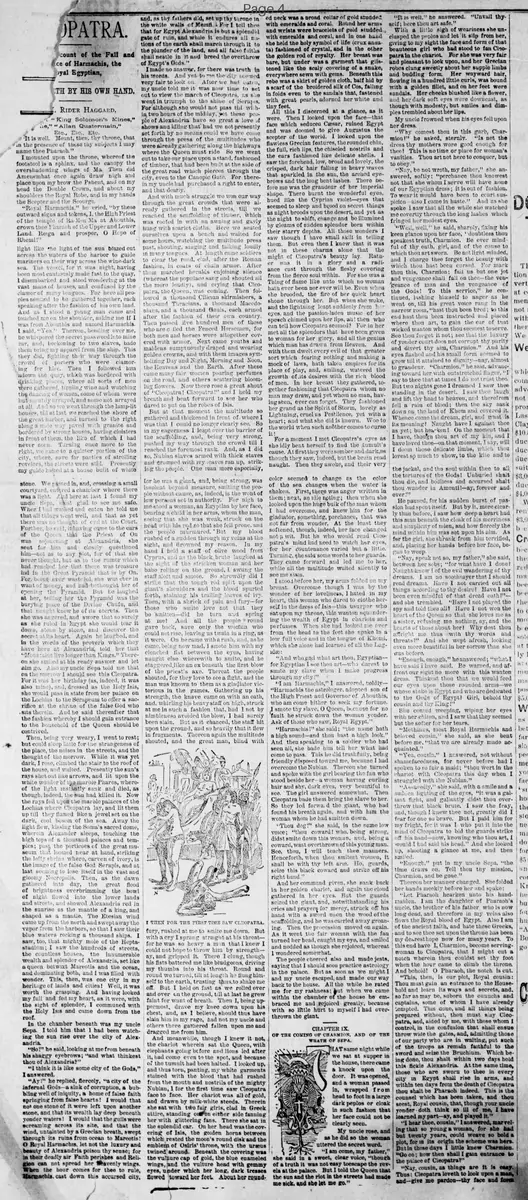
And meanwhile, though I knew it not, the chariot wherein sat the Queen, with elephants going before and lions led after it, had come even to the spot, and—because of the tumult—had been halted. I looked up, and thus torn, panting, my white garments stained with the blood that had rushed from the mouth and nostrils of the mighty Nubian, I for the first time saw Cleopatra face to face. Her chariot was all of gold, and drawn by milk-white steeds. Therein she sat with two fair girls, clad in Greek attire, standing on either side fanning her with glittering fans. There she sat in the splendid car. On her head was the covering of Isis, the golden horns between which rested the moon's round disk and the emblem of Osiris' throne, with the uraeus twined around. Beneath the covering was the vulture cap of gold, the blue enameled wings, and the vulture head with gemmy eyes, under which her long, dark tresses flowed toward her feet. About her rounded neck was a broad collar of gold studded with emeralds and coral. Round her arms and wrists were bracelets of gold studded with emeralds and coral, and in one hand she held the holy symbol of life (crux ansata) fashioned of crystal, and in the other the golden rod of royalty. Her breast was bare, but under was a garment that glistened like the scaly covering of a snake, everywhere sewn with gems. Beneath this robe was a skirt of golden cloth, half hid by a scarf of the broidered silk of Cos, falling in folds even to the sandals that, fastened with great pearls, adorned her white and tiny feet.
All this I discerned at a glance, as it were. Then I looked upon the face—that face which seduced Cæsar, ruined Egypt and was doomed to give Augustus the scepter of the world. I looked upon the flawless Grecian features, the rounded chin, the full, rich lips, the chiseled nostrils and the ears fashioned like delicate shells. I saw the forehead, low, broad and lovely, the crisped, dark hair falling in heavy waves that sparkled in the sun, the arched eyebrows and the long bent lashes. There before me was the grandeur of her imperial shape. There burnt the wonderful eyes, hued like the Cyprian violet—eyes that seemed to sleep and brood on secret things as night broods upon the desert, and yet as the night to shift, change and be illumined by gleams of sudden splendor born within their starry depths. All those wonders I saw though I have small skill in telling them. But even then I knew that it was not in these charms alone that the might of Cleopatra's beauty lay. Rather was it in a glory and a radiance cast through the fleshy covering from the fierce soul within. For she was a Thing of flame like unto which no woman hath ever been nor ever will be. Even when she brooded, the fire of her quick heart shone through her. But when she woke, and the lightning leapt suddenly from her eyes, and the passion-laden music of her speech chimed upon her lips, ah! then who can tell how Cleopatra seemed? For in her met all the splendors that have been given to woman for her glory, and all the genius which man has drawn from Heaven. And with them dwelt every evil of that greater sort which fearing nothing and making a mock of laws, hath taken empires for its place of play, and, smiling, watered the growth of its desires with the rich blood of men. In her breast they gathered, together fashioning that Cleopatra whom no man may draw, and yet whom no man, having seen, ever can forget. They fashioned her grand as the Spirit of Storm, lovely as Lightning, cruel as Pestilence, yet with a heart; and what she did is known. Woe to the world when such another comes to curse it!
For a moment I met Cleopatra's eyes as she idly bent herself to find the tumult's cause. At first they were somber and dark, as though they saw, indeed, but the brain read naught. Then they awoke, and their very color seemed to change as the color of the sea changes when the water is shaken. First, there was anger written in them; next, an idle noting; then when she looked upon the huge bulk of the man whom I had overcome, and knew him for the gladiator, something, perchance, that was not far from wonder. At the least they softened, though, indeed, her face changed not a wit. But he who would read Cleopatra's mind had need to watch her eyes, for her countenance varied but a little. Turning, she said some words to her guards. They came forward and led me to her, while all the multitude waited silently to see me slain.
I stood before her, my arms folded on my breast. Overcome though I was by the wonder of her loveliness, I hated in my heart this woman who dared to clothe herself in the dress of Isis—this usurper who sat upon my throne, this wanton squandering the wealth of Egypt in chariots and perfumes. When she had looked me over from the head to the feet she spake in a low full voice and in the tongue of Khemi, which she alone had learned of all the Lagidæ:
"And who and what art thou, Egyptian—for Egyptian I see thou art—who darest to smite my slave when I make progress through my city?"
"I am Harmachis," I answered, boldly—“Harmachis the astrologer, adopted son of the High Priest and Governor of Abouthis, who am come hither to seek my fortune. I smote thy slave, O Queen, because for no fault he struck down the woman yonder. Ask of those who saw, Royal Egypt."
"Harmachis!" she said; "the name hath a high sound—and thou hast a high look." And then speaking to a soldier who had seen all, she bade him tell her what had come to pass. This he did truthfully, being friendly disposed toward me, because I had overcome the Nubian. Thereon she turned and spoke with the girl bearing the fan who stood beside her—a woman having curling hair and shy, dark eyes, very beautiful to see. The girl answered somewhat. Then Cleopatra bade them bring the slave to her. So they led forward the giant, who had found his breath again, and with him the woman whom he had smitten down.
"Thou dog!" she said, in the same low voice; "thou coward! who, being strong, didst smite down this woman, and, being a coward, wast overthrown of this young man. See, thou, I will teach thee manners. Henceforth, when thou smitest women, it shall be with thy left arm. Ho, guards, seize this black coward and strike off his right hand."
And her command given, she sank back in her golden chariot, and again the cloud gathered in her eyes. But the guards seized the giant, and, notwithstanding his cries and prayers for mercy, struck off his hand with a sword upon the wood of the scaffolding, and he was carried away groaning. Then the procession moved on again. As it went the fair woman with the fan turned her head, caught my eye, and smiled and nodded as though she rejoiced, whereat I wondered somewhat.
The people cheered also and made jests, saying that I should soon practice astrology in the palace. But as soon as we might I and my uncle escaped, and made our way back to the house. All the while he rated me for my rashness; but when we came within the chamber of the house he embraced me and rejoiced greatly, because with so little hurt to myself I had overthrown the giant.
CHAPTER IX.
OF THE COMING OF CHARMION,
AND OF THE
WRATH OF SEPA.
That same night while we sat at supper in the house, there came a knock upon the door. It was opened, and a woman passed in, wrapped from head to foot in a large dark peplos or cloak in such fashion that her face could not be clearly seen.
My uncle rose, and as he did so the woman uttered the secret word.
"I am come, my father," she said in a sweet, clear voice, "though of a truth it was not easy to escape the revels at the palace. But I told the Queen that the sun and the riot in the streets had made me sick, and she let me go."
"It is well," he answered. "Unveil thyself; here thou art safe."
With a little sigh of weariness she unclasped the peplos and let it slip from her, giving to my sight the face and form of that beauteous girl who had stood to fan Cleopatra in the chariot. For she was very fair and pleasant to look upon, and her Grecian robes clung sweetly about her supple limbs and budding form. Her wayward hair, flowing in a hundred little curls, was bound with a golden fillet, and on her feet were sandals. Her cheeks blushed like a flower, and her dark soft eyes were downcast, as though with modesty, but smiles and dimples trembled about her lips.
My uncle frowned when his eyes fell upon her dress.
"Why comest thou in this garb, Charmion?" he asked, sternly. "Is not the dress thy mothers wore good enough for thee? This is no time or place for woman's vanities. Thou art not here to conquer, but to obey."
"Nay, be not wroth, my father," she answered, softly; "perchance thou knowest not that she whom I serve will have none of our Egyptian dress; it is out of fashion. To wear it would have been to court suspicion—also I came in haste." And as she spoke I saw that all the while she watched me covertly through the long lashes which fringed her modest eyes.
"Well, well," he said, sharply, fixing his keen glance upon her face, "doubtless thou speakest truth, Charmion. Be ever mindful of thy oath, girl, and of the cause to which thou art sworn. Be not light-minded, and I charge thee forget the beauty with which thou hast been cursed. For mark thou this, Charmion: fail us but one jot and vengeance shall fall on thee—the vengeance of man and the vengeance of the Gods! To this service," he continued, lashing himself to anger as he went on, till his great voice rang in the narrow room, "hast thou been bred; to this end hast thou been instructed and placed where thou art, to gain the ear of that wicked wanton whom thou seemest to serve. See thou forget it not; see that the luxury of yonder court does not corrupt thy purity and divert thy aim, Charmion." And his eyes flashed and his small form seemed to grow till it attained to dignity—nay, almost to grandeur. "Charmion," he said, advancing toward her with outstretched finger, "I say to thee that at times I do not trust thee. But two nights gone I dreamed I saw thee standing in the desert. I saw thee laugh and lift thy hand to heaven, and therefrom fell a rain of blood; then the sky sank down on the land of Khem and covered it. Whence came the dream, girl, and what is its meaning? Naught have I against thee as yet; but hearken! On the moment that I have, though thou art, of my kin, and I have loved thee—on that moment, I say, will I doom those delicate limbs, which thou lovest so much to show, to the kite and to the jackal, and the soul within thee to all the tortures of the Gods! Unburied shalt thou die, and bodiless and accursed shalt thou wander in Amenti!—ay, forever and ever!"
He paused, for his sudden burst of passion had spent itself. But by it, more clearly than before, I saw how deep a heart had this man beneath the cloak of his merriness and simplicity of mien, and how fiercely the mind within him was set upon his aim. As for the girl, she shrank from him terrified, and, placing her hands before her face, began to weep.
"Nay, speak not so, my father," she said between her sobs; "for what have I done? Naught know I of the evil wandering of thy dreams. I am no soothsayer that I should read dreams. Have I not carried out all things according to thy desire? Have I not been even mindful of that dread oath?" and she trembled. "Have I not played the spy and told thee all? Have I not won the heart of the Queen so that she loves me as a sister, refusing me nothing, ay, and the hearts of those about her? Why dost thou affright me thus with thy words and threats?" And she wept afresh, looking even more beautiful in her sorrow than she was before.
"Enough, enough," he answered; "what I have said I have said. Be warned, and affront our sight no more with this wanton dress. Thinkest thou that we would feed our eyes upon those rounded arms—we whose stake is Egypt and who are dedicated to the Gods of Egypt? Girl, behold thy cousin and thy King!"
She ceased weeping, wiping her eyes with her chiton, and I saw that they seemed but the softer for her tears.
"Methinks, most Royal Harmachis and beloved cousin," she said, as she bent before me, "that we are already made acquainted."
"Yea, cousin," I answered, not without shamefacedness, for never before had I spoken to so fair a maid; "thou wert in the chariot with Cleopatra this day when I struggled with the Nubian."
"Assuredly," she said, with a smile and a sudden lighting of the eyes, "it was a gallant fight, and gallantly didst thou overthrow that black brute. I saw the fray, and, though I knew thee not, greatly did I fear for one so brave. But I paid him for my fright, for it was I who put it into the mind of Cleopatra to bid the guards strike off his hand—now, knowing who thou art, I would I had said his head." And she looked up, shooting a glance at me, and then smiled.
"Enough," put in my uncle Sepa, "the time draws on. Tell thou thy mission, Charmion, and be gone."
Thereon her manner changed. She folded her hands meekly before her and spake:
"Let Pharaoh hearken unto his handmaiden. I am the daughter of Pharaoh's uncle, the brother of his father who is now long dead, and therefore in my veins also flows the Royal blood of Egypt. Also I am of the ancient faith, and hate these Greeks, and to see thee set upon the throne has been my dearest hope now for many years. To this end have I, Charmion, become serving-woman to Cleopatra, that I might cut a notch wherein thou couldst set thy foot when the hour came to climb the throne. And behold! O Pharaoh, the notch is cut.
"This, then, is our plot, Royal cousin: Thou must gain an entrance to the Household and learn its ways and secrets, and, so far as may be, suborn the eunuchs and captains, some of whom I have already tempted. This done, and all things being prepared without, thou must slay Cleopatra, and, aided by me, with those whom I control, in the confusion that shall ensue throw wide the gates, and, admitting those of our party who are in waiting, put such of the troops as remain faithful to the sword and seize the Bruchium. Which being done, thou shalt within two days hold this fickle Alexandria. At the same time, those who are sworn to thee in every city in Egypt shall rise in arms, and within ten days from the death of Cleopatra thou shalt be Pharaoh indeed. This is the counsel which has been taken, and thou seest, Royal cousin, that, though your uncle yonder doth think so ill of me, I have learned my part—ay, and played it."
"I hear thee, cousin," I answered, marveling that so young a woman, for she had but twenty years, could weave so bold a plot, for in its origin the scheme was hers. But in those days I little knew Charmion.
"Go on; how then shall I gain entrance to the palace of Cleopatra?"
"Nay, cousin, as things are it is easy. Thus: Cleopatra loveth to look upon a man, and—give me pardon—thy face and form...
What sub-type of article is it?
Prose Fiction
What themes does it cover?
Political
Patriotism
Liberty Freedom
What keywords are associated?
Cleopatra
Harmachis
Egypt
Alexandria
Intrigue
Assassination
Procession
Nubian Fight
Charmion
Sepa
What entities or persons were involved?
Rider Haggard, Author Of "King Solomon's Mines," "Allan Quatermain," Etc., Etc., Etc.
Literary Details
Title
Cleopatra
Author
Rider Haggard, Author Of "King Solomon's Mines," "Allan Quatermain," Etc., Etc., Etc.
Subject
Account Of The Fall And Rise Of Harmachis, The Royal Egyptian. Written By His Own Hand.
Key Lines
It Is Well. Mount, Then, Thy Throne, That In The Presence Of These Thy Subjects I May Name Thee Pharaoh.
"Royal Harmachis," He Cried, "By These Outward Signs And Tokens, I, The High Priest Of The Temple Of Ra Men Ma At Abouthis, Crown Thee Pharaoh Of The Upper And Lower Land. Reign And Prosper, O Hope Of Khemi!"
I Looked Upon The Flawless Grecian Features, The Rounded Chin, The Full, Rich Lips, The Chiseled Nostrils And The Ears Fashioned Like Delicate Shells.
"And Who And What Art Thou, Egyptian—For Egyptian I See Thou Art—Who Darest To Smite My Slave When I Make Progress Through My City?"
"This, Then, Is Our Plot, Royal Cousin: Thou Must Gain An Entrance To The Household And Learn Its Ways And Secrets... Thou Must Slay Cleopatra..."