Thank you for visiting SNEWPapers!
Sign up free
Story
August 8, 1914
The Hays Free Press
Hays, Ellis County, Kansas
What is this article about?
Article describes the oral-deaf education at Parker Practice School in Chicago, led by Miss Mary McCowen, focusing on how deaf children learn speech through lip-reading and imitation, emphasizing visual concentration and natural language development for young pupils aged 5-16.
Clipping
OCR Quality
72%
Good
Full Text
THE HAYS FREE PRESS
HOW
the
DEAF
SEE
SOUNDS
ROBERT MOULTON
ILLUSTRATING DIFFERENCE BETWEEN SOUNDS P and B
[Illustration or garbled text placeholder]
to be turned away from the visitor upon his entrance, their attention would not be diverted, since their organs of sight have to perform the duty of the useless ears.
Should they see the newcomer, however, they will smile an affectionate welcome, then direct their gaze once more to the lips of their teacher. It is this concentration of gaze which first betrays their physical handicap. All the knowledge they receive must come through the sense of sight, and so their eyes are ever on the alert to catch the smallest movement of their teacher's lips.
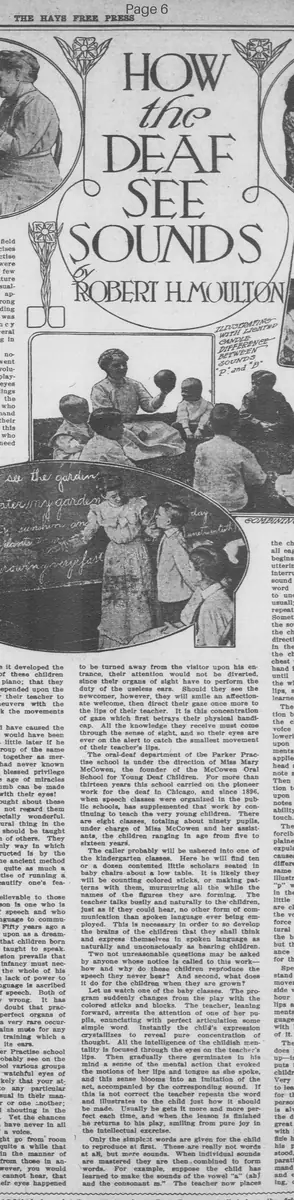
The oral-deaf department of the Parker Practice school is under the direction of Miss Mary McCowen, the founder of the McCowen Oral School for Young Deaf Children. For more than thirteen years this school carried on the pioneer work for the deaf in Chicago, and since 1896, when speech classes were organized in the public schools, has supplemented that work by continuing to teach the very young children. There are eight classes, totaling about ninety pupils, under charge of Miss McCowen and her assistants, the children ranging in age from five to sixteen years.
The caller probably will be ushered into one of the kindergarten classes. Here he will find ten or a dozen contented little scholars seated in baby chairs about a low table. It is likely they will be counting colored sticks, or making patterns with them, murmuring all the while the names of the figures they are forming. The teacher talks busily and naturally to the children, just as if they could hear, no other form of communication than spoken language ever being employed. This is necessary in order to so develop the brains of the children that they shall think and express themselves in spoken language as naturally and unconsciously as hearing children.
Two not unreasonable questions may be asked by anyone whose notice is called to this work: how and why do these children reproduce the speech they never hear? And second, what does it do for the children when they are grown?
Let us watch one of the baby classes. The program suddenly changes from the play with the colored sticks and blocks. The teacher, leaning forward, arrests the attention of one of her pupils, enunciating with perfect articulation some simple word.
Instantly the child's expression crystallizes to reveal pure concentration of thought. All the intelligence of the childish mentality is focused through the eyes on the teacher's lips.
Then gradually there germinates in his mind a sense of the mental action that evoked the motions of her lips and tongue as she spoke, and this sense blooms into an imitation of the act, accompanied by the corresponding sound. If this is not correct the teacher repeats the word and illustrates to the child just how it should be made. Usually he gets it more and more perfect each time, and when the lesson is finished he returns to his play, smiling from pure joy in the intellectual exercise.
Only the simplest words are given for the child to reproduce at first. These are really not words at all, but mere sounds. When individual sounds are mastered they are then combined to form words. For example, suppose the child has learned to make the sounds of the vowel "a" (ah) and the consonant "m." The teacher now places
HOW
the
DEAF
SEE
SOUNDS
ROBERT MOULTON
ILLUSTRATING DIFFERENCE BETWEEN SOUNDS P and B
[Illustration or garbled text placeholder]
to be turned away from the visitor upon his entrance, their attention would not be diverted, since their organs of sight have to perform the duty of the useless ears.
Should they see the newcomer, however, they will smile an affectionate welcome, then direct their gaze once more to the lips of their teacher. It is this concentration of gaze which first betrays their physical handicap. All the knowledge they receive must come through the sense of sight, and so their eyes are ever on the alert to catch the smallest movement of their teacher's lips.
The oral-deaf department of the Parker Practice school is under the direction of Miss Mary McCowen, the founder of the McCowen Oral School for Young Deaf Children. For more than thirteen years this school carried on the pioneer work for the deaf in Chicago, and since 1896, when speech classes were organized in the public schools, has supplemented that work by continuing to teach the very young children. There are eight classes, totaling about ninety pupils, under charge of Miss McCowen and her assistants, the children ranging in age from five to sixteen years.
The caller probably will be ushered into one of the kindergarten classes. Here he will find ten or a dozen contented little scholars seated in baby chairs about a low table. It is likely they will be counting colored sticks, or making patterns with them, murmuring all the while the names of the figures they are forming. The teacher talks busily and naturally to the children, just as if they could hear, no other form of communication than spoken language ever being employed. This is necessary in order to so develop the brains of the children that they shall think and express themselves in spoken language as naturally and unconsciously as hearing children.
Two not unreasonable questions may be asked by anyone whose notice is called to this work: how and why do these children reproduce the speech they never hear? And second, what does it do for the children when they are grown?
Let us watch one of the baby classes. The program suddenly changes from the play with the colored sticks and blocks. The teacher, leaning forward, arrests the attention of one of her pupils, enunciating with perfect articulation some simple word.
Instantly the child's expression crystallizes to reveal pure concentration of thought. All the intelligence of the childish mentality is focused through the eyes on the teacher's lips.
Then gradually there germinates in his mind a sense of the mental action that evoked the motions of her lips and tongue as she spoke, and this sense blooms into an imitation of the act, accompanied by the corresponding sound. If this is not correct the teacher repeats the word and illustrates to the child just how it should be made. Usually he gets it more and more perfect each time, and when the lesson is finished he returns to his play, smiling from pure joy in the intellectual exercise.
Only the simplest words are given for the child to reproduce at first. These are really not words at all, but mere sounds. When individual sounds are mastered they are then combined to form words. For example, suppose the child has learned to make the sounds of the vowel "a" (ah) and the consonant "m." The teacher now places
What sub-type of article is it?
Curiosity
Medical Curiosity
What themes does it cover?
Recovery
Triumph
What keywords are associated?
Deaf Education
Oral Method
Lip Reading
Speech Imitation
Chicago School
Young Deaf Children
What entities or persons were involved?
Miss Mary Mccowen
Robert Moulton
Where did it happen?
Chicago, Parker Practice School, Mccowen Oral School
Story Details
Key Persons
Miss Mary Mccowen
Robert Moulton
Location
Chicago, Parker Practice School, Mccowen Oral School
Event Date
Since 1896, More Than Thirteen Years
Story Details
Deaf children in oral classes learn speech by watching teachers' lips, imitating sounds starting from simple vowels and consonants, developing natural spoken language through visual concentration and play-based lessons.