Thank you for visiting SNEWPapers!
Sign up free
Editorial
May 10, 1928
Watauga Democrat
Boone, Watauga County, North Carolina
What is this article about?
Editorial criticizes Section 10 of North Carolina's Turlington Act (Volstead Act) for allowing householders to store and serve liquor at home without charge, despite requiring illegal acquisition, and notes Supreme Court's ruling placing burden of proof on the accused. Argues this creates absurdity and privileges the elite while burdening the common class.
Clipping
OCR Quality
98%
Excellent
Full Text
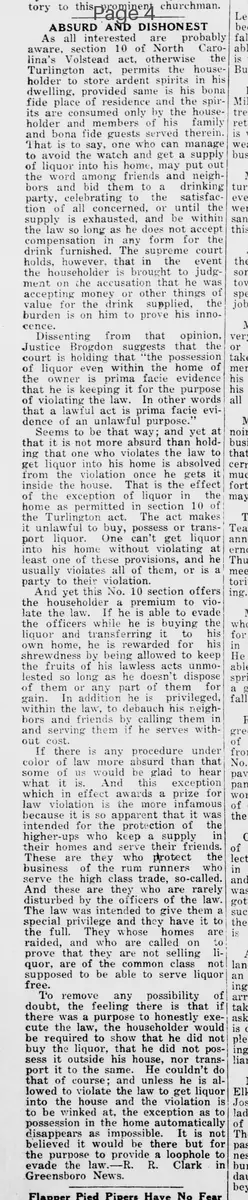
ABSURD AND DISHONEST
As all interested are probably aware, section 10 of North Carolina's Volstead act, otherwise the Turlington act, permits the householder to store ardent spirits in his dwelling, provided same is his bona fide place of residence and the spirits are consumed only by the householder and members of his family and bona fide guests served therein. That is to say, one who can manage to avoid the watch and get a supply of liquor into his home, may put out the word among friends and neighbors and bid them to a drinking party, celebrating to the satisfaction of all concerned, or until the supply is exhausted, and be within the law so long as he does not accept compensation in any form for the drink furnished. The supreme court holds, however, that in the event the householder is brought to judgment on the accusation that he was accepting money or other things of value for the drink supplied, the burden is on him to prove his innocence.
Dissenting from that opinion, Justice Brogden suggests that the court is holding that "the possession of liquor even within the home of the owner is prima facie evidence that he is keeping it for the purpose of violating the law. In other words that a lawful act is prima facie evidence of an unlawful purpose."
Seems to be that way; and yet at that it is not more absurd than holding that one who violates the law to get liquor into his home is absolved from the violation once he gets it inside the house. That is the effect of the exception of liquor in the home as permitted in section 10 of the Turlington act. The act makes it unlawful to buy, possess or transport liquor. One can't get liquor into his home without violating at least one of these provisions, and he usually violates all of them, or is a party to their violation.
And yet this No. 10 section offers the householder a premium to violate the law. If he is able to evade the officers while he is buying the liquor and transferring it to his own home, he is rewarded for his shrewdness by being allowed to keep the fruits of his lawless acts unmolested so long as he doesn't dispose of them or any part of them for gain. In addition he is privileged, within the law, to debauch his neighbors and friends by calling them in and serving them if he serves without cost.
If there is any procedure under color of law more absurd than that some of us would be glad to hear what it is. And this exception which in effect awards a prize for law violation is the more infamous because it is so apparent that it was intended for the protection of the higher-ups who keep a supply in their homes and serve their friends. These are they who protect the business of the rum runners who serve the high class trade, so-called. And these are they who are rarely disturbed by the officers of the law. The law was intended to give them a special privilege and they have it to the full. They whose homes are raided, and who are called on to prove that they are not selling liquor, are of the common class not supposed to be able to serve liquor free.
To remove any possibility of doubt, the feeling there is that if there was a purpose to honestly execute the law, the householder would be required to show that he did not buy the liquor, that he did not possess it outside his house, nor transport it to the same. He couldn't do that of course; and unless he is allowed to violate the law to get liquor into the house and the violation is to be winked at, the exception as to possession in the home automatically disappears as impossible. It is not believed it would be there but for the purpose to provide a loophole to evade the law.—R. R. Clark in Greensboro News.
As all interested are probably aware, section 10 of North Carolina's Volstead act, otherwise the Turlington act, permits the householder to store ardent spirits in his dwelling, provided same is his bona fide place of residence and the spirits are consumed only by the householder and members of his family and bona fide guests served therein. That is to say, one who can manage to avoid the watch and get a supply of liquor into his home, may put out the word among friends and neighbors and bid them to a drinking party, celebrating to the satisfaction of all concerned, or until the supply is exhausted, and be within the law so long as he does not accept compensation in any form for the drink furnished. The supreme court holds, however, that in the event the householder is brought to judgment on the accusation that he was accepting money or other things of value for the drink supplied, the burden is on him to prove his innocence.
Dissenting from that opinion, Justice Brogden suggests that the court is holding that "the possession of liquor even within the home of the owner is prima facie evidence that he is keeping it for the purpose of violating the law. In other words that a lawful act is prima facie evidence of an unlawful purpose."
Seems to be that way; and yet at that it is not more absurd than holding that one who violates the law to get liquor into his home is absolved from the violation once he gets it inside the house. That is the effect of the exception of liquor in the home as permitted in section 10 of the Turlington act. The act makes it unlawful to buy, possess or transport liquor. One can't get liquor into his home without violating at least one of these provisions, and he usually violates all of them, or is a party to their violation.
And yet this No. 10 section offers the householder a premium to violate the law. If he is able to evade the officers while he is buying the liquor and transferring it to his own home, he is rewarded for his shrewdness by being allowed to keep the fruits of his lawless acts unmolested so long as he doesn't dispose of them or any part of them for gain. In addition he is privileged, within the law, to debauch his neighbors and friends by calling them in and serving them if he serves without cost.
If there is any procedure under color of law more absurd than that some of us would be glad to hear what it is. And this exception which in effect awards a prize for law violation is the more infamous because it is so apparent that it was intended for the protection of the higher-ups who keep a supply in their homes and serve their friends. These are they who protect the business of the rum runners who serve the high class trade, so-called. And these are they who are rarely disturbed by the officers of the law. The law was intended to give them a special privilege and they have it to the full. They whose homes are raided, and who are called on to prove that they are not selling liquor, are of the common class not supposed to be able to serve liquor free.
To remove any possibility of doubt, the feeling there is that if there was a purpose to honestly execute the law, the householder would be required to show that he did not buy the liquor, that he did not possess it outside his house, nor transport it to the same. He couldn't do that of course; and unless he is allowed to violate the law to get liquor into the house and the violation is to be winked at, the exception as to possession in the home automatically disappears as impossible. It is not believed it would be there but for the purpose to provide a loophole to evade the law.—R. R. Clark in Greensboro News.
What sub-type of article is it?
Temperance
Legal Reform
Crime Or Punishment
What keywords are associated?
Turlington Act
Volstead Act
Home Possession
Liquor Laws
Prohibition Enforcement
Supreme Court Ruling
Justice Brogden
Rum Runners
What entities or persons were involved?
Justice Brogden
Supreme Court
R. R. Clark
Higher Ups
Rum Runners
Greensboro News
Editorial Details
Primary Topic
Critique Of Section 10 Of North Carolina's Turlington Act On Home Liquor Possession
Stance / Tone
Strongly Critical Of Legal Absurdity And Class Bias In Prohibition Enforcement
Key Figures
Justice Brogden
Supreme Court
R. R. Clark
Higher Ups
Rum Runners
Greensboro News
Key Arguments
Section 10 Permits Home Storage And Serving Of Liquor To Family And Guests Without Compensation, But Acquisition Requires Violating Buy/Possess/Transport Laws.
Supreme Court Places Burden On Householder To Prove Innocence If Accused Of Selling.
Law Rewards Illegal Acquisition By Allowing Possession Once Inside Home.
Provision Protects Elite Who Serve High Class Trade, While Common People Face Raids And Proof Burdens.
Exception Creates Loophole For Evasion, Intended To Privilege The Wealthy.
True Enforcement Would Require Proving Legal Acquisition, Which Is Impossible.