Thank you for visiting SNEWPapers!
Sign up free
The New York Packet
New York, New York County, New York
What is this article about?
Biographical account of Comte de Vergennes, France's Prime Minister, detailing his family background, diplomatic career under mentors like Chavigny and Maurepas, key negotiations in Constantinople, Stockholm, and as Foreign Minister, including roles in American Revolution alliances, peace efforts, and commercial treaties.
Merged-components note: Image at reading order 27 overlaps spatially with the foreign news article at reading order 28.
Clipping
OCR Quality
Full Text
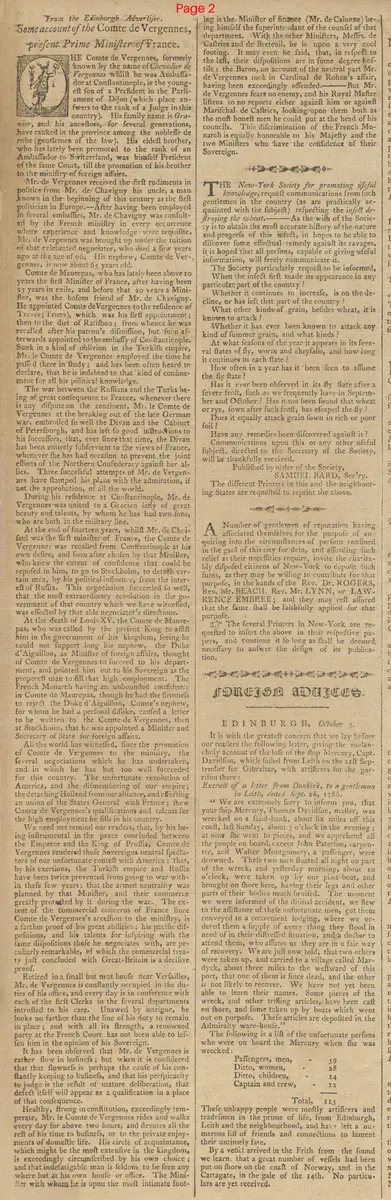
Some account of the Comte de Vergennes, present Prime Minister of France.
The Comte de Vergennes, formerly known by the name of Chevalier de Vergennes while he was Ambassador at Constantinople, is the youngest son of a President in the Parliament of Dijon (which place answers to the rank of a Judge in this country). His family name is Gravier, and his ancestors, for several generations, have ranked in the province among the noblest de robe (gentlemen of the law). His elder brother, who has lately been promoted to the rank of an Ambassador to Switzerland, was himself President of the same Court, till the promotion of his brother to the ministry of foreign affairs.
Mr. de Vergennes received the first rudiments in politics from Mr. de Chavigny his uncle, a man known in the beginning of this century as the first politician in Europe. After having been employed in several embassies, Mr. de Chavigny was consulted by the French ministry in every occurrence where experience and knowledge were requisite.
Mr. de Vergennes was brought up under the tuition of that celebrated negotiator, who died a few years ago at the age of 96. His nephew, Comte de Vergennes, is now about 65 years old.
Comte de Maurepas, who has lately been above 70 years the first Minister of France, after having been 25 years in exile, and before that 20 years a Minister, was the bosom friend of Mr. de Chavigny.
He appointed Comte de Vergennes to the residence of Treves (Triers), which was his first appointment; then to the diet of Ratisbon: from whence he was recalled after his patron's dismission, but soon afterwards appointed to the embassy of Constantinople.
Sunk in a kind of oblivion in the Turkish empire, Mr. le Comte de Vergennes employed the time he passed there in study; and has been often heard to declare, that he is indebted to that kind of confinement for all his political knowledge.
The war between the Russians and the Turks being of great consequence to France, whenever there is any dispute on the continent, Mr. le Comte de Vergennes at the breaking out of the late German war, embroiled so well the Divan and the Cabinet of Petersburg, and has left so good instructions to his successors, that, ever since that time, the Divan has been entirely subservient to the views of France, whenever she has had occasion to prevent the joint efforts of the Northern Confederacy against her allies. Three successful attempts of Mr. de Vergennes have stamped his plans with the admiration, if not the approbation, of all the world.
During his residence at Constantinople, Mr. de Vergennes was united to a Grecian lady of great beauty and talents, by whom he has had two sons, who are both in the military line.
At the end of fourteen years, whilst Mr. de Choiseul was the first minister of France, the Comte de Vergennes was recalled from Constantinople at his own desire, and soon after chosen by that Minister, who knew the extent of confidence that could be reposed in him, to go to Stockholm, to detach certain men, by his political influence, from the interest of Russia. This negotiation succeeded so well, that the most extraordinary revolution in the government of that country which we have witnessed, was effected by that able negotiator's directions.
At the death of Louis XV. the Comte de Maurepas, who was called by the present King to assist him in the government of his kingdom, seeing he could not support long his nephew, the Duke d'Aiguillon, as Minister of foreign affairs, thought of Comte de Vergennes to succeed to his department, and pointed him out to his Sovereign as the properest man to fill that high employment. The French Monarch having an unbounded confidence in Comte de Maurepas, though he had the firmness to reject the Duke d'Aiguillon, Comte's nephew, for whom he had a personal dislike, caused a letter to be written to the Comte de Vergennes, then at Stockholm, that he was appointed a Minister and Secretary of State for foreign affairs.
All the world has witnessed, since the promotion of Comte de Vergennes to the ministry, the several negotiations which he has undertaken, and in which he has but too well succeeded for this country. The unfortunate revolution of America, and the dismembering of our empire; the detaching Holland from our alliance, and effecting an union of the States General with France; show Comte de Vergennes's qualifications and talents for the high employment he fills in his country.
We need not remind our readers, that, by his being instrumental in the peace concluded between the Emperor and the King of Prussia, Comte de Vergennes rendered those Sovereigns neutral protectors of our unfortunate contest with America; that, by his exertions, the Turkish empire and Russia have been twice prevented from going to war within these few years; that the armed neutrality was planned by that Minister, and their commerce greatly protected by it during the war. The extent of the commercial concerns of France since Comte de Vergennes's accession to the ministry, is a farther proof of his great abilities; his pacific dispositions, and his talents for inspiring with the same dispositions those he negotiates with, are peculiarly remarkable, of which the commercial treaty just concluded with Great-Britain is a decisive proof.
Retired in a small but neat house near Versailles, Mr. de Vergennes is constantly occupied in the duties of his office, and every day is in conference with each of the first Clerks in the several departments intrusted to his care. Unawed by intrigue, he looks no farther than the line of his duty to remain in place; and with all its strength, a renowned party at the French Court has not been able to lessen him in the opinion of his Sovereign.
It has been observed that Mr. de Vergennes is rather slow in business; but when it is considered that that slowness is perhaps the cause of his constantly keeping to business, and that his perspicacity to judge is the result of mature deliberation, that defect itself will appear as a qualification in a place of that consequence.
Healthy, strong in constitution, exceedingly temperate, Mr. le Comte de Vergennes rides and walks every day for above two hours, and devotes all the rest of his time to business, or to the private enjoyments of domestic life. His circle of acquaintance, which might be the most extensive in the kingdom, is exceedingly circumscribed by his own choice; and that indefatigable man is seldom to be seen anywhere but at his own house or office. The Minister with whom he is upon the most intimate footing is the Minister of finance (Mr. de Calonne) being himself the superintendent of the council of that department. With the other Ministers, Messrs. de Castries and de Breteuil, he is upon a very cool footing. It may even be said, that, in respect to the last, their dispositions are in some degree hostile; the Baron, on account of the neutral part Mr. de Vergennes took in Cardinal de Rohan's affair, having been exceedingly offended.
But Mr. de Vergennes fears no enemy, and his Royal Master listens to no reports either against him or against Marshal de Castries, looking upon them both as the most honest men he could put at the head of his councils. This discrimination of the French Monarch is equally honorable to his Majesty and the two Ministers who have the confidence of their Sovereign.
What sub-type of article is it?
What keywords are associated?
What entities or persons were involved?
Where did it happen?
Foreign News Details
Primary Location
France
Key Persons
Outcome
successful diplomatic negotiations including influencing ottoman empire, swedish revolution, american alliances, preventing russo-turkish wars, armed neutrality, and commercial treaty with britain; maintained position despite court intrigues.
Event Details
Biographical sketch of Comte de Vergennes, youngest son of a Dijon parliament president, trained in politics by uncle Chavigny, appointed to diplomatic posts by Maurepas including Triers, Ratisbon, Constantinople (14 years, studied politics, married Grecian lady, two sons in military), Stockholm (engineered government revolution against Russian influence), and as Foreign Minister under Louis XVI, handling key negotiations on American Revolution, Dutch alliance, Prussian-Austrian peace, Ottoman-Russian tensions, armed neutrality, and Anglo-French trade.