Thank you for visiting SNEWPapers!
Sign up free
Letter to Editor
November 6, 1862
The Weekly Lancaster Gazette
Lancaster, Fairfield County, Ohio
What is this article about?
A letter from a soldier in the 46th Ohio Regiment, dated Oct. 25, 1862, from Memphis, Tennessee, describes a military expedition against guerrillas on the Arkansas side, including property destruction on plantations and reflections on the ethical challenges of such duties during the Civil War.
Clipping
OCR Quality
92%
Excellent
Full Text
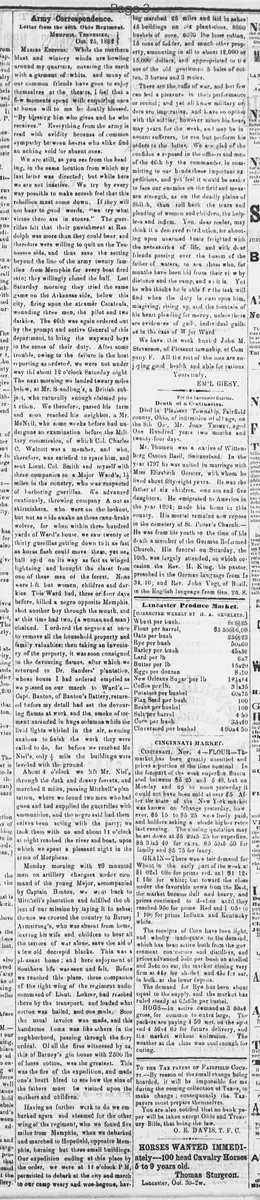
Army Correspondence.
Letter from the 46th Ohio Regiment,
Memphis, Tennessee,
Oct. 25, 1862.
Messrs. Editors: While the northern
blast and wintry winds are howling
around my quarters, covering the earth
with a garment of white, and many of
our common friends have gone to enjoy
themselves at the theatre, I feel that a
few moments spent with enquiring ones
at home will to me be doubly blessed
"By blessing him who gives and he who
receives." Everything from the army is
read with avidity because of common
sympathy between hearts who alike find
an aching void for absent ones.
We are still, as you see from the heading,
in the same location from which my
last letter was directed; but while here
we are not inactive. We try by every
way possible to make secesh feel that this
rebellion must come down. If they will
not hear to good words, "we try what
virtue there are in stones." The guerrillas
felt that their punishment at Randolph
was more than they could bear, and
therefore were willing to quit on the Tennessee
side, and thus save the setting
beyond the line of the army twenty families
from Memphis for every boat fired
into; they willingly closed the ball. Last
Saturday morning they tried the same
game on the Arkansas side, below this
city, firing upon the steamer Catalina
wounding three men, the pilot and two
darkies. The 46th was again ordered out
by the prompt and active General of this
department, to bring the wayward boys
to the sense of their duty. After some
trouble, owing to the failure in the boat
reporting as ordered, we were not under
way till about 12 o'clock Saturday night.
The next morning we landed twenty miles
below, at Mr. Sandling's, a British subject,
who naturally enough claimed protection.
We therefore passed his farm
and soon reached his neighbor, a Mr.
McNeil, who some weeks before had undergone
an examination before the Military
commission, of which Col. Charles
C. Walcott was a member, and who,
therefore, was satisfied to spare him, and
sent Lieut. Col. Smith and myself with
three companies to a Major Ward's, 11
miles in the country, who was suspected
of harboring guerrillas. We advanced
cautiously, throwing company A out as
skirmishers, who were on the lookout,
but not as wide awake as these cane-brake
wolves, for when within three hundred
yards of Ward's house, we saw twenty or
thirty guerrillas getting down to it as fast
as horse flesh could move them, yet one
ball sped on its way as fast as winged
lightning and brought the claret from
one of these men of the forest. None
were left but women, children and darkies.
This Ward had, three or four days
before, killed a negro opposite Memphis,
shot another boy through the mouth, and
at this time had two, (a woman and man)
chained. I ordered the negroes at once
to remove all the household property and
family valuables: then taking an inventory
of the property, it was soon consigned
to the devouring flames, after which we
returned to Dr. Sanders' plantation,
whose house I had ordered emptied as
we passed on our march to Ward's.—
Capt. Banton, of Banton's Battery, returned
before my detail had set the devouring
flames at work and the smoke of torment
ascended in huge columns while the
livid lights whirled in the air, seeming
anxious to finish the work they were
called to do, for before we reached McNeil's,
only a mile the buildings were
leveled with the ground.
About 4 o'clock we left Mr. Neil's,
through the dark and dreary forests, and
marched 8 miles, passing Mitchell's plantation,
where we found two men who had
guns and had supplied the guerrillas with
ammunition, and the negro said had themselves
been acting with the party; we
took them with us and about 11 o'clock
at night reached the river and boat, upon
which we spent a pleasant night in the
arms of Morpheus.
Monday morning with 20 mounted
men on artillery chargers under command
of the young Major, accompanied
by Captain Banton, we went back to
Mitchell's plantation and fulfilled the object
of our mission by laying it in ashes;
thence we crossed the country to Barnes
Armstrong's, who was absent from home
leaving his wife and children to bear all
the terrors of war alone, save the aid
a few old decrepit blacks. This was
pleasant home; and here enjoyment of
Southern life was seen and felt. Before
we reached this place, three companies
of the right wing of the regiment under
command of Lieut. Lohrer, had reached
there by the transport, and loaded what
cotton was baled, and got mule. Soon
the usual invoice was made, and this
handsome home was like others in the
neighborhood, passing through the fiery
ordeal. Of all the fires witnessed by us,
this of Barney's gin house with 2500 lbs
of loose cotton, was the greatest. This
was the fire of the expedition, and made
one's heart bleed to see how the sins of
the fathers must be visited upon the
mothers and children.
Having no further work to do we embarked
again and steamed for the other
wing of the regiment, who we found five
miles from Memphis, when we debarked
and marched to Hopefield, opposite Memphis,
burning but three small buildings.
Our expedition ending at this place by
order, we were at 11 o'clock P.M.
permitted to debark at the city and march
to our camp weary and woe-begone, having
marched 25 miles and laid in ashes
45 buildings on six plantations, 8000
bushels of corn, 6500 lbs loose cotton,
15 tons of fodder, and much other property,
amounting in all to about $12,000 or
$15,000 dollars, and appropriated to the
use of the old gentleman 5 bales of cotton,
3 horses and 3 mules.
There are the rubs of war, and but few
can feel a pleasure in their performance
or recital; and yet all know military orders
are imperative, and leave no option
with the soldier, however much his heart
may yearn for the weak, and may be innocent
sufferers, he can but perform his
orders to the letter. We are glad of the
confidence reposed in the officers and men
of the 46th by the commander, in committing
to our hands these important expeditions,
and yet feel it would be easier
to face our enemies on the field and measure
strength, as on the deadly plains of
Shiloh, than roll back the tears and
pleading of women and children, the helpless
and infirm. You, dear reader, may
think it a deserved retribution, for shooting
upon unarmed boats freighted with
the necessaries of life, and with dear
friends passing over the bosom of the
father of waters, to see those who, for
months have been hid from their view by
distance and the camp, and so it is. Yet
he who thinks he is able for the task will
find when the duty is cast upon him,
misgiving, rising up, and the fountain of
his heart pleading for mercy, unless those
are evidences of guilt, individual guilt
as in the case of Major Ward.
We have this week buried John M.
Stevenson, of Pleasant township, of Company
F. All the rest of the men are enjoying
good health and able for duty.
Yours truly,
EM'L GIESY.
Letter from the 46th Ohio Regiment,
Memphis, Tennessee,
Oct. 25, 1862.
Messrs. Editors: While the northern
blast and wintry winds are howling
around my quarters, covering the earth
with a garment of white, and many of
our common friends have gone to enjoy
themselves at the theatre, I feel that a
few moments spent with enquiring ones
at home will to me be doubly blessed
"By blessing him who gives and he who
receives." Everything from the army is
read with avidity because of common
sympathy between hearts who alike find
an aching void for absent ones.
We are still, as you see from the heading,
in the same location from which my
last letter was directed; but while here
we are not inactive. We try by every
way possible to make secesh feel that this
rebellion must come down. If they will
not hear to good words, "we try what
virtue there are in stones." The guerrillas
felt that their punishment at Randolph
was more than they could bear, and
therefore were willing to quit on the Tennessee
side, and thus save the setting
beyond the line of the army twenty families
from Memphis for every boat fired
into; they willingly closed the ball. Last
Saturday morning they tried the same
game on the Arkansas side, below this
city, firing upon the steamer Catalina
wounding three men, the pilot and two
darkies. The 46th was again ordered out
by the prompt and active General of this
department, to bring the wayward boys
to the sense of their duty. After some
trouble, owing to the failure in the boat
reporting as ordered, we were not under
way till about 12 o'clock Saturday night.
The next morning we landed twenty miles
below, at Mr. Sandling's, a British subject,
who naturally enough claimed protection.
We therefore passed his farm
and soon reached his neighbor, a Mr.
McNeil, who some weeks before had undergone
an examination before the Military
commission, of which Col. Charles
C. Walcott was a member, and who,
therefore, was satisfied to spare him, and
sent Lieut. Col. Smith and myself with
three companies to a Major Ward's, 11
miles in the country, who was suspected
of harboring guerrillas. We advanced
cautiously, throwing company A out as
skirmishers, who were on the lookout,
but not as wide awake as these cane-brake
wolves, for when within three hundred
yards of Ward's house, we saw twenty or
thirty guerrillas getting down to it as fast
as horse flesh could move them, yet one
ball sped on its way as fast as winged
lightning and brought the claret from
one of these men of the forest. None
were left but women, children and darkies.
This Ward had, three or four days
before, killed a negro opposite Memphis,
shot another boy through the mouth, and
at this time had two, (a woman and man)
chained. I ordered the negroes at once
to remove all the household property and
family valuables: then taking an inventory
of the property, it was soon consigned
to the devouring flames, after which we
returned to Dr. Sanders' plantation,
whose house I had ordered emptied as
we passed on our march to Ward's.—
Capt. Banton, of Banton's Battery, returned
before my detail had set the devouring
flames at work and the smoke of torment
ascended in huge columns while the
livid lights whirled in the air, seeming
anxious to finish the work they were
called to do, for before we reached McNeil's,
only a mile the buildings were
leveled with the ground.
About 4 o'clock we left Mr. Neil's,
through the dark and dreary forests, and
marched 8 miles, passing Mitchell's plantation,
where we found two men who had
guns and had supplied the guerrillas with
ammunition, and the negro said had themselves
been acting with the party; we
took them with us and about 11 o'clock
at night reached the river and boat, upon
which we spent a pleasant night in the
arms of Morpheus.
Monday morning with 20 mounted
men on artillery chargers under command
of the young Major, accompanied
by Captain Banton, we went back to
Mitchell's plantation and fulfilled the object
of our mission by laying it in ashes;
thence we crossed the country to Barnes
Armstrong's, who was absent from home
leaving his wife and children to bear all
the terrors of war alone, save the aid
a few old decrepit blacks. This was
pleasant home; and here enjoyment of
Southern life was seen and felt. Before
we reached this place, three companies
of the right wing of the regiment under
command of Lieut. Lohrer, had reached
there by the transport, and loaded what
cotton was baled, and got mule. Soon
the usual invoice was made, and this
handsome home was like others in the
neighborhood, passing through the fiery
ordeal. Of all the fires witnessed by us,
this of Barney's gin house with 2500 lbs
of loose cotton, was the greatest. This
was the fire of the expedition, and made
one's heart bleed to see how the sins of
the fathers must be visited upon the
mothers and children.
Having no further work to do we embarked
again and steamed for the other
wing of the regiment, who we found five
miles from Memphis, when we debarked
and marched to Hopefield, opposite Memphis,
burning but three small buildings.
Our expedition ending at this place by
order, we were at 11 o'clock P.M.
permitted to debark at the city and march
to our camp weary and woe-begone, having
marched 25 miles and laid in ashes
45 buildings on six plantations, 8000
bushels of corn, 6500 lbs loose cotton,
15 tons of fodder, and much other property,
amounting in all to about $12,000 or
$15,000 dollars, and appropriated to the
use of the old gentleman 5 bales of cotton,
3 horses and 3 mules.
There are the rubs of war, and but few
can feel a pleasure in their performance
or recital; and yet all know military orders
are imperative, and leave no option
with the soldier, however much his heart
may yearn for the weak, and may be innocent
sufferers, he can but perform his
orders to the letter. We are glad of the
confidence reposed in the officers and men
of the 46th by the commander, in committing
to our hands these important expeditions,
and yet feel it would be easier
to face our enemies on the field and measure
strength, as on the deadly plains of
Shiloh, than roll back the tears and
pleading of women and children, the helpless
and infirm. You, dear reader, may
think it a deserved retribution, for shooting
upon unarmed boats freighted with
the necessaries of life, and with dear
friends passing over the bosom of the
father of waters, to see those who, for
months have been hid from their view by
distance and the camp, and so it is. Yet
he who thinks he is able for the task will
find when the duty is cast upon him,
misgiving, rising up, and the fountain of
his heart pleading for mercy, unless those
are evidences of guilt, individual guilt
as in the case of Major Ward.
We have this week buried John M.
Stevenson, of Pleasant township, of Company
F. All the rest of the men are enjoying
good health and able for duty.
Yours truly,
EM'L GIESY.
What sub-type of article is it?
Informative
Historical
Reflective
What themes does it cover?
Military War
Morality
What keywords are associated?
Civil War
46th Ohio Regiment
Guerrillas
Memphis Tennessee
Property Destruction
Military Expedition
Arkansas Side
Plantation Burning
What entities or persons were involved?
Em'l Giesy
Messrs. Editors
Letter to Editor Details
Author
Em'l Giesy
Recipient
Messrs. Editors
Main Argument
the letter reports on a military expedition by the 46th ohio regiment to punish guerrillas for attacking steamboats by destroying rebel properties and reflects on the moral difficulties of inflicting hardship on civilians while following orders.
Notable Details
Expedition To Arkansas Side Below Memphis
Destruction Of Major Ward's Property Due To Harboring Guerrillas And Mistreatment Of Negroes
Burning Of Plantations Including Mitchell's, Barnes Armstrong's, And Others
Total Destruction: 45 Buildings, 8000 Bushels Corn, 6500 Lbs Cotton, Etc., Valued At $12,000 $15,000
Reference To Battle Of Shiloh
Burial Of John M. Stevenson Of Company F