Thank you for visiting SNEWPapers!
Sign up free
The Wilmington Morning Star
Wilmington, New Hanover County, North Carolina
What is this article about?
Wilmington City Council appoints Lt. Hubert Hayes as police chief succeeding retired Charles H. Casteen, amid department morale issues from arrests and a suicide. Hayes, a 15-year veteran, is praised for experience; biographical sketch included.
Merged-components note: Continuation of Officer Spotlighted story from page 1 to page 2.
Clippings
1 of 2
OCR Quality
Full Text
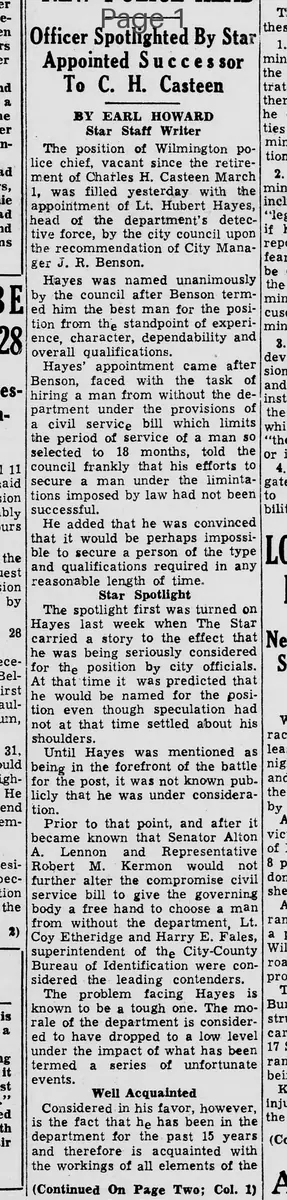
BY EARL HOWARD Star Staff Writer
The position of Wilmington police chief, vacant since the retirement of Charles H. Casteen March 1, was filled yesterday with the appointment of Lt. Hubert Hayes, head of the department's detective force, by the city council upon the recommendation of City Manager J. R. Benson.
Hayes was named unanimously by the council after Benson termed him the best man for the position from the standpoint of experience, character, dependability and overall qualifications.
Hayes' appointment came after Benson, faced with the task of hiring a man from without the department under the provisions of a civil service bill which limits the period of service of a man so selected to 18 months, told the council frankly that his efforts to secure a man under the limitations imposed by law had not been successful.
He added that he was convinced that it would be perhaps impossible to secure a person of the type and qualifications required in any reasonable length of time.
Star Spotlight
The spotlight first was turned on Hayes last week when The Star carried a story to the effect that he was being seriously considered for the position by city officials.
At that time it was predicted that he would be named for the position even though speculation had not at that time settled about his shoulders.
Until Hayes was mentioned as being in the forefront of the battle for the post, it was not known publicly that he was under consideration.
Prior to that point, and after it became known that Senator Alton A. Lennon and Representative Robert M. Kermon would not further alter the compromise civil service bill to give the governing body a free hand to choose a man from without the department, Lt. Coy Etheridge and Harry E. Fales, superintendent of the City-County Bureau of Identification were considered the leading contenders.
The problem facing Hayes is known to be a tough one. The morale of the department is considered to have dropped to a low level under the impact of what has been termed a series of unfortunate events.
Well Acquainted
Considered in his favor, however, is the fact that he has been in the department for the past 15 years and therefore is acquainted with the workings of all elements of the (Continued On Page Two; Col. 1)
HAYES
(Continued From Page One)
force he now commands. This, coupled with the fact that he is considered one of the best liked men on the force, is expected to stand him in good stead in his task of restoring the morale of the department's personnel. That Hayes faces a hard job is evidenced by Benson's remarks to the council at yesterday's session.
He pointed out that "there is a considerable unrest and lack of general coordination of effort in the police department and I think any further delay in making the appointment of a chief of police is unwise and not to the best interest of law enforcement in our city."
Decline in Morale
The decline in morale of the department started with the arrest of two officers on charges of breaking and entering and was climaxed by the death of Sgt. Phil J. Parish at his own hand.
Parish had been named to succeed Casteen and his confirmation was delayed by the civil service commission since he was in a local hospital when the matter was taken under consideration by the commission.
Named by the council yesterday to succeed Hayes as head of the detective force with the rank of lieutenant was Sgt. L. A. Teague.
He is a native of Randolph county and a member of the department since December 18, 1929. He is the father of three children.
Hayes, 51 years of age, is a native of Sampson county and a graduate of State high school in Salemburg.
After service overseas in World War I, he went to work with the Atlantic Coast Line Railway and held the position of car inspector at the time he resigned to join the police force here.
Hayes married the former Sarah Margaret Spell in 1920 and they are the parents of three children, Mrs. Liletha Crabtree of Wilmington, Vennon, a student at the University of North Carolina, and Joyce, who resides with her parents.
Hayes is a member of the Southside Baptist church and the American Legion.
What sub-type of article is it?
What themes does it cover?
What keywords are associated?
What entities or persons were involved?
Where did it happen?
Story Details
Key Persons
Location
Wilmington
Story Details
Lt. Hubert Hayes, head of the detective force, is appointed Wilmington police chief by the city council on recommendation of City Manager J. R. Benson, succeeding Charles H. Casteen who retired March 1. Hayes, spotlighted by The Star, is chosen over external candidates due to civil service limitations. He faces challenges in restoring low department morale after arrests and a suicide. Sgt. L. A. Teague succeeds Hayes as detective lieutenant. Biographical details on Hayes provided.