Thank you for visiting SNEWPapers!
Sign up free
Letter to Editor
June 1, 1802
The Kentucky Gazette
Lexington, Fayette County, Kentucky
What is this article about?
A letter to S. L. A. argues that studying Latin and Greek languages offers little benefit compared to sciences and modern studies, wasting youth's time and genius better applied elsewhere. It critiques their necessity for understanding English or other knowledge, citing authorities like Sheridan and Johnson. Signed Philanthropist.
Clipping
OCR Quality
98%
Excellent
Full Text
To S. L. A.
Sir,
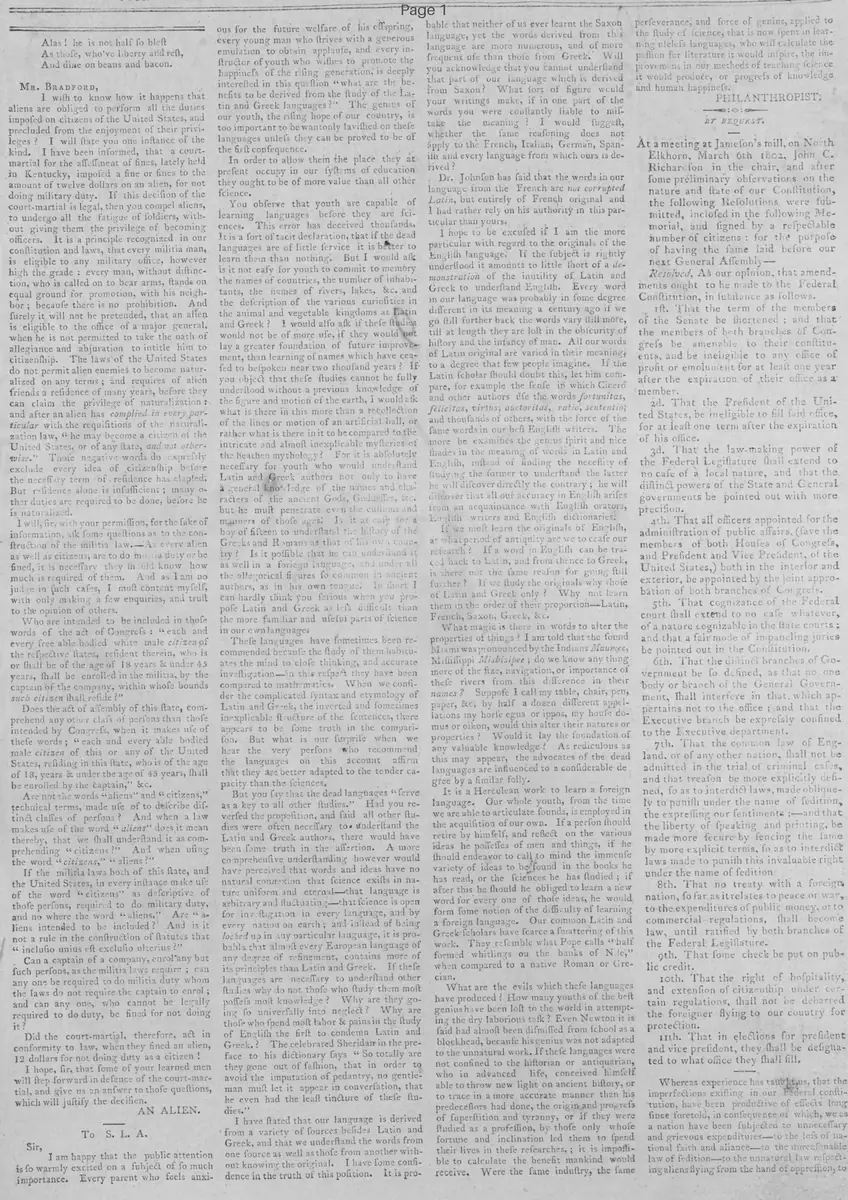
I am happy that the public attention is so warmly excited on a subject of so much importance. Every parent who feels anxious for the future welfare of his offspring, every young man who strives with a generous emulation to obtain applause, and every instructor of youth who wishes to promote the happiness of the rising generation, is deeply interested in this question "what are the benefits to be derived from the study of the Latin and Greek languages?" The genius of our youth, the rising hope of our country, is too important to be wantonly lavished on these languages unless they can be proved to be of the first consequence.
In order to allow them the place they at present occupy in our systems of education they ought to be of more value than all other science.
You observe that youth are capable of learning languages before they are sciences. This error has deceived thousands. It is a sort of tacit declaration, that if the dead languages are of little service it is better to learn them than nothing. But I would ask is it not easy for youth to commit to memory the names of countries, the number of inhabitants, the names of rivers, lakes, &c. and the description of the various curiosities in the animal and vegetable kingdoms as Latin and Greek? I would also ask if these studies would not be of more use, if they would not lay a greater foundation of future improvement, than learning of names which have ceased to be spoken near two thousand years? If you object that these studies cannot be fully understood without a previous knowledge of the figure and motion of the earth, I would ask what is there in this more than a recollection of the lines or motion of an artificial ball, or rather what is there in it to be compared to the intricate and almost inexplicable mysteries of the heathen mythology? For it is absolutely necessary for youth who would understand Latin and Greek authors not only to have a general knowledge of the names and characters of the ancient Gods, Goddesses, &c. but he must penetrate even the customs and manners of those ages: Is it as easy for a boy of fifteen to understand the history of the Greeks and Romans as that of his own country? Is it possible that he can understand it as well in a foreign language, and under all the allegorical figures so common in ancient authors, as in his own tongue. In short I can hardly think you serious when you propose Latin and Greek as less difficult than the more familiar and useful parts of science in our own language.
These languages have sometimes been recommended because the study of them habituates the mind to close thinking, and accurate investigation--in this respect they have been compared to mathematics. When we consider the complicated syntax and etymology of Latin and Greek, the inverted and sometimes inexplicable structure of the sentences, there appears to be some truth in the comparison. But what is our surprise when we hear the very persons who recommend the languages on this account affirm that they are better adapted to the tender capacity than the sciences.
But you say that the dead languages "serve as a key to all other studies." Had you reversed the proposition, and said all other studies were often necessary to understand the Latin and Greek authors, there would have been some truth in the assertion. A more comprehensive understanding however would have perceived that words and ideas have no natural connexion that science exists in nature uniform and eternal--that language is arbitrary and fluctuating--that science is open for investigation in every language, and by every nation on earth; and instead of being locked up in any particular language, it is probable that almost every European language of any degree of refinement, contains more of its principles than Latin and Greek. If these languages are necessary to understand other studies why do not those who study them most possess most knowledge? Why are they going so universally into neglect? Why are those who spend most labor & pains in the study of English the first to condemn Latin and Greek.? The celebrated Sheridan in the preface to his dictionary says "So totally are they gone out of fashion, that in order to avoid the imputation of pedantry, no gentleman must let it appear in conversation, that he even had the least tincture of these studies."
I have stated that our language is derived from a variety of sources besides Latin and Greek, and that we understand the words from one source as well as those from another without knowing the original. I have some confidence in the truth of this position. It is probable that neither of us ever learnt the Saxon language, yet the words derived from this language are more numerous, and of more frequent use than those from Greek. Will you acknowledge that you cannot understand that part of our language which is derived from Saxon? What sort of figure would your writings make, if in one part of the words you were constantly liable to mistake the meaning? I would suggest, whether the same reasoning does not apply to the French, Italian, German, Spanish and every language from which ours is derived?
Dr. Johnson has said that the words in our language from the French are not corrupted Latin, but entirely of French original and I had rather rely on his authority in this particular than yours.
I hope to be excused if I am the more particular with regard to the originals of the English language. If the subject is rightly understood it amounts to little short of a demonstration of the inutility of Latin and Greek to understand English. Every word in our language was probably in some degree different in its meaning a century ago if we go still further back the words vary still more, till at length they are lost in the obscurity of history and the infancy of man. All our words of Latin original are varied in their meanings to a degree that few people imagine. If the Latin scholar should doubt this, let him compare, for example the sense in which Cicero and other authors use the words fortunitas, felicitas, virtus, auctoritas, ratio, sententia; and thousands of others, with the force of the same words in our best English writers. The more he examines the genius spirit and nice shades in the meaning of words in Latin and English, instead of finding the necessity of studying the former to understand the latter he will discover directly the contrary; he will discover that all our accuracy in English arises from an acquaintance with English orators, English writers and English dictionaries.
If we must learn the originals of English, at what period of antiquity are we to cease our research? If a word in English can be traced back to Latin, and from thence to Greek, is there not the same reason for going still further? If we study the originals why those of Latin and Greek only? Why not learn them in the order of their proportion Latin, French, Saxon, Greek, &c.
What magic is there in words to alter the properties of things? I am told that the sound Miami was pronounced by the Indians Maumee, Mississippi Misisipi; do we know any thing more of the size, navigation, or importance of these rivers from this difference in their names? Suppose I call my table, chair, pen, paper, &c, by half a dozen different appellations my horse equus or ippos, my house domus or oikon, would this alter their natures or properties? Would it lay the foundation of any valuable knowledge? As ridiculous as this may appear, the advocates of the dead languages are influenced to a considerable degree by a similar folly.
It is a Herculean work to learn a foreign language. Our whole youth, from the time we are able to articulate sounds, is employed in the acquisition of our own. If a person should retire by himself, and reflect on the various ideas he possesses of men and things, if he should endeavor to call to mind the immense variety of ideas to be found in the books he has read, or the sciences he has studied; if after this he should be obliged to learn a new word for every one of those ideas, he would form some notion of the difficulty of learning a foreign language. Our common Latin and Greek Scholars have scarce a smattering of this work. They resemble what Pope calls "half formed whifflings on the banks of Nile," when compared to a native Roman or Grecian.
What are the evils which these languages have produced? How many youths of the best genius have been lost to the world in attempting the dry laborious task? Even Newton it is said had almost been dismissed from school as a blockhead, because his genius was not adapted to the unnatural work. If these languages were not confined to the historian or antiquarian, who in advanced life, conceived himself able to throw new light on ancient history, or to trace in a more accurate manner than his predecessors had done, the origin and progress of superstition and tyranny, or if they were studied as a profession, by those only whose fortune and inclination led them to spend their lives in these researches, ; it is impossible to calculate the benefit mankind would receive. Were the same industry, the same perseverance, and force of genius, applied to the study of science, that is now spent in learning useless languages, who will calculate the passion for literature it would inspire, the improvement in our methods of teaching science it would produce, or progress of knowledge and human happiness.
PHILANTHROPIST.
Sir,
I am happy that the public attention is so warmly excited on a subject of so much importance. Every parent who feels anxious for the future welfare of his offspring, every young man who strives with a generous emulation to obtain applause, and every instructor of youth who wishes to promote the happiness of the rising generation, is deeply interested in this question "what are the benefits to be derived from the study of the Latin and Greek languages?" The genius of our youth, the rising hope of our country, is too important to be wantonly lavished on these languages unless they can be proved to be of the first consequence.
In order to allow them the place they at present occupy in our systems of education they ought to be of more value than all other science.
You observe that youth are capable of learning languages before they are sciences. This error has deceived thousands. It is a sort of tacit declaration, that if the dead languages are of little service it is better to learn them than nothing. But I would ask is it not easy for youth to commit to memory the names of countries, the number of inhabitants, the names of rivers, lakes, &c. and the description of the various curiosities in the animal and vegetable kingdoms as Latin and Greek? I would also ask if these studies would not be of more use, if they would not lay a greater foundation of future improvement, than learning of names which have ceased to be spoken near two thousand years? If you object that these studies cannot be fully understood without a previous knowledge of the figure and motion of the earth, I would ask what is there in this more than a recollection of the lines or motion of an artificial ball, or rather what is there in it to be compared to the intricate and almost inexplicable mysteries of the heathen mythology? For it is absolutely necessary for youth who would understand Latin and Greek authors not only to have a general knowledge of the names and characters of the ancient Gods, Goddesses, &c. but he must penetrate even the customs and manners of those ages: Is it as easy for a boy of fifteen to understand the history of the Greeks and Romans as that of his own country? Is it possible that he can understand it as well in a foreign language, and under all the allegorical figures so common in ancient authors, as in his own tongue. In short I can hardly think you serious when you propose Latin and Greek as less difficult than the more familiar and useful parts of science in our own language.
These languages have sometimes been recommended because the study of them habituates the mind to close thinking, and accurate investigation--in this respect they have been compared to mathematics. When we consider the complicated syntax and etymology of Latin and Greek, the inverted and sometimes inexplicable structure of the sentences, there appears to be some truth in the comparison. But what is our surprise when we hear the very persons who recommend the languages on this account affirm that they are better adapted to the tender capacity than the sciences.
But you say that the dead languages "serve as a key to all other studies." Had you reversed the proposition, and said all other studies were often necessary to understand the Latin and Greek authors, there would have been some truth in the assertion. A more comprehensive understanding however would have perceived that words and ideas have no natural connexion that science exists in nature uniform and eternal--that language is arbitrary and fluctuating--that science is open for investigation in every language, and by every nation on earth; and instead of being locked up in any particular language, it is probable that almost every European language of any degree of refinement, contains more of its principles than Latin and Greek. If these languages are necessary to understand other studies why do not those who study them most possess most knowledge? Why are they going so universally into neglect? Why are those who spend most labor & pains in the study of English the first to condemn Latin and Greek.? The celebrated Sheridan in the preface to his dictionary says "So totally are they gone out of fashion, that in order to avoid the imputation of pedantry, no gentleman must let it appear in conversation, that he even had the least tincture of these studies."
I have stated that our language is derived from a variety of sources besides Latin and Greek, and that we understand the words from one source as well as those from another without knowing the original. I have some confidence in the truth of this position. It is probable that neither of us ever learnt the Saxon language, yet the words derived from this language are more numerous, and of more frequent use than those from Greek. Will you acknowledge that you cannot understand that part of our language which is derived from Saxon? What sort of figure would your writings make, if in one part of the words you were constantly liable to mistake the meaning? I would suggest, whether the same reasoning does not apply to the French, Italian, German, Spanish and every language from which ours is derived?
Dr. Johnson has said that the words in our language from the French are not corrupted Latin, but entirely of French original and I had rather rely on his authority in this particular than yours.
I hope to be excused if I am the more particular with regard to the originals of the English language. If the subject is rightly understood it amounts to little short of a demonstration of the inutility of Latin and Greek to understand English. Every word in our language was probably in some degree different in its meaning a century ago if we go still further back the words vary still more, till at length they are lost in the obscurity of history and the infancy of man. All our words of Latin original are varied in their meanings to a degree that few people imagine. If the Latin scholar should doubt this, let him compare, for example the sense in which Cicero and other authors use the words fortunitas, felicitas, virtus, auctoritas, ratio, sententia; and thousands of others, with the force of the same words in our best English writers. The more he examines the genius spirit and nice shades in the meaning of words in Latin and English, instead of finding the necessity of studying the former to understand the latter he will discover directly the contrary; he will discover that all our accuracy in English arises from an acquaintance with English orators, English writers and English dictionaries.
If we must learn the originals of English, at what period of antiquity are we to cease our research? If a word in English can be traced back to Latin, and from thence to Greek, is there not the same reason for going still further? If we study the originals why those of Latin and Greek only? Why not learn them in the order of their proportion Latin, French, Saxon, Greek, &c.
What magic is there in words to alter the properties of things? I am told that the sound Miami was pronounced by the Indians Maumee, Mississippi Misisipi; do we know any thing more of the size, navigation, or importance of these rivers from this difference in their names? Suppose I call my table, chair, pen, paper, &c, by half a dozen different appellations my horse equus or ippos, my house domus or oikon, would this alter their natures or properties? Would it lay the foundation of any valuable knowledge? As ridiculous as this may appear, the advocates of the dead languages are influenced to a considerable degree by a similar folly.
It is a Herculean work to learn a foreign language. Our whole youth, from the time we are able to articulate sounds, is employed in the acquisition of our own. If a person should retire by himself, and reflect on the various ideas he possesses of men and things, if he should endeavor to call to mind the immense variety of ideas to be found in the books he has read, or the sciences he has studied; if after this he should be obliged to learn a new word for every one of those ideas, he would form some notion of the difficulty of learning a foreign language. Our common Latin and Greek Scholars have scarce a smattering of this work. They resemble what Pope calls "half formed whifflings on the banks of Nile," when compared to a native Roman or Grecian.
What are the evils which these languages have produced? How many youths of the best genius have been lost to the world in attempting the dry laborious task? Even Newton it is said had almost been dismissed from school as a blockhead, because his genius was not adapted to the unnatural work. If these languages were not confined to the historian or antiquarian, who in advanced life, conceived himself able to throw new light on ancient history, or to trace in a more accurate manner than his predecessors had done, the origin and progress of superstition and tyranny, or if they were studied as a profession, by those only whose fortune and inclination led them to spend their lives in these researches, ; it is impossible to calculate the benefit mankind would receive. Were the same industry, the same perseverance, and force of genius, applied to the study of science, that is now spent in learning useless languages, who will calculate the passion for literature it would inspire, the improvement in our methods of teaching science it would produce, or progress of knowledge and human happiness.
PHILANTHROPIST.
What sub-type of article is it?
Persuasive
Informative
Philosophical
What themes does it cover?
Education
Science Nature
What keywords are associated?
Latin Greek Study
Dead Languages
Education Reform
Scientific Education
English Language Origins
Youth Genius
Classical Mythology
What entities or persons were involved?
Philanthropist.
S. L. A.
Letter to Editor Details
Author
Philanthropist.
Recipient
S. L. A.
Main Argument
the study of latin and greek languages is unnecessary and inferior to studying sciences and modern subjects, as it wastes youth's time, provides no essential key to knowledge, and is better suited to specialists rather than general education.
Notable Details
References Sheridan On Decline Of Classical Studies
Cites Dr. Johnson On French Origins Of English Words
Mentions Newton Nearly Dismissed For Lacking Aptitude In Classics
Quotes Pope On Incomplete Scholars
Discusses Cicero's Word Usages Vs. English