Thank you for visiting SNEWPapers!
Sign up free
The Sumter Banner
Sumter, Sumter County, South Carolina
What is this article about?
An article praises Hon. William F. DeSaussure's 1844 opinion favoring transferring the election of presidential electors from the South Carolina legislature directly to the people, aligning with other states and constitutional interpretations, for more direct democratic agency.
Clipping
OCR Quality
Full Text
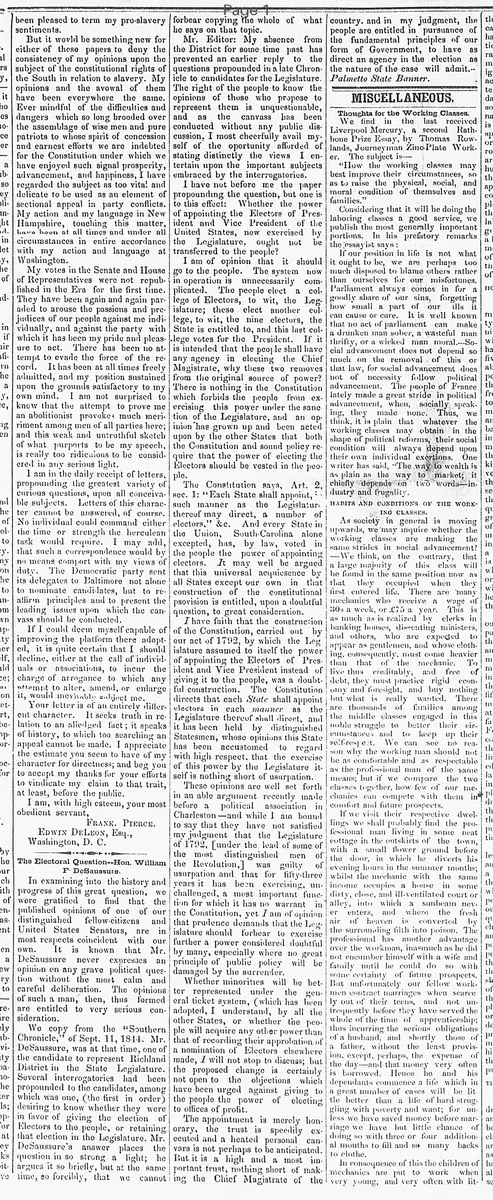
In examining into the history and progress of this great question, we were gratified to find that the published opinions of one of our distinguished fellow-citizens and United States Senators, are in most respects coincident with our own.
It is known that Mr. DeSaussure never expresses an opinion on any grave political question without the most calm and careful deliberation. The opinions of such a man, then, thus formed, are entitled to very serious consideration.
We copy from the "Southern Chronicle," of Sept. 11, 1844. Mr. DeSaussure, was at that time, one of the candidates to represent Richland District in the State Legislature. Several interrogatories had been propounded to the candidates, among which was one, (the first in order) desiring to know whether they were in favor of giving the election of Electors to the people, or retaining that election in the Legislature. Mr. DeSaussure's answer places the question in so strong a light; he argues it so briefly, but at the same time, so forcibly, that we cannot forbear copying the whole of what he says on that topic.
Mr. Editor: My absence from the District for some time past has prevented an earlier reply to the questions propounded in a late Chronicle to candidates for the Legislature.
The right of the people to know the opinions of those who propose to represent them is unquestionable, and as the canvass has been conducted without any public discussion. I most cheerfully avail myself of the opportunity afforded of stating distinctly the views I entertain upon the important subjects embraced by the interrogatories.
I have not before me the paper propounding the question, but one is to this effect: Whether the power of appointing the Electors of President and Vice President of the United States, now exercised by the Legislature, ought not be transferred to the people?
I am of opinion that it should go to the people. The system now in operation is unnecessarily complicated. The people elect a college of Electors, to wit, the Legislature; these elect another college, to wit, the nine electors, the State is entitled to, and this last college votes for the President. If it is intended that the people shall have any agency in electing the Chief Magistrate, why these two removes from the original source of power?
There is nothing in the Constitution which forbids the people from exercising this power under the sanction of the Legislature, and an opinion has grown up and been acted upon by the other States that both the Constitution and sound policy require that the power of electing the Electors should be vested in the people.
The Constitution says, Art. 2 sec. 1: "Each State shall appoint, in such manner as the Legislature thereof may direct, a number of electors,"&c. And every State in the Union, South-Carolina alone excepted, has, by law, voted in the people the power of appointing electors. It may well be argued that this universal acquiescence by all States except our own in that construction of the constitutional provision is entitled, upon a doubtful question, to great consideration.
I have faith that the construction of the Constitution, carried out by our act of 1792, by which the Legislature assumed to itself the power of appointing the Electors of President and Vice President instead of giving it to the people, was a doubtful construction. The Constitution directs that each State shall appoint electors in such manner as the Legislature thereof shall direct, and it has been held by distinguished Statesmen, whose opinions this State has been accustomed to regard with high respect, that the exercise of this power by the Legislature itself is nothing short of usurpation.
These opinions are well set forth in an able argument recently made before a political association in Charleston--and while I am bound to say that they have not satisfied my judgment that the Legislature of 1792, [under the lead of some of the most distinguished men of the Revolution.] was guilty of usurpation and that for fifty-three years it has been exercising, unchallenged, a most important function for which it has no warrant in the Constitution, yet I am of opinion that prudence demands that the Legislature should forbear to exercise further a power considered doubtful by many, especially where no great principle of public policy will be damaged by the surrender.
Whether minorities will be better represented under the general ticket system. (which has been adopted, I understand, by all the other States, or whether the people will acquire any other power than that of recording their approbation of a nomination of Electors elsewhere made, I will not stop to discuss; but the proposed change is certainly not open to the objections which have been urged against giving to the people the power of electing to offices of profit.
The appointment is merely honorary, the trust is speedily executed and a heated personal canvass is not perhaps to be anticipated.
But it is a high and a most important trust, nothing short of making the Chief Magistrate of the country. and in my judgment, the people are entitled in pursuance of the fundamental principles of our form of Government, to have as direct an agency in the election as the nature of the case will admit.
Palmetto State Banner.
What sub-type of article is it?
What themes does it cover?
What keywords are associated?
What entities or persons were involved?
Where did it happen?
Story Details
Key Persons
Location
South Carolina, Richland District
Event Date
Sept. 11, 1844
Story Details
Hon. William F. DeSaussure, a candidate for the State Legislature, responds to interrogatories by advocating for transferring the power to appoint presidential electors from the legislature to the people, citing constitutional provisions, practices of other states, and the need for direct democratic agency in electing the Chief Magistrate.