Thank you for visiting SNEWPapers!
Sign up free
Yorkville Enquirer
York, York County, South Carolina
What is this article about?
In the Charleston Circuit, Judge Carpenter ruled the Homestead exemption law unconstitutional as applied to liens predating its passage, in the case of Joseph Purcell vs. Dr. J. E. Whaley, involving a $3,368.70 judgment and levy on a 400-acre plantation valued at $4-5,000 but selling for $2,400.
Clipping
OCR Quality
Full Text
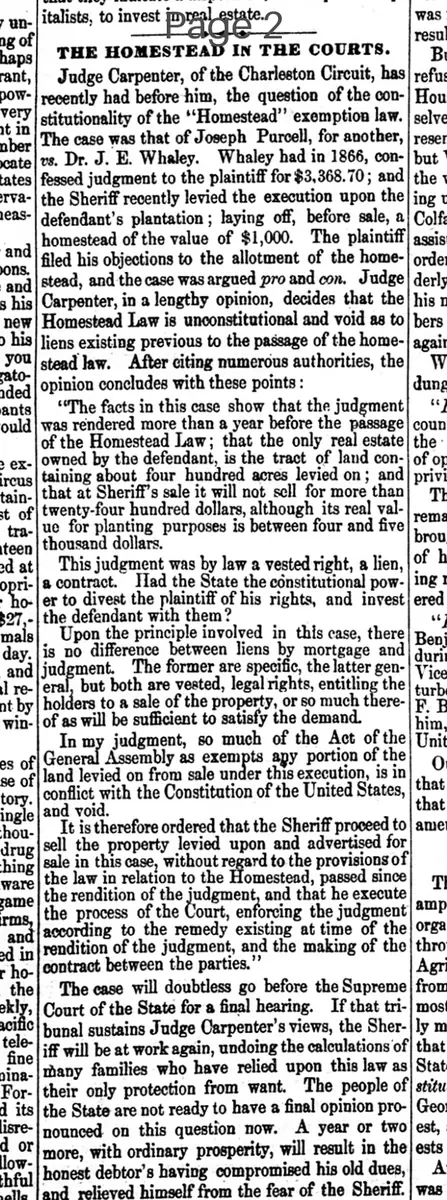
Judge Carpenter, of the Charleston Circuit, has recently had before him, the question of the constitutionality of the "Homestead" exemption law. The case was that of Joseph Purcell, for another, vs. Dr. J. E. Whaley. Whaley had in 1866, confessed judgment to the plaintiff for $3,368.70; and the Sheriff recently levied the execution upon the defendant's plantation: laving off, before sale, a homestead of the value of $1,000. The plaintiff filed his objections to the allotment of the homestead, and the case was argued pro and con. Judge Carpenter, in a lengthy opinion, decides that the Homestead Law is unconstitutional and void as to liens existing previous to the passage of the homestead law. After citing numerous authorities, the opinion concludes with these points:
The facts in this case show that the judgment was rendered more than a year before the passage of the Homestead Law; that the only real estate owned by the defendant, is the tract of land containing about four hundred acres levied on; and that at Sheriff's sale it will not sell for more than twenty-four hundred dollars, although its real value for planting purposes is between four and five thousand dollars.
This judgment was by law a vested right, a lien, a contract. Had the State the constitutional power to divest the plaintiff of his rights, and invest the defendant with them?
Upon the principle involved in this case, there is no difference between liens by mortgage and judgment. The former are specific, the latter general, but both are vested, legal rights, entitling the holders to a sale of the property, or so much thereof as will be sufficient to satisfy the demand.
In my judgment, so much of the Act of the General Assembly as exempts any portion of the land levied on from sale under this execution, is in conflict with the Constitution of the United States, and void.
It is therefore ordered that the Sheriff proceed to sell the property levied upon and advertised for sale in this case, without regard to the provisions of the law in relation to the Homestead, passed since the rendition of the judgment, and that he execute the process of the Court, enforcing the judgment according to the remedy existing at time of the rendition of the judgment, and the making of the contract between the parties."
The case will doubtless go before the Supreme Court of the State for a final hearing. If that tribunal sustains Judge Carpenter's views, the Sheriff will be at work again, undoing the calculations of many families who have relied upon this law as their only protection from want. The people of the State are not ready to have a final opinion pronounced on this question now. A year or two more, with ordinary prosperity, will result in the
What sub-type of article is it?
What themes does it cover?
What keywords are associated?
What entities or persons were involved?
Where did it happen?
Story Details
Key Persons
Location
Charleston Circuit
Event Date
1866
Story Details
Joseph Purcell sued Dr. J. E. Whaley over a 1866 judgment of $3,368.70. Sheriff levied on Whaley's 400-acre plantation, allotting $1,000 homestead. Judge Carpenter ruled the Homestead Law unconstitutional for pre-existing liens, ordering full sale without exemption. Case likely to appeal to Supreme Court, impacting families relying on the law.