Thank you for visiting SNEWPapers!
Sign up free
Story
October 18, 1894
The Washington Times
Washington, District Of Columbia
What is this article about?
In Chicago on Oct. 17, army officials deny that Gen. Miles' report reflected on President Cleveland's handling of railroad strikes, clarifying it targeted Eugene V. Debs for declaring a rebellion.
Clipping
OCR Quality
95%
Excellent
Full Text
WAS
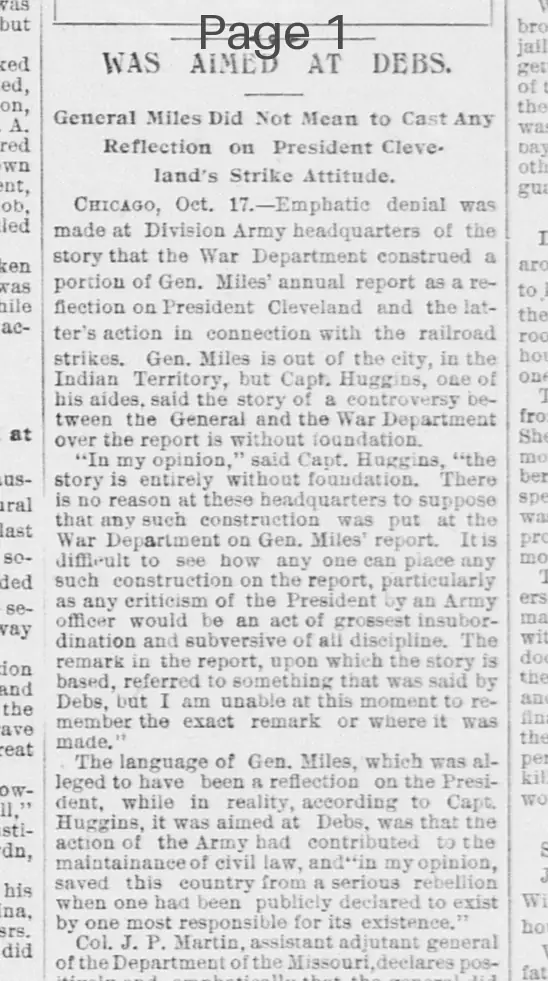
AIMED AT DEBS.
General Miles Did Not Mean to Cast Any Reflection on President Cleveland's Strike Attitude.
CHICAGO, Oct. 17.—Emphatic denial was made at Division Army headquarters of the story that the War Department construed a portion of Gen. Miles' annual report as a reflection on President Cleveland and the latter's action in connection with the railroad strikes. Gen. Miles is out of the city. In the Indian Territory, but Capt. Huggins, one of his aides, said the story of a controversy between the General and the War Department over the report is without foundation.
"In my opinion," said Capt. Huggins, "the story is entirely without foundation. There is no reason at these headquarters to suppose that any such construction was put at the War Department on Gen. Miles' report. It is difficult to see how any one can place any such construction on the report, particularly as any criticism of the President by an Army officer would be an act of grossest insubordination and subversive of all discipline. The remark in the report, upon which the story is based, referred to something that was said by Debs, but I am unable at this moment to remember the exact remark or where it was made."
The language of Gen. Miles, which was alleged to have been a reflection on the President, while in reality, according to Capt. Huggins, it was aimed at Debs, was that the action of the Army had contributed to the maintenance of civil law, and "in my opinion, saved this country from a serious rebellion when one had been publicly declared to exist by one most responsible for its existence."
Col. J. P. Martin, assistant adjutant general of the Department of the Missouri, declares positively and emphatically that the general did not mean President Cleveland at all, but Eugene V. Debs, president of the American Railway Union. "Gen. Miles did not refer to any one but Debs and his coadjutors," said Col. Martin. "I know the phrase alluded not to President Cleveland at all, but to those who inspired the strike."
AIMED AT DEBS.
General Miles Did Not Mean to Cast Any Reflection on President Cleveland's Strike Attitude.
CHICAGO, Oct. 17.—Emphatic denial was made at Division Army headquarters of the story that the War Department construed a portion of Gen. Miles' annual report as a reflection on President Cleveland and the latter's action in connection with the railroad strikes. Gen. Miles is out of the city. In the Indian Territory, but Capt. Huggins, one of his aides, said the story of a controversy between the General and the War Department over the report is without foundation.
"In my opinion," said Capt. Huggins, "the story is entirely without foundation. There is no reason at these headquarters to suppose that any such construction was put at the War Department on Gen. Miles' report. It is difficult to see how any one can place any such construction on the report, particularly as any criticism of the President by an Army officer would be an act of grossest insubordination and subversive of all discipline. The remark in the report, upon which the story is based, referred to something that was said by Debs, but I am unable at this moment to remember the exact remark or where it was made."
The language of Gen. Miles, which was alleged to have been a reflection on the President, while in reality, according to Capt. Huggins, it was aimed at Debs, was that the action of the Army had contributed to the maintenance of civil law, and "in my opinion, saved this country from a serious rebellion when one had been publicly declared to exist by one most responsible for its existence."
Col. J. P. Martin, assistant adjutant general of the Department of the Missouri, declares positively and emphatically that the general did not mean President Cleveland at all, but Eugene V. Debs, president of the American Railway Union. "Gen. Miles did not refer to any one but Debs and his coadjutors," said Col. Martin. "I know the phrase alluded not to President Cleveland at all, but to those who inspired the strike."
What sub-type of article is it?
Historical Event
Mystery
What themes does it cover?
Justice
Deception
What keywords are associated?
General Miles
President Cleveland
Eugene Debs
Railroad Strikes
Army Report
War Department
What entities or persons were involved?
General Miles
President Cleveland
Capt. Huggins
Eugene V. Debs
Col. J. P. Martin
Where did it happen?
Chicago
Story Details
Key Persons
General Miles
President Cleveland
Capt. Huggins
Eugene V. Debs
Col. J. P. Martin
Location
Chicago
Event Date
Oct. 17
Story Details
Army officials in Chicago deny that Gen. Miles' annual report criticized President Cleveland's actions during the railroad strikes, clarifying that the remarks targeted Eugene V. Debs for publicly declaring a rebellion.