Thank you for visiting SNEWPapers!
Sign up free
Editorial
September 15, 1838
Columbus Democrat
Columbus, Lowndes County, Mississippi
What is this article about?
Declaration by Republican congressional committees outlining principles: advocate economical government, independent treasury to avoid bank influence, oppose surplus revenues and public money for private use; firmly reject federal interference with slavery in states or DC, emphasizing constitutional limits and union preservation.
Clipping
OCR Quality
98%
Excellent
Full Text
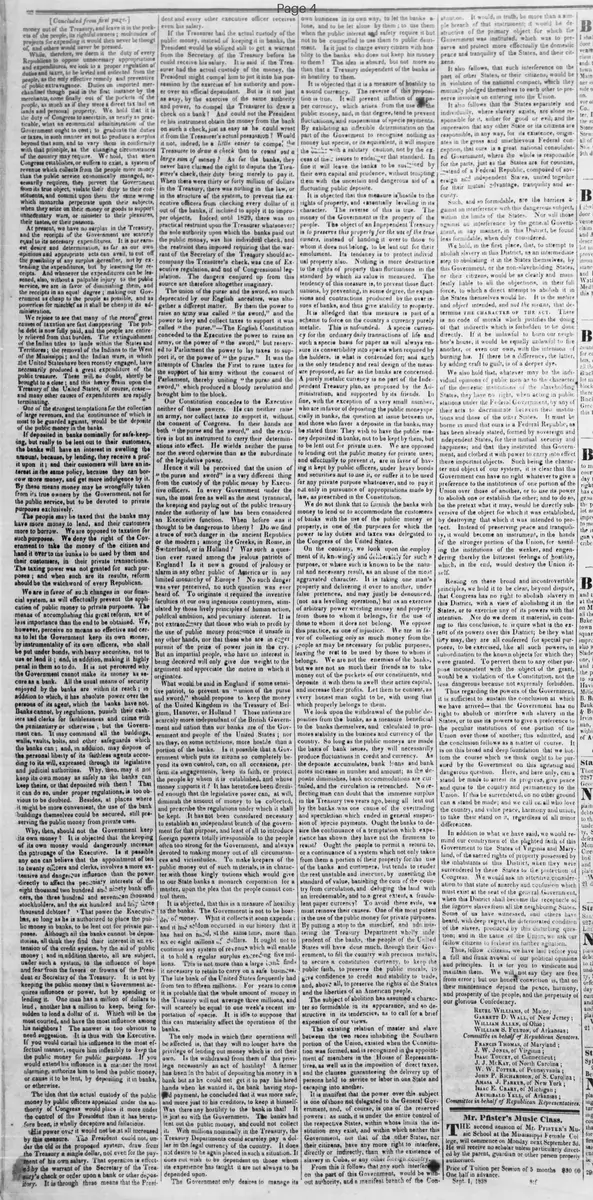
money out of the Treasury, and leave it in the pocket of the people, its rightful owners; multitudes of projects for expending it would then never be thought of, and others would never be pursued. While, therefore, we deem it the duty of every Republican to oppose unnecessary appropriations and expenditures, we look to a proper regulation of duties and taxes, to be levied and collected from the people, as the only effective remedy and preventive of public extravagance. Duties on imported merchandise though paid in the first instance by the merchants, come finally out of the pockets of the people, as much as if they were a direct tax laid on lands and personal property. We hold that it is the duty of Congress to ascertain, as nearly as practicable, what an economical administration of the Government ought to cost; to graduate the duties or taxes, in such manner as not to produce a surplus beyond that sum, and to vary them in conformity with that principle, as the changing circumstances of the country may require. We hold, that when Congress establishes, or suffers to exist, a system of revenue which collects from the people more money than the public service economically managed, necessarily requires, they pervert the Government from its true object, violate their duty to their constituents, and commit upon them the same wrong which monarchs perpetrate upon their subjects, when they seize on their money or goods to support unnecessary wars, or minister to their pleasures, their tastes, or their passions. At present, we have no surplus in the Treasury, and the receipts of the Government are scarcely equal to its necessary expenditures. It is our earnest desire and determination, as far as our own opinions and appropriate acts can avail, to cut off the possibility of any surplus hereafter, not by extending the expenditures, but by lessening the receipts. And whenever the expenditures can be lessened, also, without a palpable injury to the public service, we are in favor of diminishing them, and the receipts in an equal degree; making our Government as cheap to the people as possible, and as powerless for mischief as it shall be cheap in its administration. We rejoice to see that many of the recent great causes of taxation are fast disappearing. The public debt is now fully paid, and the people are entirely relieved from that burden. The extinguishment of the Indian titles to lands within the States and Territories; the removal of the Indians to the West of the Mississippi; and the Indian wars, in which the United States have been recently engaged, have necessarily produced a great expenditure of the public treasure. These will, no doubt, shortly be brought to a close; and this heavy drain upon the Treasury of the United States, of course, cease—and many other causes of expenditures are rapidly terminating. One of the strongest temptations for the collection of large revenues, and the continuance of which is most to be guarded against, would be the deposite of the public money in the banks. If deposited in banks nominally for safe-keeping, but really to be lent out to their customers, the banks will have an interest in swelling the amount, because, by lending, they receive a profit upon it; and their customers will have an interest in the same policy, because they can borrow more money, and get more indulgence by it. By these means money may be wrongfully taken from its true owners by the Government, not for the public service, but to be devoted to private purposes exclusively. The people may be taxed that the banks may have more money to lend, and their customers more to borrow. We are opposed to taxation for such purposes. We deny the right of the Government to take the money of the citizen and hand it over to the banks to be used by them and their customers, in their private transactions. The taxing power was not granted for such purposes; and when such are its results, reform should be the watchword of every Republican. We are in favor of such changes in our financial system, as will effectually prevent the application of public money to private purposes. The means of accomplishing this great reform, are of less importance than the end to be obtained. We, however, perceive no means so effective and certain as to let the Government keep its own money, by instrumentality of its own officers, who shall be put under bonds, with heavy securities, not to use or lend it; and, in addition, making it highly penal in them so to do. It is not perceived why the Government cannot make its money as secure as a bank. All the usual means of security enjoyed by the banks are within its reach; in addition to which, it has absolute power over the persons of its agents, which the banks have not. Banks cannot, by regulations, punish their cashiers and clerks for faithlessness and crime with the penitentiary or otherwise; but the Government can. It may command all the buildings, walls, vaults, bolts, and other safeguards which the banks can; and, in addition, may dispose of the personal liberty of its faithless agents according to its will, expressed through its legislative and judicial authorities. Why, then, may it not keep its own money as safely as the banks can keep theirs, or that deposited with them? That it can do so, under proper regulations, is too obvious to be doubted. Besides, at places where it might be more convenient, the use of the bank buildings themselves could be secured, still preserving the public money from private uses. Why, then, should not the Government keep its own money? It is objected that the keeping of its own money would dangerously increase the patronage of the Executive. Is it possible any one can believe that the appointment of ten to twenty officers and clerks, involves a more extensive and dangerous influence than the power directly to affect the pecuniary interests of the eight thousand two hundred and ninety bank officers, the three hundred and seventeen thousand stockholders, and the six hundred and fifty-three thousand debtors? That power the Executive has, as long as he is authorized to place the public money in banks, to be lent out for private purposes. Although all the banks cannot be depositories, all think they find their interest in an extension of the credit system, by the aid of public money; and in addition thereto, all are subject, under such a system, to the influence of hope and fear from the favors or frowns of the President or Secretary of the Treasury. It is not by keeping the public money that a Government acquires influence or power, but by spending or lending it. One man has a million of dollars to lend, another has a million to keep, being forbidden to lend a dollar of it. Which will be the most courted, and have the most influence among his neighbors? The answer is too obvious to need suggestion. It is thus with the Executive. If you would curtail his influence in the most effectual manner, require him inflexibly to keep the public money for public purposes. If you would extend his influence in a manner the most alarming, authorize him to lend the public money, or cause it to be lent, by depositing it in banks, or otherwise. The idea that the actual custody of the public money by public officers appointed under the authority of Congress would place it more under the control of the President than it has heretofore been, is wholly deceptive and fallacious. His power over it would not be at all increased by this measure. The President could not, under the old or the proposed system, draw from the Treasury a single dollar, not even for the payment of his own salary. That operation is effected by the warrant of the Secretary of the Treasury's check or order upon a bank or other depository. It is through these means that the President and every other executive officer receives even his salary. If the Treasurer had the actual custody of the public money, instead of keeping it in banks, the President would be obliged still to get a warrant from the Secretary of the Treasury before he could receive his salary. It is said if the Treasurer had the actual custody of the money, the President might compel him to put it into his possession by the exercise of his authority and power over an official dependant. But is it not just as easy, by the exercise of the same authority and power, to compel the Treasurer to draw a check on a bank? And could not the President or his instrument obtain the money from the bank on such a check, just as easy as he could wrest it from the Treasurer's actual possession? Would it not, indeed, be a little easier to compel the Treasurer to draw a check than to count out a large sum of money? As for the banks, they never have claimed the right to dispute the Treasurer's check, their duty being merely to pay it. When there were thirty or forty million of dollars in the Treasury, there was nothing in the law, or in the structure of the system, to prevent the executive officers from checking every dollar of it out of the banks, if inclined to apply it to improper objects. Indeed until 1829, there was no practical restraint upon the Treasurer whatsoever; the sole authority upon which the banks paid out the public money, was his individual check, and the restraint then imposed requiring that the warrant of the Secretary of the Treasury should accompany the Treasurer's check, was one of Executive regulation, and not of Congressional legislation. The dangers conjured up from this source are therefore altogether imaginary. The union of the purse and the sword, so much deprecated by our English ancestors, was altogether a different matter. By them the power to raise an army was called "the sword," and the power to levy and collect taxes to support it was called "the purse." The English Constitution conceded to the Executive the power to raise an army, or the power of "the sword," but reserved to Parliament the power to lay taxes to support it, or the power of "the purse." It was the attempts of Charles the First to raise taxes for the support of his army without the consent of Parliament, thereby uniting "the purse and the sword," which produced a bloody revolution and brought him to the block. Our Constitution concedes to the Executive neither of these powers. He can neither raise an army, nor collect taxes to support it, without the consent of Congress. In their hands are both "the purse and the sword," and the executive is but an instrument to carry their determinations into effect. He wields neither the purse nor the sword otherwise than as the subordinate of the legislative power. Hence it will be perceived that the union of "the purse and sword" is a very different thing from the custody of the public money by Executive officers. In every Government under the sun, the most free as well as the most tyrannical, the keeping and paying out of the public treasury under the authority of law has been considered an Executive function. When before was it thought to be dangerous to liberty? Do we find a trace of such danger in the ancient Republics or the modern; among the Greeks, in Rome, in Switzerland, or in Holland? Was such a question ever raised among the jealous patriots of England? Is it now a ground of jealousy or alarm in any other republic of America or in any limited monarchy of Europe? No such danger was ever perceived, no such question was ever heard of. To originate it required the inventive faculties of our own ingenious countrymen, stimulated by those lively principles of human action, political ambition, and pecuniary interest. It is not extraordinary that those who wish to profit by the use of public money pronounce it unsafe in any other hands, nor that those who are in eager pursuit of the prize of power join in the cry. But an impartial people, who have no interest in being deceived will only give due weight to the argument and appreciate the motive in which it originates. What would be said in England if some sensitive patriot, to prevent an "union of the purse and sword," should propose to keep the money of the United Kingdom in the Treasury of Belgium, Hanover, or Holland? Those nations are scarcely more independent of the British Government and nation than our banks are of the Government and people of the United States; nor are they, on some occasions, more hostile than a portion of the banks. Is it possible that a Government which puts its means so completely beyond its own control, can, on all occasions, perform its engagements, keep its faith, or protect the people by whom it is established, and whose money supports it? It has heretofore been deemed enough that the legislative power can, at will, diminish the amount of money to be collected, and prescribe the regulations under which it shall be kept. It has not been considered necessary to establish an independent branch of the government for that purpose, and least of all to introduce foreign powers totally irresponsible to the people often too strong for the Government, and always devoted to making money out of all circumstances and vicissitudes. To make keepers of the public money out of such materials, is in character with those kingly notions which would give to our State banks a monarch corporation for a master, upon the plea that the people cannot control them. It is objected, that this is a measure of hostility to the banks. The Government is not a hoarder of money. What it collects it soon expends; and it has seldom occurred in our history that it has had on hand, at the same time, more than six or eight millions of dollars. It ought not to continue any system of revenue which will enable it to hold a regular surplus exceeding five millions. This is not more than a large bank finds it necessary to retain to carry on a safe business. The late bank of the United States frequently had from ten to fifteen millions. For years to come it is probable that the whole amount of money in the Treasury will not average three millions, and will scarcely be equal to one week's recent importation of specie. It is idle to suppose that this can materially affect the operations of the banks. The only mode in which their operations will be affected is, that they will no longer have the privilege of lending out money which is not their own. Is the withdrawal from them of this privilege necessarily an act of hostility? A farmer has been in the habit of depositing his money in a bank but as he could not get it to pay his hired hands when he wanted it, the bank having stopped payment, he concluded that it was more safe and more just to his creditors, to keep it himself. Was there any hostility to the bank in that? It is just so with the Government. The banks had lent out the public money, and could not collect it. With millions nominally in the Treasury, the Treasury Department could scarcely pay a dollar in the legal currency of the country. It does not desire to be again placed in such a situation. It does not wish to be dependent on those whom its experience has taught it are not always to be depended upon. The Government only desires to manage its own business in its own way, to let the banks alone, and to be let alone by them; to use them when the public interest and safety require it but not to be compelled to use them to public detriment. Is it just to charge every citizen with hostility to the banks who does not keep his money in them? The idea is absurd, but not more so than that a Treasury independent of the banks is in hostility to them. It is objected that it is a measure of hostility to a sound currency. The reverse of this proposition is true. It will prevent inflation of our paper currency, which arises from the use of the public money, and, in that degree, tend to prevent fluctuations, and suspensions of specie payments. By exhibiting an inflexible determination on the part of the Government to recognise nothing as money but specie, or its equivalent, it will inspire the banks with a salutary caution, not by the excess of their issues to endanger that standard. In fine it will leave the banks to be sustained by their own capital and prudence, without tempting them with the uncertain and dangerous aid of a fluctuating public deposite. It is objected that this measure is hostile to the rights of property, and essentially levelling in its character. The reverse of this is true. The money of the Government is the property of the people. The object of an Independent Treasury is to preserve this property for the use of the true owners, instead of handing it over to those to whom it does not belong, to be lent out for their emolument. Its tendency is to protect individual property also. Nothing is more destructive to the rights of property than fluctuations in the standard by which its value is measured. The tendency of this measure is, to prevent those fluctuations, by preventing, in some degree, the expansions and contractions produced by the over issues of banks, and thus give stability to property. It is alleged that this measure is part of a scheme to force on the country a currency purely metallic. This is unfounded. A specie currency for the ordinary daily transactions of life and such a specie basis for paper as will always ensure its convertibility into specie when required by the holders, is what is contended for; and such is the only tendency and real design of the measure proposed, so far as the banks are concerned. A purely metallic currency is no part of the Independent Treasury plan, as proposed by the Administration, and supported by its friends. In fine, with the exception of a very small number, who are in favor of depositing the public money especially in banks, the question at issue between us, and those who favor a deposite in the banks, may be stated thus: They wish to have the public money deposited in banks, not to be kept by them, but to be lent out for private uses. We are opposed to lending out the public money for private uses; and effectually to prevent it, are in favor of having it kept by public officers, under heavy bonds and securities not to use it, or suffer it to be used for any private purpose whatsoever, and to pay it out only in pursuance of appropriations made by law, as prescribed in the Constitution. We do not think that to furnish the banks with money to lend or to accommodate the customers of banks with the use of the public money or property, is one of the purposes for which the power to lay duties and taxes was delegated to the Congress of the United States. On the contrary, we look upon the employment of it, knowingly and deliberately for such a purpose, or where such is known to be the natural and necessary result, as an abuse of the most aggravated character. It is taking one man's property and delivering it over to another, under false pretences, and may justly be denounced (not as a levelling operation,) but as an exercise of arbitrary power wresting money and property from those to whom it belongs, for the use of those to whom it does not belong. We oppose this practice, as one of injustice. We are in favor of collecting only as much money from the people as may be necessary for public purposes, leaving the rest to be used by those to whom it belongs. We are not the enemies of the banks, but we are not so much their friends as to take money out of the pockets of our constituents, and deposite it with them to swell their active capital, and increase their profits. Let them be content, as every honest man ought to be, with using that which properly belongs to them. We look upon the withdrawal of the public deposites from the banks, as a measure beneficial to the banks themselves, and calculated to promote stability in the business and currency of the country. So long as the public moneys are made the basis of bank issues, they will necessarily produce fluctuations in credit and currency. As the deposite accumulates, bank loans and bank notes increase in number and amount; as the deposite diminishes, bank accommodations are curtailed, and the circulation is retrenched. No reflecting man can doubt that the immense surplus in the Treasury two years ago, being all lent out by the banks was one cause of the overtrading and speculation which ended in general suspension of specie payments. Ought the banks to desire the continuance of a temptation which experience has shown they have not the firmness to resist? Ought the people to permit a return to, or a continuance of a system which not only takes from them a portion of their property for the use of the banks and customers, but tends to render the rest unstable and insecure, by unsettling the standard of value, banishing the coin of the country from circulation, and deluging the land with an irredeemable, and to a great extent, a fraudulent paper currency? To avoid these evils, we must remove their causes. One of the most potent is the use of the public money for private purposes. By putting a stop to the mischief, and administering the Treasury Department wholly independent of the banks, the people of the United States will have done much, through their Government, to fill the country with precious metals, to secure a constitutional currency, to keep the public faith, to preserve the public morals, to give confidence to credit and stability to trade, and, above all, to preserve the rights of the States and the liberties of an American people. The subject of abolition has assumed a character so formidable in its appearance, and so destructive in its tendencies, as to call for a brief exposition of our views. The existing relation of master and slave between the two races inhabiting the Southern portion of the Union, existed when the Constitution was formed, and is recognized in the appointment of members in the House of Representatives, as well as in the imposition of direct taxes, and the clauses guaranteeing the delivery up of persons held to service or labor in one State and escaping into another. It is manifest that the power over this subject is one of those not delegated to the General Government, and, of course, is one of the reserved powers: as such, it is under the entire control of the respective States, within whose limits the institution may exist, and within which neither this Government, nor that of the other States, nor their citizens, have any more right to interfere, directly or indirectly, than with the existence of slavery in Cuba, or any other foreign country. From this it follows that any such interference on the part of this Government, would be without authority, and a manifest breach of the Constitution. It would, in truth, be more than a simple breach of that instrument; it would be destructive of the primary object for which the Government was instituted, which was to preserve and protect more effectually the domestic peace and tranquility of the States, and their citizens. It also follows, that such interference on the part of other States, or their citizens, would be in violation of the national compact, which they mutually pledged themselves to each other to preserve inviolate on entering into the Union. It also follows that the States separately and individually, where slavery exists, are alone responsible for it, either for good or evil; and the impression that any other State or its citizens are responsible, in any way, for its existence, originates in the gross and mischievous Federal conception, that ours is a great national consolidated Government, where the whole is responsible for the parts, just as the States are for counties, instead of a Federal Republic, composed of sovereign and independent States, united together for their mutual advantage, tranquility and security. Such, and so formidable, are the barriers against an interference with this dangerous subject, within the limits of the States. Nor will those against an interference by the general Government, in any manner, in this District, be found less formidable, when duly considered. We hold, in the first place, that, to attempt to abolish slavery in this District, as an intermediate step to abolishing it in the States themselves, by this Government, or the non-slaveholding States, or their citizens, would be as clearly and manifestly liable to all the objections, in their full force, to which a direct attempt to abolish it in the States themselves would be. It is the motive and object intended, and not the means, that determines the character of the act. There is no code of morals which justifies the doing of that indirectly which is forbidden to be done directly. If it be unlawful to burn our neighbor's house, it would be equally unlawful to fire another, or even our own, with the intention of burning his. If there be a difference, the latter, by adding craft to guilt, is of a deeper dye. We also hold that, whatever may be the individual opinions of public men as to the character of the domestic institutions of the slaveholding States, they have no right, when acting in public stations under the Federal Government, by any of their acts to discriminate between their institutions and those of the other States. It must be borne in mind that ours is a Federal Republic, as has been already stated, formed by sovereign and independent States, for their mutual security and happiness; and that they instituted this Government, and clothed it with power to carry into effect these important objects. Such being the character and object of our system, it is clear that this Government can have no right whatever to give a preference to the institutions of one portion of the Union over those of another, or to use its power to abolish one or establish the other; and to do so, be the pretext what it may, would be directly subversive of the object for which it was established, by destroying that which it was intended to protect. Instead of preserving peace and tranquility, it would become an instrument, in the hands of the stronger portion of the Union, for assailing the institutions of the weaker, and engendering thereby the bitterest feelings of hostility, which, in the end, would destroy the Union itself. Resting on these broad and incontrovertible principles, we hold it to be clear, beyond dispute, that Congress has no right to abolish slavery in this District, with a view of abolishing it in the States, or to exercise any of its powers with that intention. Nor do we deem it material, in coming to this conclusion, to inquire what is the extent of its powers over this District; be they what they may, they are all conferred for special purposes, to be exercised, like all such powers, in subordination to the known objects for which they were granted. To pervert them to any other purpose inconsistent with the object of the grant, would be a violation of the Constitution, not the less dangerous because not expressly forbidden. Thus regarding the powers of the Government, it is sufficient to sustain the conclusion at which we have arrived—that the Government has no right to abolish or interfere with slavery in the States, or to use its powers to give a preference to the peculiar institutions of one portion of the Union over those of another; this admitted, and the conclusion follows as a matter of course. It is on this broad and deep foundation that we bottom the course which we think ought to be pursued by the Government on this agitating and dangerous question. Here, and here only, can a stand be made to arrest its progress, give peace and quiet to the country and permanency to the Union. If this be surrendered, on no other ground can a stand be made; and we call on all who love the country, and value peace, harmony and union, to take their stand on it, regardless of all minor differences. In addition to what we have said, we would remind our countrymen of the plighted faith of this Government to the States of Virginia and Maryland, of the sacred rights of property possessed by the inhabitants of this District, when they were surrendered by these States to the protection of Congress. We would ask an attentive consideration to that state of anarchy and confusion which must exist at the seat of the general Government when this District shall become the receptacle of the fugitive slaves from all the neighboring States. Some of us have witnessed, and others have heard, with deep regret, the deteriorated condition of the slaves, produced by this disturbing question; and in the name of the Union, we ask our fellow citizens to forbear its further agitation. Thus, fellow citizens, we have laid before you a full and frank avowal of our political opinions and principles. It is for you to vindicate and maintain them. We will not say they are free from error; but our honest conviction is, that on their maintenance depend the peace, harmony, and prosperity of the people, and the perpetuity of our glorious Confederacy.
Reuel Williams, of Maine;
Garrett D. Wall, of New Jersey;
William Allen, of Ohio;
William S. Fulton, of Arkansas:
Committee in behalf of Republican Senators.
Francis Thomas, of Maryland;
J. W. Jones, of Virginia;
Isaac Toucey, of Connecticut;
J. J. McKay, of North Carolina;
W. W. Porter, of Pennsylvania;
John P. Richardson, of S. Carolina;
Amasa J. Parker, of New York;
Isaac E. Crary, of Michigan;
Archibald Yell, of Arkansas;
Committee in behalf of Republican Representatives.
Reuel Williams, of Maine;
Garrett D. Wall, of New Jersey;
William Allen, of Ohio;
William S. Fulton, of Arkansas:
Committee in behalf of Republican Senators.
Francis Thomas, of Maryland;
J. W. Jones, of Virginia;
Isaac Toucey, of Connecticut;
J. J. McKay, of North Carolina;
W. W. Porter, of Pennsylvania;
John P. Richardson, of S. Carolina;
Amasa J. Parker, of New York;
Isaac E. Crary, of Michigan;
Archibald Yell, of Arkansas;
Committee in behalf of Republican Representatives.
What sub-type of article is it?
Economic Policy
Taxation
Constitutional
What keywords are associated?
Independent Treasury
Public Revenue
Bank Deposits
Slavery Interference
Constitutional Limits
Republican Principles
Union Preservation
What entities or persons were involved?
Congress
Banks
Republican Senators Committee
Republican Representatives Committee
President
Secretary Of The Treasury
Editorial Details
Primary Topic
Republican Principles On Independent Treasury And Opposition To Federal Interference In Slavery
Stance / Tone
Advocacy For Limited Government, Economical Administration, And Preservation Of Union Through Non Interference With State Institutions
Key Figures
Congress
Banks
Republican Senators Committee
Republican Representatives Committee
President
Secretary Of The Treasury
Key Arguments
Oppose Unnecessary Appropriations And Surplus Revenues To Prevent Extravagance
Support Independent Treasury Kept By Government Officers To Avoid Bank Lending Of Public Funds
Deny Government Right To Use Public Money For Private Bank Purposes
Public Debt Paid And Indian Affairs Resolving, Reducing Expenditures
Oppose Federal Abolition Of Slavery In States Or Dc As Unconstitutional And Destructive To Union
Slavery Is Reserved To States; Interference Violates Compact
No Right To Discriminate Against Slaveholding States' Institutions