Thank you for visiting SNEWPapers!
Sign up free
The New Hampshire Gazette
Portsmouth, Rockingham County, New Hampshire
What is this article about?
Newspaper article announces Salem publishers' plan to republish Capt. Diaz del Castillo's 1568 'True History of the Conquest of Mexico,' translated by Maurice Keatinge. Praises its authenticity as eyewitness account, quotes Dr. Robertson and British Critic reviews, and excerpts narrative of Cortes' first meetings with Cacamatzin and Montezuma.
Merged-components note: Continuation of the excerpt from 'True History of the Conquest of Mexico' across two components.
Clipping
OCR Quality
Full Text
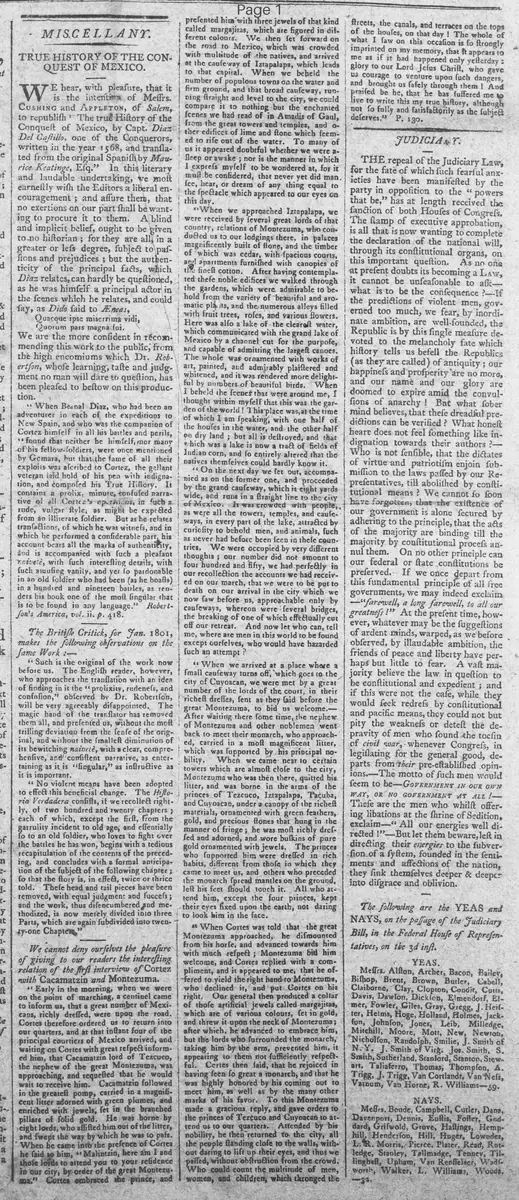
TRUE HISTORY OF THE CONQUEST OF MEXICO.
We hear, with pleasure, that it is the intention of Messrs. CUSHING and APPLETON, of Salem, to republish * The true History of the Conquest of Mexico, by Capt. Diaz Del Castillo, one of the Conquerors, written in the year 1568, and translated from the original Spanish by Maurice Keatinge, Esq." In this literary and laudable undertaking, we most earnestly wish the Editors a liberal encouragement; and assure them, that no exertions on our part shall be wanting to procure it to them. A blind and implicit belief, ought to be given to no historian; for they are all in a greater or less degree, subject to passions and prejudices; but the authenticity of the principal facts, which Diaz relates, can hardly be questioned, as he was himself a principal actor in the scenes which he relates, and could say, as Dido said to Aeneas,
Quaeque ipse miserrima vidi,
Quorum pars magna fui.
We are the more confident in recommending this work to the public, from the high encomiums which Dr. Robertson, whose learning, taste and judgment no man will dare to question, has been pleased to bestow on this production.
" When Bernal Diaz, who had been an adventurer in each of the expeditions to New Spain, and who was the companion of Cortez himself in all his battles and perils, found that neither he himself, nor many of his fellow-soldiers, were once mentioned by Gomara, but that the fame of all their exploits was ascribed to Cortez, the gallant veteran laid hold of his pen with indignation, and composed his True History. It contains a prolix, minute, confused narrative of all Cortez's operations, in such a rude, vulgar style as might be expected from an illiterate soldier. But as he relates transactions, of which he was witness, and in which he performed a considerable part, his account bears all the marks of authenticity, and is accompanied with such a pleasant naivete, with such interesting details, with such amusing vanity, and yet so pardonable in an old soldier who had been (as he boasts) in a hundred and nineteen battles, as renders his book one of the most singular that is to be found in any language." Robertson's America, vol. ii. p. 418.
The British Critic, for Jan. 1801, makes the following observations on the same Work:
" Such is the original of the work now before us. The English reader, however, who approaches the translation with an idea of finding in it the " prolixity, rudeness, and confusion," observed by Dr. Robertson, will be very agreeably disappointed. The magic hand of the translator has removed them all, and presented us, without the most trifling deviation from the sense of the original, and without the smallest diminution of its bewitching naivete, with a clear, comprehensive, and consistent narrative, as entertaining as it is "singular," as instructive as it is important.
" No violent means have been adopted to effect this beneficial change. The Historia Verdadera consists, if we recollect rightly, of two hundred and twenty chapters; each of which, except the first, from the garrulity incident to old age, and essentially so to an old soldier, who loves to fight over the battles he has won, begins with a tedious recapitulation of the contents of the preceding, and concludes with a formal anticipation of the subject of the following chapter; so that the story is, in effect, twice or thrice told. These head and tail pieces have been removed, with equal judgment and success; and the work, thus disencumbered and methodized, is now merely divided into three Parts, which are again subdivided into twenty-one Chapters"
We cannot deny ourselves the pleasure of giving to our readers the interesting relation of the first interview of Cortez with Cacamatzin and Montezuma.
" Early in the morning, when we were on the point of marching, a centinel came to inform us, that a great number of Mexicans, richly dressed, were upon the road. Cortes therefore ordered us to return into our quarters, and at that instant four of the principal courtiers of Mexico arrived, and waiting on Cortes with great respect informed him, that Cacamatzin lord of Tezcuco, the nephew of the great Montezuma, was approaching, and requested that he would wait to receive him. Cacamatzin followed in the greatest pomp, carried in a magnificent litter adorned with green plumes, and enriched with jewels set in the branched pillars of solid gold. He was borne by eight lords, who assisted him out of the litter, and swept the way by which he was to pass. When he came into the presence of Cortes he said to him, " Malintzin, here am I and those lords to attend you to your residence in our city, by order of the great Montezuma." Cortes embraced the prince, and presented him with three jewels of that kind called margaritas, which are figured in different colours. We then set forward on the road to Mexico, which was crowded with multitude of the natives, and arrived at the causeway of Iztapalapa, which leads to that capital. When we beheld the number of populous towns on the water and from ground, and that broad causeway, running straight and level to the city, we could compare it to nothing but the enchanted scenes we had read of in Amadis of Gaul, from the great towers and temples, and other edifices of lime and stone which seemed to rise out of the water. To many of us it appeared doubtful whether we were asleep or awake; nor is the manner in which I express myself to be wondered at, for it must be considered, that never yet did man see, hear, or dream of any thing equal to the spectacle which appeared to our eyes on this day.
"When we approached Iztapalapa, we were received by several great lords of that country, relations of Montezuma, who conducted us to our lodgings there, in palaces magnificently built of stone, and the timber of which was cedar, with spacious courts, and apartments furnished with canopies of the finest cotton. After having contemplated these noble edifices we walked through the gardens, which were admirable to behold from the variety of beautiful and aromatic plants, and the numerous alleys filled with fruit trees, roses, and various flowers. Here was also a lake of the clearest water, which communicated with the grand lake of Mexico by a channel cut for the purpose, and capable of admitting the largest canoes. The whole was ornamented with works of art, painted, and admirably plastered and whitened, and it was rendered more delightful by numbers of beautiful birds. When I beheld the scenes that were around me, I thought within myself that this was the garden of the world! This place was, at the time of which I am speaking, with one half of the houses in the water, and the other half on dry land: but all is destroyed, and that which was a lake is now a tract of fields of Indian corn, and so entirely altered that the natives themselves could hardly know it.
" On the next day we set out, accompanied as on the former one, and proceeded by the grand causeway, which is eight yards wide, and runs in a straight line to the city of Mexico. It was crowded with people, as were all the towers, temples, and causeways, in every part of the lake, attracted by curiosity to behold men, and animals, such as never had before been seen in these countries. We were occupied by very different thoughts; our number did not amount to four hundred and fifty, we had perfectly in our recollection the accounts we had received on our march, that we were to be put to death on our arrival in the city which we now saw before us, approachable only by causeways, whereon were several bridges, the breaking of one of which effectually cut off our retreat. And now let who can, tell me, where are men in this world to be found except ourselves, who would have hazarded such an attempt?
" When we arrived at a place where a small causeway turns off, which goes to the city of Coyoacan, we were met by a great number of the lords of the court, in their richest dress, sent as they said before the great Montezuma, to bid us welcome.— After waiting there some time, the nephew of Montezuma and other noblemen went back to meet their monarch, who approached, carried in a most magnificent litter, which was supported by his principal nobility. When we came near to certain towers which are almost close to the city, Montezuma who was then there, quitted his litter, and was borne in the arms of the princes of Tezcuco, Iztapalapa, Tacuba, and Coyoacan, under a canopy of the richest materials, ornamented with green feathers, gold, and precious stones that hung in the manner of fringe; he was most richly dressed and adorned, and wore buskins of pure gold ornamented with jewels. The princes who supported him were dressed in rich habits, different from those in which they came to meet us, and others who preceded the monarch spread mantles on the ground, lest his feet should touch it. All who attend him, except the four princes, kept their eyes fixed upon the earth, not daring to look him in the face.
When Cortes was told that the great Montezuma approached, he dismounted from his horse, and advanced towards him with much respect: Montezuma bid him welcome, and Cortes replied with a compliment, and it appeared to me, that he offered to yield the right hand to Montezuma, who declined it, and put Cortes on his right. Our general then produced a collar of those artificial jewels called margaritas, which are of various colours, set in gold, and threw it upon the neck of Montezuma; after which, he advanced to embrace him, but the lords who surrounded the monarch, taking him by the arm, prevented him, it appearing to them not sufficiently respectful. Cortes then said, that he rejoiced in having seen so great a monarch, and that he was highly honored by his coming out to meet him, as well as by the many other marks of his favor. To this Montezuma made a gracious reply, and gave orders to the princes of Tezcuco and Coyoacan to attend us to our quarters. Attended by his nobility, he then returned to the city, all the people standing close to the walls, without daring to lift up their eyes, and thus we passed, without obstruction from the crowd. Who could count the multitude of men, women, and children, which thronged the streets, the canals, and terraces on the tops of the houses, on that day! The whole of what I saw on this occasion is so strongly imprinted on my memory, that it appears to me as if it had happened only yesterday: glory to our Lord Jesus Christ, who gave us courage to venture upon such dangers, and brought us safely through them! And praised be he, that he has suffered me to live to write this my true history, although not so fully and satisfactorily as the subject deserves." P. 130.
What sub-type of article is it?
What themes does it cover?
What keywords are associated?
Literary Details
Title
True History Of The Conquest Of Mexico
Subject
Republishing Diaz Del Castillo's Eyewitness Account Of The Conquest
Form / Style
Review Essay With Historical Narrative Excerpt
Key Lines