Thank you for visiting SNEWPapers!
Sign up free
Literary
July 15, 1774
The Massachusetts Spy, Or, Thomas's Boston Journal
Boston, Suffolk County, Massachusetts
What is this article about?
A letter to the Massachusetts Spy reprints Pliny the Younger's epistle to Maximus, advising gentle governance of free Achaia (Greece) to preserve liberty's shadow, with notes drawing parallels to colonial America's spirit of independence against oppression.
Merged-components note: The second component is a direct continuation and explanatory note to the Pliny letter in the first, forming a single literary piece for the Massachusetts Spy.
Clipping
OCR Quality
92%
Excellent
Full Text
For the MASSACHUSETTS SPY.
Mr. THOMAS,
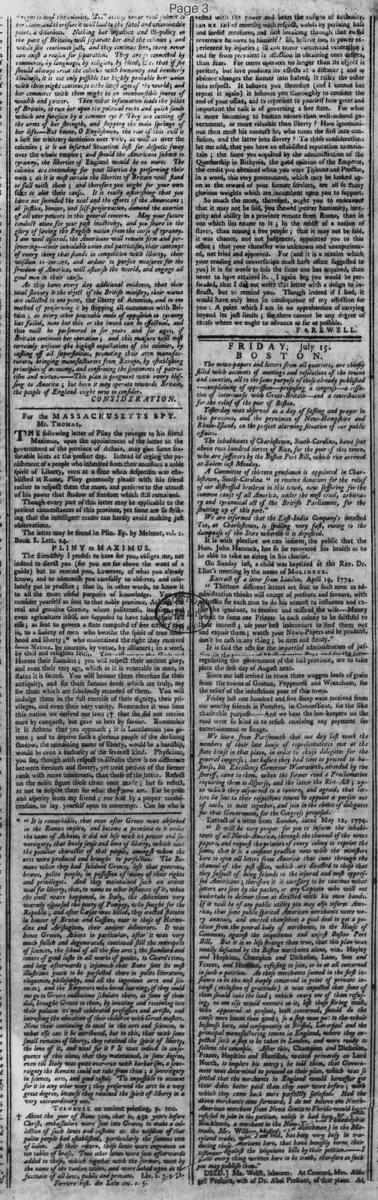
THE following letter of Pliny the younger to his friend Maximus, upon the appointment of the latter to the government of the province of Achaia, may give some reasonable hints at the present day. Instead of urging the punishment of a people who inherited from their ancestors a noble spirit of Liberty, even at a time when despotism was established at Rome, Pliny generously pleads with his friend rather to appeal to them the more, and preserve to the utmost of his power that shadow of freedom which still remained. Though every part of this letter may be applicable to the present circumstances of this province, yet some are so striking that the intelligent reader can hardly avoid making just observations,
The letter may be found in Plin. Ep. by Melmoth, vol. 2. Book 8. Lett. 24.
PLINY to MAXIMUS.
The friendship I profess to have for you, obliges me, not indeed to direct you (for you are far above the want of a guide)but to remind you, however, of what you already know, and to admonish you carefully to observe, and resolutely put in practice ; that is. in other words, to know it to all the more useful purposes of knowledge. You consider yourself as sent to that noble province, Achaia the real and genuine Greece, where politeness, learning, even agriculture itself, are supposed to have taken their first rise; as sent to govern a state composed of free citizens, to a society of men who breathe the spirit of true manhood and liberty;* who maintained the right they received from Nature. by courage, by virtue, by alliances; in a word, by civil and religious faith. You will see . . . the Gods . . . and Heroes their founders; you will respect their ancient glory, and even their very age, which as it is venerable in men, in states it is sacred. You will honour them therefore for their antiquity, and for those famous deeds which are truly, may for those which are fabulously recorded of them. You will indulge them in the full exercise of their dignity, their privileges, and even their very vanity. Remember it was from this nation we derived our laws ;t that they did not receive ours by conquest, but gave us hers by favour. Remember it is Athens that you approach ; it is Lacedaemon you govern ; and to deprive such a glorious people of the declining shadow, the remaining name of liberty, would be a hardship, would be even a barbarity of the severest kind. Physicians, you see, though with respect to diseases there is no difference between freedom and slavery, yet treat persons of the former rank with more tenderness, than those of the latter. Reflect on the noble figure these cities once made ; but so reflect, as not to despise them for what they now are. Far be pride and asperity from my friend ; nor fear by a proper condescension, to lay yourself open to contempt.. Can he who is vested with the power and bears the ensigns of authority, can he fail of meeting with respect, unless by pursuing base and sordid measures, and first breaking through that awful reverence he owes to himself ? Ill, believe me, is power experienced by injuries ; ill can terror command veneration ; and far from prevalent is affection in obtaining ones desires, than fear. For terror operates no longer than its object is present, but love produces its effects at a distance ; and after absence changes the former into hatred, it raises the other into respect. It behoves you therefore (and I cannot but repeat it again) it behoves you thoroughly to consider the end of your office, and to represent to yourself how great and important the task is of governing a free state. For what is more becoming to human nature than well-ordered government, or more valuable than liberty ? How ignominious then must his conduct be, who turns the first into confusion, and the latter into slavery ? To these considerations let me add, that you have an established reputation to maintain ; the same you acquired by the administration of the Quaestorship in Bithynia, the good opinion of the Emperor, the credit you obtained when you were Tribune and Proctor, in a word, this very government, which may be looked upon as the reward of your former services,, are all so many glorious weights which are incumbent upon you to support. So much the more, therefore, , ought you to endeavour that it may not be said, you shewed greater humanity, integrity and ability in a province remote from Rome, than in one which lies nearer to it ; in the midst of a nation of slaves, than among a free people ; that it may not be said, it was chance, and not judgment, appointed you to this office ; that your character was unknown and unexperienced, not tried and approved. For (and it is a maxim which your reading and conversation must have often suggested to you) it is far worse to lose the fame one has acquired, than never to have attained it. ., I again beg you would be persuaded, that I did not write this letter with a design to instruct, but to remind you, Though indeed if I had, it would have, only been in consequence of my affection for you : A point which I am in no apprehension of carrying beyond its just limits ; for there cannot be any degree of excess where we ought to advance as far as possible.
FAREWELL.
* It is remarkable, that even after Greece was absorbed in the Roman empire, and became a province to it under the name of Achaia, it did not lose with its power and sovereignty, that lively zeal and love of liberty, which was the peculiar character of that people, amongst whom the arts were produced and brought to perfection. The Romans when they had subdued Greece, left that generous, brave, polite people, in possession of many of their rights and privileges. And they maintained such an ardent zeal for liberty, that, to name no other instances of it, when the civil wars happened, in Italy, the Athenians very warmly espoused the party of Pompey, who fought for the Republic; and after Caesar was killed, they erected statues in honour of Brutus and Cassius, near to those of Harmodius and Aristogiton, their ancient deliverers. It was hence Greece, Athens in particular, after it was very much fallen and degenerated, continued still the metropolis of sciences, the school of all the fine arts ; the standard and centre of good taste in all works of genius, to Cicero's time, and long afterwards ; insomuch that Rome sent its most illustrious youth to be perfected there in polite literature, eloquence, philosophy, and all the ingenious arts and sciences; and the Emperors who loved learning, if they could not go to Greece and become scholars there, as some of them did, brought Greece to them, by inviting and receiving into their palaces its most celebrated professors and artists, and intrusting the education of their children with Greek masters. Now their continuing to excel in the arts and sciences, to what else can it be attributed, but to this, that with some small remains of liberty, they retained the spirit of liberty, the love of it, and zeal for it? It was indeed in consequence of this alone, that they maintained, in some degree, even till Italy was quite over-run with barbarism, a sovereignty the Romans could not take from them ; a sovereignty in science, arts, and good taste. 'Tis impossible to account for it in any other way ; they preserved the arts in a very great degree, because they retained the spirit of liberty in a very extraordinary one.
TURNBULL on ancient painting, P. 100.
About the year of Rome 300, that is, 452 years before Christ, embassadors were sent into Greece, to make a collection of such laws and customs as the wisdom of that polite people had established, particularly the famous ones of Solon. At their return, these laws were engraven on ten tables of brass. Two other laws were soon afterwards added to these, which together with the former, went by the name of the twelve tables, and were looked upon as the fountain of all laws, public and private. Liv. l. 3. c. 22.
Ferriere hist. des Loix civ. c. 5.
Mr. THOMAS,
THE following letter of Pliny the younger to his friend Maximus, upon the appointment of the latter to the government of the province of Achaia, may give some reasonable hints at the present day. Instead of urging the punishment of a people who inherited from their ancestors a noble spirit of Liberty, even at a time when despotism was established at Rome, Pliny generously pleads with his friend rather to appeal to them the more, and preserve to the utmost of his power that shadow of freedom which still remained. Though every part of this letter may be applicable to the present circumstances of this province, yet some are so striking that the intelligent reader can hardly avoid making just observations,
The letter may be found in Plin. Ep. by Melmoth, vol. 2. Book 8. Lett. 24.
PLINY to MAXIMUS.
The friendship I profess to have for you, obliges me, not indeed to direct you (for you are far above the want of a guide)but to remind you, however, of what you already know, and to admonish you carefully to observe, and resolutely put in practice ; that is. in other words, to know it to all the more useful purposes of knowledge. You consider yourself as sent to that noble province, Achaia the real and genuine Greece, where politeness, learning, even agriculture itself, are supposed to have taken their first rise; as sent to govern a state composed of free citizens, to a society of men who breathe the spirit of true manhood and liberty;* who maintained the right they received from Nature. by courage, by virtue, by alliances; in a word, by civil and religious faith. You will see . . . the Gods . . . and Heroes their founders; you will respect their ancient glory, and even their very age, which as it is venerable in men, in states it is sacred. You will honour them therefore for their antiquity, and for those famous deeds which are truly, may for those which are fabulously recorded of them. You will indulge them in the full exercise of their dignity, their privileges, and even their very vanity. Remember it was from this nation we derived our laws ;t that they did not receive ours by conquest, but gave us hers by favour. Remember it is Athens that you approach ; it is Lacedaemon you govern ; and to deprive such a glorious people of the declining shadow, the remaining name of liberty, would be a hardship, would be even a barbarity of the severest kind. Physicians, you see, though with respect to diseases there is no difference between freedom and slavery, yet treat persons of the former rank with more tenderness, than those of the latter. Reflect on the noble figure these cities once made ; but so reflect, as not to despise them for what they now are. Far be pride and asperity from my friend ; nor fear by a proper condescension, to lay yourself open to contempt.. Can he who is vested with the power and bears the ensigns of authority, can he fail of meeting with respect, unless by pursuing base and sordid measures, and first breaking through that awful reverence he owes to himself ? Ill, believe me, is power experienced by injuries ; ill can terror command veneration ; and far from prevalent is affection in obtaining ones desires, than fear. For terror operates no longer than its object is present, but love produces its effects at a distance ; and after absence changes the former into hatred, it raises the other into respect. It behoves you therefore (and I cannot but repeat it again) it behoves you thoroughly to consider the end of your office, and to represent to yourself how great and important the task is of governing a free state. For what is more becoming to human nature than well-ordered government, or more valuable than liberty ? How ignominious then must his conduct be, who turns the first into confusion, and the latter into slavery ? To these considerations let me add, that you have an established reputation to maintain ; the same you acquired by the administration of the Quaestorship in Bithynia, the good opinion of the Emperor, the credit you obtained when you were Tribune and Proctor, in a word, this very government, which may be looked upon as the reward of your former services,, are all so many glorious weights which are incumbent upon you to support. So much the more, therefore, , ought you to endeavour that it may not be said, you shewed greater humanity, integrity and ability in a province remote from Rome, than in one which lies nearer to it ; in the midst of a nation of slaves, than among a free people ; that it may not be said, it was chance, and not judgment, appointed you to this office ; that your character was unknown and unexperienced, not tried and approved. For (and it is a maxim which your reading and conversation must have often suggested to you) it is far worse to lose the fame one has acquired, than never to have attained it. ., I again beg you would be persuaded, that I did not write this letter with a design to instruct, but to remind you, Though indeed if I had, it would have, only been in consequence of my affection for you : A point which I am in no apprehension of carrying beyond its just limits ; for there cannot be any degree of excess where we ought to advance as far as possible.
FAREWELL.
* It is remarkable, that even after Greece was absorbed in the Roman empire, and became a province to it under the name of Achaia, it did not lose with its power and sovereignty, that lively zeal and love of liberty, which was the peculiar character of that people, amongst whom the arts were produced and brought to perfection. The Romans when they had subdued Greece, left that generous, brave, polite people, in possession of many of their rights and privileges. And they maintained such an ardent zeal for liberty, that, to name no other instances of it, when the civil wars happened, in Italy, the Athenians very warmly espoused the party of Pompey, who fought for the Republic; and after Caesar was killed, they erected statues in honour of Brutus and Cassius, near to those of Harmodius and Aristogiton, their ancient deliverers. It was hence Greece, Athens in particular, after it was very much fallen and degenerated, continued still the metropolis of sciences, the school of all the fine arts ; the standard and centre of good taste in all works of genius, to Cicero's time, and long afterwards ; insomuch that Rome sent its most illustrious youth to be perfected there in polite literature, eloquence, philosophy, and all the ingenious arts and sciences; and the Emperors who loved learning, if they could not go to Greece and become scholars there, as some of them did, brought Greece to them, by inviting and receiving into their palaces its most celebrated professors and artists, and intrusting the education of their children with Greek masters. Now their continuing to excel in the arts and sciences, to what else can it be attributed, but to this, that with some small remains of liberty, they retained the spirit of liberty, the love of it, and zeal for it? It was indeed in consequence of this alone, that they maintained, in some degree, even till Italy was quite over-run with barbarism, a sovereignty the Romans could not take from them ; a sovereignty in science, arts, and good taste. 'Tis impossible to account for it in any other way ; they preserved the arts in a very great degree, because they retained the spirit of liberty in a very extraordinary one.
TURNBULL on ancient painting, P. 100.
About the year of Rome 300, that is, 452 years before Christ, embassadors were sent into Greece, to make a collection of such laws and customs as the wisdom of that polite people had established, particularly the famous ones of Solon. At their return, these laws were engraven on ten tables of brass. Two other laws were soon afterwards added to these, which together with the former, went by the name of the twelve tables, and were looked upon as the fountain of all laws, public and private. Liv. l. 3. c. 22.
Ferriere hist. des Loix civ. c. 5.
What sub-type of article is it?
Epistolary
Essay
What themes does it cover?
Liberty Freedom
Political
Moral Virtue
What keywords are associated?
Pliny
Maximus
Liberty
Achaia
Governance
Greece
Rome
Freedom
Province
What entities or persons were involved?
Pliny The Younger
Literary Details
Title
Pliny To Maximus
Author
Pliny The Younger
Subject
Advice On Governing The Province Of Achaia With Respect For Liberty
Form / Style
Classical Advisory Letter In Prose
Key Lines
You Will Indulge Them In The Full Exercise Of Their Dignity, Their Privileges, And Even Their Very Vanity.
Remember It Is Athens That You Approach ; It Is Lacedaemon You Govern ; And To Deprive Such A Glorious People Of The Declining Shadow, The Remaining Name Of Liberty, Would Be A Hardship, Would Be Even A Barbarity Of The Severest Kind.
For What Is More Becoming To Human Nature Than Well Ordered Government, Or More Valuable Than Liberty ?