Thank you for visiting SNEWPapers!
Sign up free
The National Intelligencer And Washington Advertiser
Washington, District Of Columbia
What is this article about?
In the House of Commons on Monday, April 23, Mr. Pitt supports a motion for a committee to review and improve public defense measures amid war threats, criticizing ministers' inadequate preparations against potential French invasion, including volunteer forces, armed peasantry, army recruitment, and naval conduct.
Merged-components note: These components continue a single report on the British Imperial Parliament debate (House of Commons, April 23) on national defense, with the text connecting mid-sentence across page 2 and 3. Label changed from 'story' to 'foreign_news' as it is a report of foreign (British) parliamentary proceedings.
Clippings
1 of 2
OCR Quality
Full Text
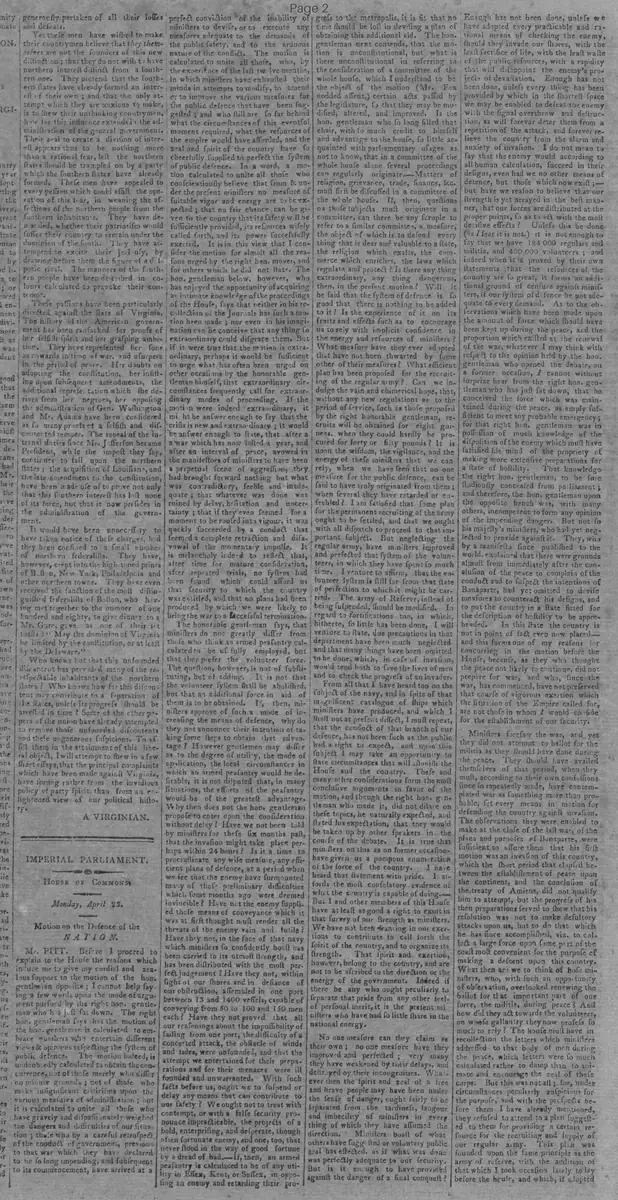
HOUSE OF COMMONS
Monday, April 23.
Motion on the Defence of the NATION.
Mr. PITT. Before I proceed to explain to the House the reasons which induce me to give my cordial and zealous support to the motion of the hon. gentleman opposite; I cannot help saying a few words upon the mode of argument pursued by the right hon. gentleman who has just sat down. The right hon. gentleman says that the motion of the hon. gentleman is calculated to embrace numbers who entertain different views & opinions respecting the system of public defence. The motion indeed, is undoubtedly calculated to obtain the concurrence, not of those merely who differ on minute grounds; not of those who make insignificant criticisms upon the various measures of administration; but it is calculated to unite all those who have gravely and dispassionately weighed the dangers and difficulties of our situation; those who by a careful retrospect of the conduct of government, previous to that war which they have declared to be so long impending, and subsequent to its commencement, have arrived at a perfect conviction of the inability of ministers to devise, or to execute any measures adequate to the demands of the public safety, and to the arduous nature of the conflict. The motion is calculated to unite all those, who, by the experience of the last twelve months, in which ministers have exhausted their minds in attempts to modify, to amend or to improve the various measures for the public defence that have been suggested; and who still are so far behind what the circumstances of this eventful moment required, what the resources of the empire would have afforded, and the zeal and spirit of the country have so cheerfully supplied to perfect the system of public defence. In a word, a motion calculated to unite all those who conscientiously believe that from & under the present ministers no measure of suitable vigor and energy are to be expected; that no fair chance can be given to the Country that its safety will be sufficiently provided, its resources wisely called forth, and its power successfully exerted. It is in this view that I consider the motion for almost all the reasons urged by the right hon. mover, and for others which he did not state. The hon. gentleman below, however, who has enjoyed the opportunity of acquiring an intimate knowledge of the proceedings of the House, says that neither in his recollection of the Journals has such a motion been made; nor even in his imagination can he conceive that any thing so extraordinary could disgrace them. But if it were true that the motion is extraordinary, perhaps it would be sufficient to urge what has often been urged on other occasions by the honorable gentleman himself, that extraordinary circumstances frequently call for extraordinary modes of proceeding. If the motion were indeed extraordinary, it might be answer enough to say that the crisis is new and extraordinary; it would be answer enough to state, that after a war which has now lasted a year, and after an interval of peace, avowed in the manifestoes of ministers to have been a perpetual scene of aggression, they had brought forward nothing but what was contradictory, feeble and inadequate; that whatever was done was ruined by delay, hesitation and uncertainty; that if they even seemed for a moment to be roused into vigour, it was quickly succeeded by a conduct that seemed a complete retraction and disavowal of the momentary impulse. It is melancholy indeed to reflect that, after time for mature consideration, after repeated trials, no system had been found which could afford us that security to which the country was entitled, and that no plans had been produced by which we were likely to bring the war to a successful termination.
The honorable gentleman says, that ministers do not greatly differ from those who think an armed peasantry calculated to be usefully employed, but that they prefer the volunteer force. The question, however, is not of substituting, but of adding. It is not that the volunteer system shall be abolished, but that an additional force in aid of them is to be obtained. If, then, ministers approve of such a mode of increasing the means of defence, why do they not announce their intention of taking some steps to obtain that advantage? However gentlemen may differ as to the degree of utility, the mode of application, the local circumstances in which an armed peasantry would be desirable, it is not disputed that, in many situations, the efforts of the peasantry would be of the greatest advantage. Why then does not the hon gentleman propose to enter upon the consideration without delay? Have we not been told by ministers for the six months past., that the invasion might take place perhaps within 24 hours? Is it a time to procrastinate any wise measure, any efficient plans of defence, at a period when we see that the enemy have surmounted many of those preliminary difficulties which, some months ago were deemed invincible? Have not the enemy supplied those means of conveyance which it was at first thought must render all the threats of the enemy vain and futile? Have they not, in the face of that navy which ministers so confidently boast has been carried to its utmost strength, and has been distributed with the most perfect judgement? Have they not, within sight of our shores and in defiance of our obstruction, assembled in one port between 13 and 1400 vessels, capable of conveying from 50 to 100 and 150 men each? Have they not proved that all our reasonings about the impossibility of sailing from one port, the difficulty of a concerted attack, the obstacle of winds and tides, were unfounded, and that the attempt we entertained for their preparations and for their menaces were ill founded and unwarranted. With such facts before us, ought we to suspend or delay any means that can contribute to our safety? We ought not to treat with contempt, or with a false security pronounce impracticable, the projects of a bold, enterprising, and desperate, though often fortunate enemy, and one, too, that never stood in the way of good fortune by a dread of bad. If, then, an armed peasantry is calculated to be of any utility in Essex, Kent, or Sussex, in opposing an enemy and retarding their progress to the metropolis, it is fit that no time should be lost in devising a plan of obtaining this additional aid. The hon. gentleman next contends, that the motion is unconstitutional, but what is there unconstitutional in referring to the consideration of a committee of the whole house, which I understand to be the object of the motion (Mr. Fox nodded assent,) certain acts passed by the legislature, so that they may be modified, altered, and improved. Is the hon. gentleman who so long filled that chair, with so much credit to himself and advantage to the house, so little acquainted with parliamentary usages as not to know, that in a committee of the whole house alone several proceedings can regularly originate. Matters of religion, grievance, trade, finance, &c. must first be discussed in a Committee of the whole house. If, then, questions on those subjects must originate in a committee, can there be any scruple to refer to a similar committee, a measure, the object of which is to defend every thing that is dear and valuable to a state, the religion which exalts, the commerce which enriches, the laws which regulate and protect? Is there any thing extraordinary, any thing dangerous, then, in the present motion? Will it be said that the system of defence is so good that there is nothing to be added to it? Is the experience of it on its fruits and effects such as to encourage us to rely with implicit confidence in the energy and resources of ministers? What measure have they ever adopted that have not been thwarted by some other of their measures? What efficient plan has been proposed for the recruiting of the regular army? Can we indulge the vain and chimerical hope, that, without any new regulations as to the period of service, such as those proposed by the right honorable gentleman, recruits will be obtained for eight guineas, when they could hardly be procured for forty or fifty pounds? It is upon the wisdom, the vigilance, and the energy of these ministers that we can rely, when we have seen that no one measure for the public defence, can be said to have truly originated from them; when several they have retarded or enfeebled? I am satisfied that some plan for the permanent recruiting of the army ought to be settled, and that we ought with all dispatch to proceed to that important subject. But neglecting the regular army, have ministers improved and perfected that system of the volunteers, in which they have spent so much time. I venture to affirm, that the volunteer system is still far from that state of perfection to which it might be carried. The army of Reserve, instead of being suspended, should be modified. In regard to fortifications too, in which, hitherto, so little has been done, I will venture to state, due precautions in that department have been much neglected and that many things have been omitted to be done, which, in case of invasion, would tend both to save the lives of men and to check the progress of an invader. From all that I have heard too on the subject of the navy, and in spite of that magnificent catalogue of ships which ministers have produced, and which I shall not at present dispute, I must repeat, that the conduct of that branch of our defence, has not been such as the public had a right to expect, and upon this subject I may take an opportunity to state circumstances that will astonish the House and the country. These and many other considerations form the most conclusive arguments in favor of the motion, and though the right hon. gentleman who made it, did not dilate on these topics, he naturally expected, and stated his expectation, that they would be taken up by other speakers in the course of the debate. It is true that ministers on this as on former occasions have given us a pompous enumeration of the force of the country. I have heard that statement with pride. It affords the most consolatory evidence of what the country is capable of doing. But I and other members of this House have at least as good a right to exult in that survey of our strength as ministers. We have not been wanting in our exertions to contribute to call forth the spirit of the country, and to organize its strength. That spirit and exertion, however, belong to the country, and are not to be ascribed to the direction or the energy of the government. Indeed if there be any who ought peculiarly to separate that pride from any other feeling of personal merit, it is the present ministers who have had so little share in the national energy.
No one measure can they claim as their own; no one measure have they improved and perfected; very many they have weakened by their delays, and destroyed by their incongruities. Whatever then the spirit and zeal of a free and brave people may have been under the sense of danger, ought fairly to be separated from the tardiness, languor and imbecility of ministers in every thing of which they have assumed the direction.
Ministers boast of what others have suggested or voluntary public zeal has effected, as if what was done was perfectly adequate to our security. But is it enough to have provided against the danger of a final conquest?
Enough has not been done, unless we have adopted every practicable and rational means of checking the enemy, should they invade our shores, with the least sacrifice of life, with the least waste of the public resources, with a rapidity that will disappoint the enemy's projects of devastation. Enough has not been done, unless every thing has been provided by which in the shortest space we may be enabled to defeat the enemy with the signal overthrow and destruction, as will forever deter them from a repetition of the attack, and forever relieve the country from the alarm and anxiety of invasion. I do not mean to say that the enemy would according to all human calculation, succeed in their designs, even had we no other means of defence, but those which now exist; but have we reason to believe that our strength is yet arrayed in the best manner, that our forces are distributed at the proper points, so as to act with the most decisive effects? Unless this be done (as I fear it is not,) it is not enough to say that we have 184,000 regulars and militia, and 400,000 volunteers; and indeed when it is proved by their own statements that the resources of the country are so great, it forms an additional ground of censure against ministers, if our system of defence be not adequate to every demand. As to the observations which have been made upon the amount of force which should have been kept up during the peace, and the proportion which existed at the renewal of the war, whatever I may think with respect to the opinion held by the hon. gentleman who opened the debate, on a former occasion, I cannot without surprise hear from the right hon. gentleman who has just sat down, that he conceived the force which was maintained during the peace, as amply sufficient to meet any probable emergency; for that right hon. gentleman was in possession of much knowledge of the disposition of the enemy which must have satisfied his mind of the propriety of making more extensive preparations for a state of hostility. That knowledge the right hon. gentleman, to be sure studiously concealed from parliament; and therefore, the hon. gentleman upon the opposite bench was, with many others, incompetent to form any opinion of the impending danger. But not so his majesty's ministers, who had yet neglected to provide against it. They, who by a manifesto since published to the world, explained that there were grounds almost from immediately after the conclusion of the peace to complain of the conduct and to suspect the intentions of Bonaparte, had yet omitted to devise measures to counteract his designs, and to put the country in a state fitted for the description of hostility to be apprehended. In this state the country is not in point of fact even now placed and this forms one of my reasons for concurring in the motion before the House, because, as they who thought the peace not likely to continue, did not prepare for war, and who, since the war, has commenced, have not preserved that course of vigorous exertion which the situation of the Empire called for. are not those in whom I would confide for the establishment of our security.
Ministers foresaw the war, and yet they did not attempt to ballot for the militia as they should have done during the peace. They should have availed themselves of that period, when they must, according to their own confessions. since so repeatedly made, have contemplated war as something more than probable, set every means in motion for defending the country against invasion. The observations they were enabled to make at the close of the last war, of the plans and purposes of Bonaparte, were sufficient to assure them that his first motion was an invasion of this country, which the short period that elapsed between the establishment of peace upon the continent, and the conclusion of the treaty of Amiens, did not qualify him to attempt, but the progress of his then preparations served to show that his resolution was not to make desultory attacks upon us, but to do that which he has since accomplished, viz. to collect a large force upon some part of the coast most convenient for the purpose of making a descent upon this country. What then are we to think of those ministers, who, with such an opportunity of observation, overlooked renewing the ballot for that important part of our force, the militia, during peace? And how did they act towards the volunteers, on whose gallantry they now profess so much to rely? The house must have in recollection the letters which ministers addressed to that body of men during the peace, which letters were so much calculated rather to damp than to animate and encourage the zeal of those corps: But this was not all ; for, under circumstances peculiarly auspicious for the purpose, and with the prospects before them I have already mentioned, they refused to attend to a plan suggested to them for providing a certain resource for the recruiting and supply of our regular army. This plan was founded upon the same principle as the army of reserve, with the addition of that which I took occasion lately to lay before the house, and which, if adopted
when my opinion was first urged to ministers, would have furnished the means of adding to our army, with all possible expedition, not less than 40 or 50,000 men. This plan has, I admit, been since adopted in part; and I shall feel it my duty to urge the adoption of the whole of it again and again. The committee proposed by the motion I conceive the most convenient place for entering into the detail of this and other measures for the public defence--to no branch of which I perceive with regret have ministers attended in due time, and to the execution of none of which do they appear to be adequate. Passing by all the omissions I complain of during the period of peace; drawing a veil over their conduct on that occasion altogether; and supposing the war recommenced as much to the surprise of ministers as to that of many persons in that house and the country; supposing that they were not all prepared to expect it--let us only look at their proceedings since that event, and let us examine how far their measures have been so contrived or executed as to justify a hope, much less an opinion, of safety to be derived from their exertions.
The first part of their plan of defence, and that to which they seemed principally to look, related to volunteers. This topic has, I am aware, been already very fully discussed, and on that account overlooked by the hon. mover of the proposition before the house: but upon this point I would wish to ask of ministers whether they foresaw or had even a remote idea at the commencement of hostilities, that this description of our force would have extended so far, whether they contemplated that it ever should be so numerous? It was known by those who had any knowledge of their sentiments, who had any conversation with ministers, that they had no such intentions, & that on the contrary they expressed their disapprobation of the policy of their predecessors in allowing the volunteer system to enlarge so much. This fact I alluded to merely to show that they are entitled to no praise for the multiplication of the volunteers: & to state that the spirit which produced the increase of that body arose outvies their calculation or hopes : and also, as it seemed, exceeded their power of direction, for they afterwards thought proper to check and restrain it. So much as to the origin of the volunteer system.
But how did ministers proceed to carry that system into execution ? Why, without going much at length into this part of the subject, which I do not mean at present. I will merely remark on the case of exemptions, which have been much and very justly objected to--The propriety of granting these exemptions I could never see uncertain it is that they were never necessary; for the volunteers for the most part required no such thing in the shape of encouragement to their services, and many of them were not at all aware when they did engage: that any exemptions were to be granted : on the contrary, it is notorious that they were in several districts actually subscribing a certain sum of each to purchase substitutes for any of their body which might be balloted for the militia. Such was the state of the volunteers when the act of parliament was passed with the strong recommendation of ministers for allowing exemptions, clogged however with such conditions that the measure was not be well understood. In another part of this act of ministers, there was something still less intelligible with respect to a volunteer's right of resignation, upon which ministers had evinced the most mot complete want of penetration and foresight. Had they judged wisely. they never would have attempted to dispute this right; for paradoxical as it may seem, nothing tends more to preserve discipline among the corps than the undisputed exercise of this right ; and the reason is this, that, while a volunteer has the right of leaving a corps, he cannot object to any regulation that may be deemed necessary by a commanding officer for the promotion of order and discipline in such corps, the private having his choice to submit or resign : but as to the act of ministers and the attorney general, for whose judgment and learning I entertain the most unfeigned respect, interpreted the law upon resignations in one way, and the court of king's bench in another. Ministers in this contradiction thought proper to circulate the opinion of the former as that to be acted upon by the volunteers, although they have since avowed that they did not agree with that opinion, and that they intended to introduce a declaratory law upon the subject. This I must class among the most unaccountable proceedings of ministers.--As to the volunteer system generally, according to its present constitution, it appears to me to have several radical errors, & principally as to the mode in which the volunteers are distributed over the face of the country. When they were forming, and particularly when it was determined to limit their numbers, regard should have been had to the proportion proper to be assigned to each district. With that view, it would have been right to consider the difference between the inland and maritime counties
What sub-type of article is it?
What keywords are associated?
What entities or persons were involved?
Where did it happen?
Foreign News Details
Primary Location
England
Event Date
Monday, April 23.
Key Persons
Event Details
Mr. Pitt delivers a speech in the House of Commons supporting a motion to refer defense acts to a committee for modification and improvement, criticizing ministers for inadequate preparations against enemy invasion, including failures in volunteer system, armed peasantry, army recruitment, fortifications, and navy conduct, amid a war lasting a year after a peace interval.