Thank you for visiting SNEWPapers!
Sign up free
Southern Christian Advocate
Charleston, Charleston County, South Carolina
What is this article about?
An analysis of Russian socialism, contrasting native peasant communal land ownership with imported Marxist industrial socialism. Discusses leaders like Milyukov, Kerensky, Lenin, and Trotsky, predicting a primitive Soviet system rather than Western parliamentary government.
Clipping
OCR Quality
Full Text
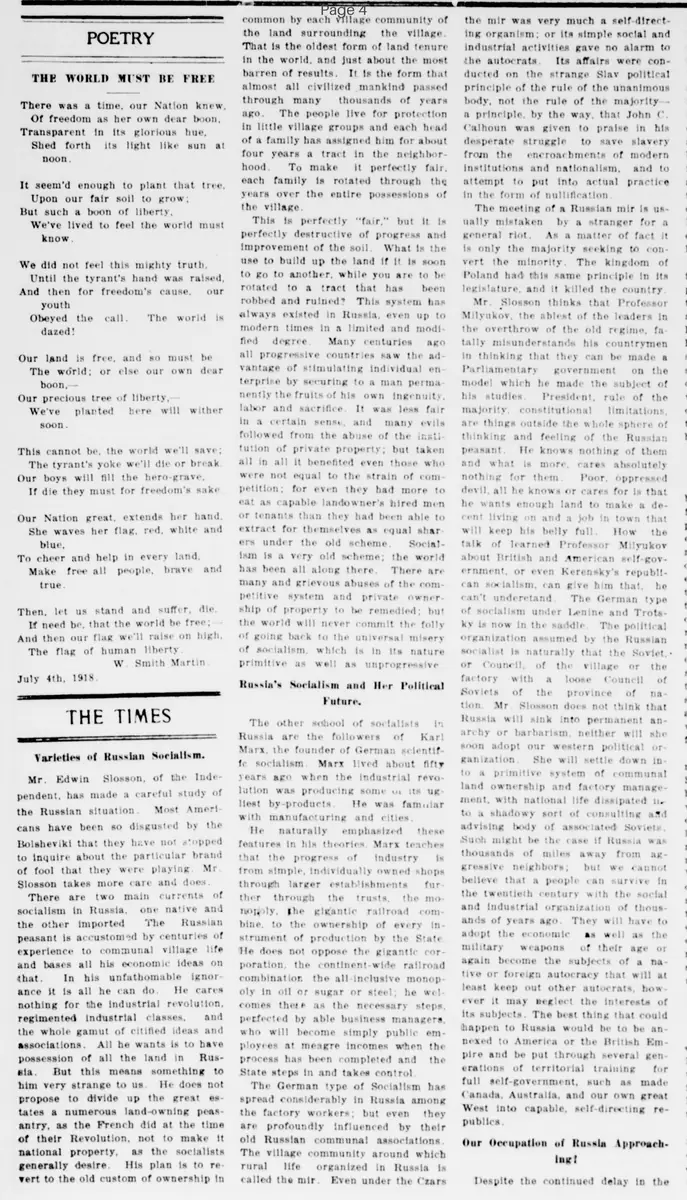
Varieties of Russian Socialism.
Mr. Edwin Slosson, of the Independent, has made a careful study of the Russian situation. Most Americans have been so disgusted by the Bolsheviki that they have not stopped to inquire about the particular brand of fool that they were playing. Mr. Slosson takes more care and does.
There are two main currents of socialism in Russia, one native and the other imported. The Russian peasant is accustomed by centuries of experience to communal village life and bases all his economic ideas on that. In his unfathomable ignorance it is all he can do. He cares nothing for the industrial revolution, regimented industrial classes, and the whole gamut of citified ideas and associations. All he wants is to have possession of all the land in Russia.
But this means something to him very strange to us. He does not propose to divide up the great estates among a numerous land-owning peasantry, as the French did at the time of their Revolution, not to make it national property, as the socialists generally desire. His plan is to revert to the old custom of ownership in common by each village community of the land surrounding the village.
That is the oldest form of land tenure in the world, and just about the most barren of results. It is the form that almost all civilized mankind passed through many thousands of years ago. The people live for protection in little village groups and each head of a family has assigned him for about four years a tract in the neighborhood. To make it perfectly fair, each family is rotated through the years over the entire possessions of the village.
This is perfectly "fair," but it is perfectly destructive of progress and improvement of the soil. What is the use to build up the land if it is soon to go to another, while you are to be rotated to a tract that has been robbed and ruined? This system has always existed in Russia, even up to modern times in a limited and modified degree.
Many centuries ago all progressive countries saw the advantage of stimulating individual enterprise by securing to a man permanently the fruits of his own ingenuity, labor and sacrifice. It was less fair in a certain sense, and many evils followed from the abuse of the institution of private property; but taken all in all it benefited even those who were not equal to the strain of competition: for even they had more to eat as capable landowners' hired men or tenants than they had been able to extract for themselves as equal sharers under the old scheme. Socialism is a very old scheme: the world has been all along there. There are many and grievous abuses of the competitive system and private ownership of property to be remedied: but the world will never commit the folly of going back to the universal misery of socialism, which is in its nature primitive as well as unprogressive.
Russia's Socialism and Her Political Future.
The other school of socialists in Russia are the followers of Karl Marx, the founder of German scientific socialism. Marx lived about fifty years ago when the industrial revolution was producing some of its ugliest by-products. He was familiar with manufacturing and cities. He naturally emphasized these features in his theories. Marx teaches that the progress of industry is from simple, individually owned shops through larger establishments further through the trusts, the monopoly, the gigantic railroad combine, to the ownership of every instrument of production by the State. He does not oppose the gigantic corporation, the continent-wide railroad combination, the all-inclusive monopoly in oil or sugar or steel; he welcomes there as the necessary steps, perfected by able business managers, who will become simply public employees at meagre incomes when the process has been completed and the State steps in and takes control.
The German type of Socialism has spread considerably in Russia among the factory workers; but even they are profoundly influenced by their old Russian communal associations. The village community around which rural life organized in Russia is called the mir. Even under the Czars the mir was very much a self-directing organism: or its simple social and industrial activities gave no alarm to the autocrats. Its affairs were conducted on the strange Slav political principle of the rule of the unanimous body, not the rule of the majority—a principle, by the way, that John C. Calhoun was given to praise in his desperate struggle to save slavery from the encroachments of modern institutions and nationalism, and to attempt to put into actual practice in the form of nullification.
The meeting of a Russian mir is usually mistaken by a stranger for a general riot. As a matter of fact it is only the majority seeking to convert the minority. The kingdom of Poland had this same principle in its legislature, and it killed the country.
Mr. Slosson thinks that Professor Milyukov, the ablest of the leaders in the overthrow of the old regime, fatally misunderstands his countrymen in thinking that they can be made a Parliamentary government on the model which he made the subject of his studies. President, rule of the majority, constitutional limitations, are things outside the whole sphere of thinking and feeling of the Russian peasant. He knows nothing of them and what is more, cares absolutely nothing for them. Poor, oppressed devil, all he knows or cares for is that he wants enough land to make a decent living on and a job in town that will keep his belly full. How the talk of learned Professor Milyukov about British and American self-government, or even Kerensky's republican socialism, can give him that, he can't understand. The German type of socialism under Lenin and Trotsky is now in the saddle. The political organization assumed by the Russian socialist is naturally that the Soviet, or Council, of the village or the factory with a loose council of Soviets of the province or nation. Mr. Slosson does not think that Russia will sink into permanent anarchy or barbarism, neither will she soon adopt our western political organization. She will settle down into a primitive system of communal land ownership and factory management, with national life dissipated into a shadowy sort of consulting and advising body of associated Soviets.
Such might be the case if Russia was thousands of miles away from aggressive neighbors; but we cannot believe that a people can survive in the twentieth century with the social and industrial organization of thousands of years ago. They will have to adopt the economic as well as the military weapons of their age or again become the subjects of a native or foreign autocracy that will at least keep out other autocrats, however it may neglect the interests of its subjects. The best thing that could happen to Russia would be to be annexed to America or the British Empire and be put through several generations of territorial training for full self-government, such as made Canada, Australia, and our own great West into capable, self-directing republics.
What sub-type of article is it?
What keywords are associated?
What entities or persons were involved?
Where did it happen?
Foreign News Details
Primary Location
Russia
Key Persons
Outcome
russia predicted to settle into primitive communal land ownership and factory management under soviets, rather than western political organization.
Event Details
Two main socialist currents in Russia: native peasant communal village land ownership (mir system) and imported Marxist socialism emphasizing state control of industry. Bolsheviks (Lenin, Trotsky) hold power with Soviet councils. Milyukov's parliamentary ideas misunderstand Russian peasants' preferences for land and basic needs over majority rule or constitutions.