Thank you for visiting SNEWPapers!
Sign up free
Editorial
June 30, 1824
Massachusetts Spy And Worcester Advertiser
Worcester, Worcester County, Massachusetts
What is this article about?
Editorial from Worcester, June 30, 1824, endorses John Quincy Adams for U.S. President over William H. Crawford, citing Crawford's duelling, minority caucus nomination, and dubious supporters, while praising Adams' talents and integrity. Reflects broad local support for Adams.
Clipping
OCR Quality
98%
Excellent
Full Text
WORCESTER:
WEDNESDAY, JUNE 30, 1824.
OUR NEXT PRESIDENT.
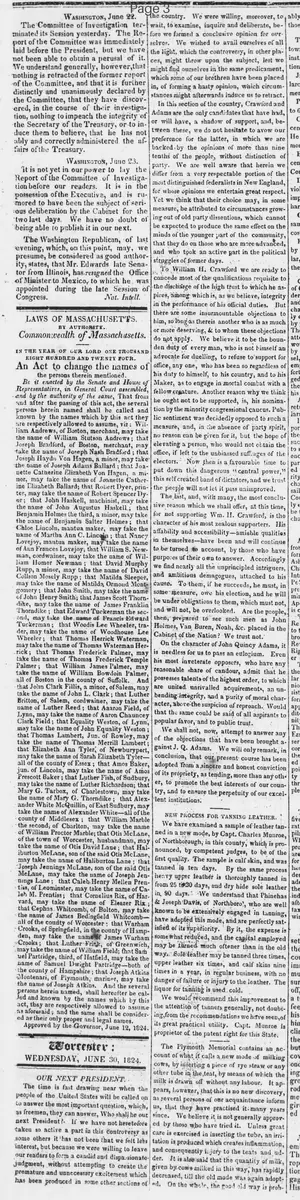
The time is fast drawing near when the people of the United States will be called on to answer the most important question, which, as freemen, they can answer, Who shall be our next President? If we have not heretofore taken so active a part in this controversy as some others it has not been that we felt less interest, but because we were willing to leave our readers to form a candid and dispassionate judgment, without attempting to create the premature and unnecessary excitement which has been produced in some other sections of the country. We were willing, moreover, to wait, to examine, inquire and deliberate, before we formed a conclusive opinion for ourselves. We wished to avail ourselves of all the light, which the controversy, in other places, might throw upon the subject, lest we might find ourselves in the same predicament which some of our brethren have been placed in, of forming a hasty opinion, which circumstances might afterwards induce us to retract. In this section of the country, Crawford and Adams are the only candidates that have had or will have, a shadow of support, and, between these, we do not hesitate to avow our preference for the latter, in which we are backed by the opinions of more than nine tenths of the people, without distinction of party. We are well aware that herein we differ from a very respectable portion of the most distinguished federalists in New England, for whose opinions we entertain great respect. Yet we think that their choice may, in some measure, be attributed to circumstances growing out of old party dissensions, which cannot be expected to produce the same effect on the minds of the younger part of the community, that they do on those who are more advanced, and who took an active part in the political struggles of former days. To William H. Crawford we are ready to concede most of the qualifications requisite to the discharge of the high trust to which he aspires, among which is, as we believe, integrity in the performance of his official duties. But there are some insurmountable objections to him, so long as there is another who is as much or more deserving, & to whom these objections do not apply. We believe it to be the bounden duty of every man, who is not himself an advocate for duelling, to refuse to support for office, any one, who has been so regardless of his duty to himself, to his country, and to his Maker, as to engage in mortal combat with a fellow creature. Another reason why we think he ought not to be supported, is, his nomination by the minority congressional caucus. Public sentiment was decidedly opposed to such a measure, and, in the absence of party spirit, no reason can be given for it, but the hope of elevating a person, who would not obtain the office, if left to the unbiased suffrages of the electors. Now then is a favourable time to put down this dangerous "central power," this self created band of dictators, and we trust the people will not let it pass unimproved. The last, and, with many, the most conclusive reason which we shall offer, at this time, for not supporting Wm. H. Crawford, is the character of his most zealous supporters. His affability and accessibility—amiable qualities in themselves—have been and will continue to be turned to account, by those who have purposes of their own to answer. Accordingly we find nearly all the unprincipled intriguers, and ambitious demagogues, attached to his cause. To them, if he succeeds, he must, in some measure, owe his election, and he will be under obligations to them, which must not and will not, be overlooked. Are the people, then, prepared to see such men as John Holmes, Van Buren, Noah, &c. placed in the Cabinet of the Nation? We trust not. On the character of John Quincy Adams, it is needless for us to pass an eulogium. Even his most inveterate opposers, who have any reasonable share of candour, admit that he possesses talents of the highest order, to which are united unrivalled acquirements, an unbending integrity, and a purity of moral character, above the suspicion of reproach. Would that the same could be said of all aspirants to popular favor, and to public trust. We shall not, now, attempt to answer any of the objections that have been brought against J. Q. Adams. We will only remark, in conclusion, that our present course has been adopted from a sincere and honest conviction of its propriety, as tending, more than any other, to promote the best interests of our country, and to ensure the perpetuity of our excellent institutions.
WEDNESDAY, JUNE 30, 1824.
OUR NEXT PRESIDENT.
The time is fast drawing near when the people of the United States will be called on to answer the most important question, which, as freemen, they can answer, Who shall be our next President? If we have not heretofore taken so active a part in this controversy as some others it has not been that we felt less interest, but because we were willing to leave our readers to form a candid and dispassionate judgment, without attempting to create the premature and unnecessary excitement which has been produced in some other sections of the country. We were willing, moreover, to wait, to examine, inquire and deliberate, before we formed a conclusive opinion for ourselves. We wished to avail ourselves of all the light, which the controversy, in other places, might throw upon the subject, lest we might find ourselves in the same predicament which some of our brethren have been placed in, of forming a hasty opinion, which circumstances might afterwards induce us to retract. In this section of the country, Crawford and Adams are the only candidates that have had or will have, a shadow of support, and, between these, we do not hesitate to avow our preference for the latter, in which we are backed by the opinions of more than nine tenths of the people, without distinction of party. We are well aware that herein we differ from a very respectable portion of the most distinguished federalists in New England, for whose opinions we entertain great respect. Yet we think that their choice may, in some measure, be attributed to circumstances growing out of old party dissensions, which cannot be expected to produce the same effect on the minds of the younger part of the community, that they do on those who are more advanced, and who took an active part in the political struggles of former days. To William H. Crawford we are ready to concede most of the qualifications requisite to the discharge of the high trust to which he aspires, among which is, as we believe, integrity in the performance of his official duties. But there are some insurmountable objections to him, so long as there is another who is as much or more deserving, & to whom these objections do not apply. We believe it to be the bounden duty of every man, who is not himself an advocate for duelling, to refuse to support for office, any one, who has been so regardless of his duty to himself, to his country, and to his Maker, as to engage in mortal combat with a fellow creature. Another reason why we think he ought not to be supported, is, his nomination by the minority congressional caucus. Public sentiment was decidedly opposed to such a measure, and, in the absence of party spirit, no reason can be given for it, but the hope of elevating a person, who would not obtain the office, if left to the unbiased suffrages of the electors. Now then is a favourable time to put down this dangerous "central power," this self created band of dictators, and we trust the people will not let it pass unimproved. The last, and, with many, the most conclusive reason which we shall offer, at this time, for not supporting Wm. H. Crawford, is the character of his most zealous supporters. His affability and accessibility—amiable qualities in themselves—have been and will continue to be turned to account, by those who have purposes of their own to answer. Accordingly we find nearly all the unprincipled intriguers, and ambitious demagogues, attached to his cause. To them, if he succeeds, he must, in some measure, owe his election, and he will be under obligations to them, which must not and will not, be overlooked. Are the people, then, prepared to see such men as John Holmes, Van Buren, Noah, &c. placed in the Cabinet of the Nation? We trust not. On the character of John Quincy Adams, it is needless for us to pass an eulogium. Even his most inveterate opposers, who have any reasonable share of candour, admit that he possesses talents of the highest order, to which are united unrivalled acquirements, an unbending integrity, and a purity of moral character, above the suspicion of reproach. Would that the same could be said of all aspirants to popular favor, and to public trust. We shall not, now, attempt to answer any of the objections that have been brought against J. Q. Adams. We will only remark, in conclusion, that our present course has been adopted from a sincere and honest conviction of its propriety, as tending, more than any other, to promote the best interests of our country, and to ensure the perpetuity of our excellent institutions.
What sub-type of article is it?
Partisan Politics
What keywords are associated?
1824 Presidential Election
John Quincy Adams
William H. Crawford
Candidate Preference
Duelling Objection
Caucus Nomination
Political Supporters
What entities or persons were involved?
John Quincy Adams
William H. Crawford
John Holmes
Van Buren
Noah
Federalists In New England
Editorial Details
Primary Topic
Support For John Quincy Adams Over William H. Crawford In The 1824 Presidential Election
Stance / Tone
Preference For John Quincy Adams And Opposition To William H. Crawford
Key Figures
John Quincy Adams
William H. Crawford
John Holmes
Van Buren
Noah
Federalists In New England
Key Arguments
Crawford's Involvement In Duelling Disqualifies Him From Office
Crawford's Nomination By Minority Congressional Caucus Opposes Public Sentiment And Central Power
Character Of Crawford's Supporters Includes Unprincipled Intriguers And Demagogues
Adams Possesses High Talents, Unrivalled Acquirements, Unbending Integrity, And Pure Moral Character