Thank you for visiting SNEWPapers!
Sign up free
Letter to Editor
December 28, 1836
Morning Star
Limerick, York County, Maine
What is this article about?
A letter to the Morning Star critiques the spirit of aristocracy among Christians, arguing it contradicts equality and Christian principles. It examines aristocracy of pedigree, wealth, and intellect, using scripture, history, and an anecdote about Alexander to advocate humility and equality.
Clipping
OCR Quality
95%
Excellent
Full Text
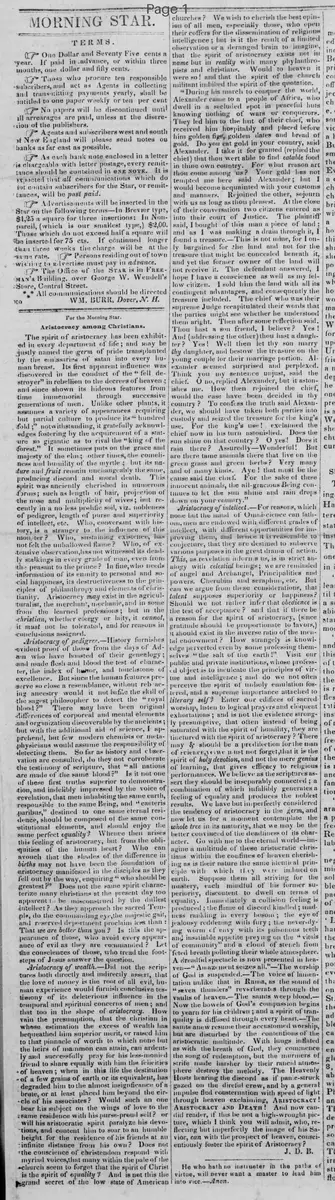
For the Morning Star.
Aristocracy among Christians.
The spirit of aristocracy has been exhibited in every department of life; and may be justly named the germ of pride transplanted by the emissaries of satan into every human breast. Its first apparent influence was discovered in the conduct of the "fell destroyer" in rebellion to the decrees of heaven; and since shown its hideous features from time immemorial through successive generations of men. Unlike other plants, it assumes a variety of appearances requiring but partial culture to produce its "hundred fold;" notwithstanding, it gratefully acknowledges fostering by the acquisition of a stature so gigantic as to rival the "king of the forest." It sometimes puts on the grace and majesty of the elms other times, the comeliness and humility of the myrtle; but its nature and fruit remain unchangeably the same, producing discord and moral death. This spirit was anciently cherished in numerous forms; such as length of hair, projection of the nose and multiplicity of wives; but recently in a no less prolific soil, viz. nobleness of pedigree, length of purse and superiority of intellect, etc. Who, conversant with history, is a stranger to the influence of this monster? Who, sustaining existence, has not felt the unhallowed flame? Who, of extensive observation, has not witnessed its deadly stalkings in every grade of man, even from the peasant to the prince? In fine, who needs information of its enmity to personal and social happiness, its destructiveness to the principles of philanthropy and elements of christianity. Aristocracy may exist in the agriculturalist, the merchant, mechanic, and in some from the learned professions; but in the christian, whether clergy or laity, it cannot, it must not be tolerated, and for reasons in conclusions assigned.
Aristocracy of pedigree.—History furnishes evident proof of those from the days of Adam who have boasted of their genealogies and made flesh and blood the test of character, the index of honor, and touchstone of excellence. But since the human features preserve so close a resemblance, without reb being ancestry would it not baffle the skill of the sagest philosopher to detect the "royal blood?" There may have been original differences of corporeal and mental elements and organization discoverable by the ancients; but with the additional aid of science, I apprehend, but few modern chemists or metaphysicians would assume the responsibility of detecting them. So far as history and observation are consulted, do they not corroborate the testimony of scripture, that "all nations are made of the same blood?" Is it not one of these first truths superior to demonstration, and indelibly impressed by the voice of revelation, that men inhabiting the same earth, responsible to the same Being, and "ceteris paribus." destined to one same eternal residence, should be composed of the same constitutional elements, and should enjoy the same perfect equality? Whence then arises this feeling of aristocracy, but from the obliquities of the human heart? Who can avouch that the shades of the difference in births may not have been the foundation of aristocracy manifested in the disciples as they fell out by the way, enquiring "who should be greatest?" Does not the same spirit characterize many christians at the present day too apparent to be misconstrued by the dullest intellect? As they approach the sacred Temple, do the commanding eye, the majestic gait, and reserved deportment proclaim less than: That we are better than you? Is this the appearance of those, who avoid every appearance of evil as they are commanded? Let the consciences of those, who tread the footsteps of Jesus answer the question.
Aristocracy of wealth.—Did not the scriptures both directly and indirectly assert, that the love of money is the root of all evil, human experience would furnish conclusive testimony of its deleterious influence in the temporal and spiritual concerns of men; and that too in the shape of aristocracy. How vain the presumption, that the christian in whose estimation the excess of wealth has bequeathed him superior merit, or raised him to that pinnacle of worth to which none but the heirs of mammon can attain, can ardently and successfully pray for his less-monied friend to share equally with him the felicities of heaven; when in this life the destitution of a few grains of earth or its equivalent, has degraded him to the almost insignificance of a brute, or at least placed him beyond the circle of his associates? Would such an one bear his subject on the wings of love to the same residence with his purse-proud self? or will his aristocratic spirit paralyze his devotions, and content him to soar to an humble height for the residence of his friends at an infinite distance from his own? Does not the conscience of christendom respond with myriad voices, that many within the pale of the church seem to forget that the spirit of Christ is the spirit of equality? And is not this the grand secret of the low state of American churches? We wish to cherish the best opinion of all men, especially those, who open their coffers for the dissemination of religious intelligence; but is it the result of a limited observation or a deranged brain to imagine, that the spirit of aristocracy exists not in name but in reality with many philanthropists and christians. Would to heaven it were so! and that the spirit of the church militant imbibed the spirit of the quotation.
"During his march to conquer the world, Alexander came to a people of Africa, who dwell in a secluded spot in peaceful huts knowing nothing of wars or conquerors. They led him to the hut of their chief, who received him hospitably and placed before him golden figs, golden dates and bread of gold." Do you eat gold in your country, said Alexander. I take it for granted (replied the chief) that thou wert able to find eatable food in thine own country. For what reason art thou come among us? Your gold has not tempted me here said Alexander; but I would become acquainted with your customs and manners. Rejoined the other, sojourn with us as long as thou pleasest. At the close of their conversation two citizens entered as into their court of Justice. The plaintiff said, I bought of this man a piece of land: and as I was making a drain through it, I found a treasure. This is not mine, for I only bargained for the land and not for the treasure that might be concealed beneath it, and yet the former owner of the land will not receive it. The defendant answered, I hope I have a conscience as well as my fellow citizen. I sold him the land with all its contingent advantages, and consequently the treasure included. The chief who was their supreme Judge recapitulated their words that the parties might see whether he understood them aright. Then after some reflection said. Thou hast a son friend, I believe? Yes! And (addressing the other) thou hast a daughter? Yes! Well then let thy son marry thy daughter, and bestow the treasure on the young couple for their marriage portion. Alexander seemed surprised and perplexed. Think you my sentence unjust, said the chief. O no, replied Alexander, but it astonishes me. How then rejoined the chief. would the case have been decided in thy country? To confess the truth said Alexander, we should have taken both parties into custody and seized the treasure for the king's use. For the king's use! exclaimed the chief now in his turn astonished. Does the sun shine on that country? O yes! Does it rain there? Assuredly—Wonderful! But are there tame animals there that live on the green grass and green herbs? Very many and of many kinds. Aye! that must be the cause said the chief. For the sake of these innocent animals, the all-gracious Being continues to let the sun shine and rain drops down on your country."
Aristocracy of intellect.—For reasons, which none but the hand of Omniscience can fathom, men are endowed with different grades of intellect, with different opportunities for improving them, and hence it is reasonable to conjecture, that they are destined to subserve various purposes in the great drama of action. This, as revelation informs us, is in strict analogy with celestial beings; we are reminded of angel and Archangel, Principalities and powers. Cherubim and seraphim, etc. But can we argue from these considerations, that talent supposes superiority or happiness? Should we not rather infer that obedience is the test of acceptance? and that if there be a reason for the spirit of aristocracy, (since gratitude should be proportionate to favors,) it should exist in the inverse ratio of the mental endowment? How strangely is knowledge perverted even by some professing themselves "the salt of the earth!" Visit our public and private institutions, whose professed object is to inculcate the principles of virtue and intelligence; and do we not often perceive the spirit of unholy emulation fostered, and a supreme importance attached to literary self? Enter our edifices of sacred worship, listen to logical prayers and eloquent exhortations; and is not the evidence strongly presumptive, that often instead of being saturated with the spirit of humility, they are tinctured with the spirit of aristocracy? There may & should be a predilection for the man of science; we must not forget, that it is the spirit of holy devotion, and not the mere genius of learning, that gives efficacy to religious performances. We believe as the scriptures assert they should be inseparably connected; a combination of which infallibly generates a feeling of equality and produces the noblest results. We have but imperfectly considered the tendency of aristocracy in the germ, and now let us for a moment contemplate the whole tree in its maturity, that we may be the better convinced of the deadliness of its character. Go with me to the eternal world—imagine a multitude of these aristocratic christians within the confines of heaven cherishing as is their nature the same identical principle with which they were imbued on earth. Suppose them all striving for the mastery, each mindful of his former superiority, discontent to dwell on terms of equality. Immediately a collision feeling is produced; the flame of discord kindled; madness rankling in every bosom; the eye of jealousy reddening with fury; the never-dying worm of envy with its poisonous teeth and insatiable appetite preying on the "vitals of community" and a cloud of stench from feted breath polluting their whole atmosphere. A dreadful spectacle is now presented in heaven—"Amazement seizes all."—The worship of God is suspended.—The voice of lamentation unlike that in Rama, as the sound of "seven thunders" reverberates through the vaults of heaven.—The saints weep blood.—Now the bowels of God's compassion begins to yearn for his children; and a spirit of tranquility is diffused through every heart.—The saints anew resume their accustomed worship, but are disturbed by the contentions of the aristocratic multitude. With lungs inflated as with the breath of God, they commence the song of redemption. but the murmurs of strife made harsher by their rancid atmosphere destroy the melody. The Heavenly Hosts hearing the discord as if panic-struck gazed on the dreadful crew, and by a general impulse fled consternation with speed of light through heaven exclaiming, Aristocracy! Aristocracy and Death! And now candid reader, if this be not a high-wrought picture, which I think you will admit, who, reflecting but imperfectly the image of his Savior, can with the prospect of heaven, conscientiously foster the spirit of Aristocracy?
J. D. B.
He who hath no instructor in the paths of virtue, will never want a master to lead him into vice.—Anon.
Aristocracy among Christians.
The spirit of aristocracy has been exhibited in every department of life; and may be justly named the germ of pride transplanted by the emissaries of satan into every human breast. Its first apparent influence was discovered in the conduct of the "fell destroyer" in rebellion to the decrees of heaven; and since shown its hideous features from time immemorial through successive generations of men. Unlike other plants, it assumes a variety of appearances requiring but partial culture to produce its "hundred fold;" notwithstanding, it gratefully acknowledges fostering by the acquisition of a stature so gigantic as to rival the "king of the forest." It sometimes puts on the grace and majesty of the elms other times, the comeliness and humility of the myrtle; but its nature and fruit remain unchangeably the same, producing discord and moral death. This spirit was anciently cherished in numerous forms; such as length of hair, projection of the nose and multiplicity of wives; but recently in a no less prolific soil, viz. nobleness of pedigree, length of purse and superiority of intellect, etc. Who, conversant with history, is a stranger to the influence of this monster? Who, sustaining existence, has not felt the unhallowed flame? Who, of extensive observation, has not witnessed its deadly stalkings in every grade of man, even from the peasant to the prince? In fine, who needs information of its enmity to personal and social happiness, its destructiveness to the principles of philanthropy and elements of christianity. Aristocracy may exist in the agriculturalist, the merchant, mechanic, and in some from the learned professions; but in the christian, whether clergy or laity, it cannot, it must not be tolerated, and for reasons in conclusions assigned.
Aristocracy of pedigree.—History furnishes evident proof of those from the days of Adam who have boasted of their genealogies and made flesh and blood the test of character, the index of honor, and touchstone of excellence. But since the human features preserve so close a resemblance, without reb being ancestry would it not baffle the skill of the sagest philosopher to detect the "royal blood?" There may have been original differences of corporeal and mental elements and organization discoverable by the ancients; but with the additional aid of science, I apprehend, but few modern chemists or metaphysicians would assume the responsibility of detecting them. So far as history and observation are consulted, do they not corroborate the testimony of scripture, that "all nations are made of the same blood?" Is it not one of these first truths superior to demonstration, and indelibly impressed by the voice of revelation, that men inhabiting the same earth, responsible to the same Being, and "ceteris paribus." destined to one same eternal residence, should be composed of the same constitutional elements, and should enjoy the same perfect equality? Whence then arises this feeling of aristocracy, but from the obliquities of the human heart? Who can avouch that the shades of the difference in births may not have been the foundation of aristocracy manifested in the disciples as they fell out by the way, enquiring "who should be greatest?" Does not the same spirit characterize many christians at the present day too apparent to be misconstrued by the dullest intellect? As they approach the sacred Temple, do the commanding eye, the majestic gait, and reserved deportment proclaim less than: That we are better than you? Is this the appearance of those, who avoid every appearance of evil as they are commanded? Let the consciences of those, who tread the footsteps of Jesus answer the question.
Aristocracy of wealth.—Did not the scriptures both directly and indirectly assert, that the love of money is the root of all evil, human experience would furnish conclusive testimony of its deleterious influence in the temporal and spiritual concerns of men; and that too in the shape of aristocracy. How vain the presumption, that the christian in whose estimation the excess of wealth has bequeathed him superior merit, or raised him to that pinnacle of worth to which none but the heirs of mammon can attain, can ardently and successfully pray for his less-monied friend to share equally with him the felicities of heaven; when in this life the destitution of a few grains of earth or its equivalent, has degraded him to the almost insignificance of a brute, or at least placed him beyond the circle of his associates? Would such an one bear his subject on the wings of love to the same residence with his purse-proud self? or will his aristocratic spirit paralyze his devotions, and content him to soar to an humble height for the residence of his friends at an infinite distance from his own? Does not the conscience of christendom respond with myriad voices, that many within the pale of the church seem to forget that the spirit of Christ is the spirit of equality? And is not this the grand secret of the low state of American churches? We wish to cherish the best opinion of all men, especially those, who open their coffers for the dissemination of religious intelligence; but is it the result of a limited observation or a deranged brain to imagine, that the spirit of aristocracy exists not in name but in reality with many philanthropists and christians. Would to heaven it were so! and that the spirit of the church militant imbibed the spirit of the quotation.
"During his march to conquer the world, Alexander came to a people of Africa, who dwell in a secluded spot in peaceful huts knowing nothing of wars or conquerors. They led him to the hut of their chief, who received him hospitably and placed before him golden figs, golden dates and bread of gold." Do you eat gold in your country, said Alexander. I take it for granted (replied the chief) that thou wert able to find eatable food in thine own country. For what reason art thou come among us? Your gold has not tempted me here said Alexander; but I would become acquainted with your customs and manners. Rejoined the other, sojourn with us as long as thou pleasest. At the close of their conversation two citizens entered as into their court of Justice. The plaintiff said, I bought of this man a piece of land: and as I was making a drain through it, I found a treasure. This is not mine, for I only bargained for the land and not for the treasure that might be concealed beneath it, and yet the former owner of the land will not receive it. The defendant answered, I hope I have a conscience as well as my fellow citizen. I sold him the land with all its contingent advantages, and consequently the treasure included. The chief who was their supreme Judge recapitulated their words that the parties might see whether he understood them aright. Then after some reflection said. Thou hast a son friend, I believe? Yes! And (addressing the other) thou hast a daughter? Yes! Well then let thy son marry thy daughter, and bestow the treasure on the young couple for their marriage portion. Alexander seemed surprised and perplexed. Think you my sentence unjust, said the chief. O no, replied Alexander, but it astonishes me. How then rejoined the chief. would the case have been decided in thy country? To confess the truth said Alexander, we should have taken both parties into custody and seized the treasure for the king's use. For the king's use! exclaimed the chief now in his turn astonished. Does the sun shine on that country? O yes! Does it rain there? Assuredly—Wonderful! But are there tame animals there that live on the green grass and green herbs? Very many and of many kinds. Aye! that must be the cause said the chief. For the sake of these innocent animals, the all-gracious Being continues to let the sun shine and rain drops down on your country."
Aristocracy of intellect.—For reasons, which none but the hand of Omniscience can fathom, men are endowed with different grades of intellect, with different opportunities for improving them, and hence it is reasonable to conjecture, that they are destined to subserve various purposes in the great drama of action. This, as revelation informs us, is in strict analogy with celestial beings; we are reminded of angel and Archangel, Principalities and powers. Cherubim and seraphim, etc. But can we argue from these considerations, that talent supposes superiority or happiness? Should we not rather infer that obedience is the test of acceptance? and that if there be a reason for the spirit of aristocracy, (since gratitude should be proportionate to favors,) it should exist in the inverse ratio of the mental endowment? How strangely is knowledge perverted even by some professing themselves "the salt of the earth!" Visit our public and private institutions, whose professed object is to inculcate the principles of virtue and intelligence; and do we not often perceive the spirit of unholy emulation fostered, and a supreme importance attached to literary self? Enter our edifices of sacred worship, listen to logical prayers and eloquent exhortations; and is not the evidence strongly presumptive, that often instead of being saturated with the spirit of humility, they are tinctured with the spirit of aristocracy? There may & should be a predilection for the man of science; we must not forget, that it is the spirit of holy devotion, and not the mere genius of learning, that gives efficacy to religious performances. We believe as the scriptures assert they should be inseparably connected; a combination of which infallibly generates a feeling of equality and produces the noblest results. We have but imperfectly considered the tendency of aristocracy in the germ, and now let us for a moment contemplate the whole tree in its maturity, that we may be the better convinced of the deadliness of its character. Go with me to the eternal world—imagine a multitude of these aristocratic christians within the confines of heaven cherishing as is their nature the same identical principle with which they were imbued on earth. Suppose them all striving for the mastery, each mindful of his former superiority, discontent to dwell on terms of equality. Immediately a collision feeling is produced; the flame of discord kindled; madness rankling in every bosom; the eye of jealousy reddening with fury; the never-dying worm of envy with its poisonous teeth and insatiable appetite preying on the "vitals of community" and a cloud of stench from feted breath polluting their whole atmosphere. A dreadful spectacle is now presented in heaven—"Amazement seizes all."—The worship of God is suspended.—The voice of lamentation unlike that in Rama, as the sound of "seven thunders" reverberates through the vaults of heaven.—The saints weep blood.—Now the bowels of God's compassion begins to yearn for his children; and a spirit of tranquility is diffused through every heart.—The saints anew resume their accustomed worship, but are disturbed by the contentions of the aristocratic multitude. With lungs inflated as with the breath of God, they commence the song of redemption. but the murmurs of strife made harsher by their rancid atmosphere destroy the melody. The Heavenly Hosts hearing the discord as if panic-struck gazed on the dreadful crew, and by a general impulse fled consternation with speed of light through heaven exclaiming, Aristocracy! Aristocracy and Death! And now candid reader, if this be not a high-wrought picture, which I think you will admit, who, reflecting but imperfectly the image of his Savior, can with the prospect of heaven, conscientiously foster the spirit of Aristocracy?
J. D. B.
He who hath no instructor in the paths of virtue, will never want a master to lead him into vice.—Anon.
What sub-type of article is it?
Philosophical
Ethical Moral
Persuasive
What themes does it cover?
Religion
Morality
Social Issues
What keywords are associated?
Aristocracy
Christianity
Equality
Pedigree
Wealth
Intellect
Morality
Humility
What entities or persons were involved?
J. D. B.
Morning Star
Letter to Editor Details
Author
J. D. B.
Recipient
Morning Star
Main Argument
the spirit of aristocracy, manifesting in pedigree, wealth, and intellect, is incompatible with christianity's emphasis on equality and humility, leading to discord even in heaven if unchecked.
Notable Details
References Scripture On Equality And Love Of Money
Anecdote Of Alexander And The African Chief Illustrating Just Governance
Vivid Imagery Of Aristocratic Christians Disrupting Heaven