Thank you for visiting SNEWPapers!
Sign up free
Story
April 23, 1850
Oxford Democrat
Paris, South Paris, Oxford County, Maine
What is this article about?
An explanatory article on the role of plants in converting minerals from soil and air into nourishment for humans and animals, detailing the natural cycle where animal waste fertilizes plants, and advocating the use of human refuse as soil fertilizer to maintain ecological balance.
Clipping
OCR Quality
95%
Excellent
Full Text
The Use and Value of Right Soil.
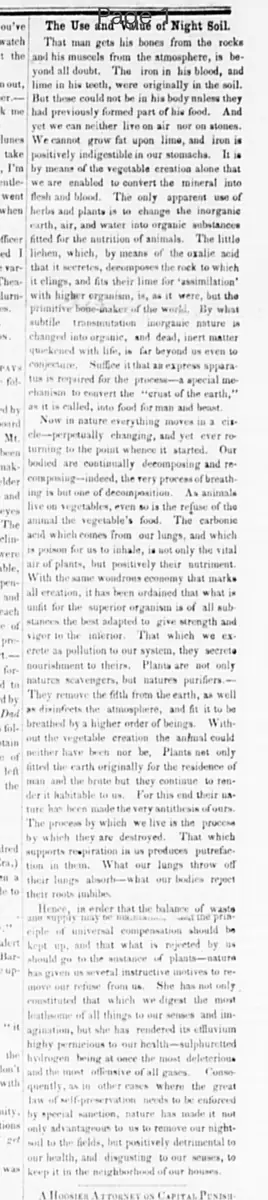
That man gets his bones from the rocks and his muscles from the atmosphere, is beyond all doubt. The iron in his blood, and lime in his teeth, were originally in the soil. But these could not be in his body unless they had previously formed part of his food. And yet we can neither live on air nor on stones. We cannot grow fat upon lime, and iron is positively indigestible in our stomachs. It is by means of the vegetable creation alone that we are enabled to convert the mineral into flesh and blood. The only apparent use of herbs and plants is to change the inorganic earth, air, and water into organic substances fitted for the nutrition of animals. The little lichen, which, by means of the oxalic acid that it secretes, decomposes the rock to which it clings, and fits their lime for 'assimilation' with higher organism, is, as it were, but the primitive bone-maker of the world. By what subtile transmutation inorganic nature is changed into organic, and dead, inert matter quickened with life, is far beyond us even to conjecture. Suffice it that an express apparatus is required for the process—a special mechanism to convert the "crust of the earth," as it is called, into food for man and beast.
Now in nature everything moves in a circle—perpetually changing, and yet ever returning to the point whence it started. Our bodies are continually decomposing and recomposing—indeed, the very process of breathing is but one of decomposition. As animals live on vegetables, even so is the refuse of the animal the vegetable's food. The carbonic acid which comes from our lungs, and which is poison for us to inhale, is not only the vital air of plants, but positively their nutriment. With the same wondrous economy that marks all creation, it has been ordained that what is unfit for the superior organism is of all substances the best adapted to give strength and vigor to the inferior. That which we excrete as pollution to our system, they secrete nourishment to theirs. Plants are not only nature's scavengers, but nature's purifiers.—They remove the filth from the earth, as well as disinfect the atmosphere, and fit it to be breathed by a higher order of beings. Without the vegetable creation the animal could neither have been nor be. Plants not only fitted the earth originally for the residence of man and the brute but they continue to render it habitable to us. For thus end their nature has been made the very antithesis of ours.
The process by which we live is the process by which they are destroyed. That which supports respiration in us produces putrefaction in them. What our lungs throw off their lungs absorb—what our bodies reject their roots imbibe.
Hence, in order that the balance of waste and supply may be maintained—with the principle of universal compensation should be kept up, and that what is rejected by us should go to the sustenance of plants—nature has given us several instinctive motives to remove our refuse from us. She has not only constituted that which we digest the most loathsome of all things to our senses and imagination, but she has rendered its effluvium highly pernicious to our health—sulphuretted hydrogen being at once the most deleterious and the most offensive of all gases. Consequently, as in other cases where the great law of self-preservation needs to be enforced by special sanction, nature has made it not only advantageous to us to remove our night-soil to the fields, but positively detrimental to our health, and disgusting to our senses, to keep it in the neighborhood of our houses.
That man gets his bones from the rocks and his muscles from the atmosphere, is beyond all doubt. The iron in his blood, and lime in his teeth, were originally in the soil. But these could not be in his body unless they had previously formed part of his food. And yet we can neither live on air nor on stones. We cannot grow fat upon lime, and iron is positively indigestible in our stomachs. It is by means of the vegetable creation alone that we are enabled to convert the mineral into flesh and blood. The only apparent use of herbs and plants is to change the inorganic earth, air, and water into organic substances fitted for the nutrition of animals. The little lichen, which, by means of the oxalic acid that it secretes, decomposes the rock to which it clings, and fits their lime for 'assimilation' with higher organism, is, as it were, but the primitive bone-maker of the world. By what subtile transmutation inorganic nature is changed into organic, and dead, inert matter quickened with life, is far beyond us even to conjecture. Suffice it that an express apparatus is required for the process—a special mechanism to convert the "crust of the earth," as it is called, into food for man and beast.
Now in nature everything moves in a circle—perpetually changing, and yet ever returning to the point whence it started. Our bodies are continually decomposing and recomposing—indeed, the very process of breathing is but one of decomposition. As animals live on vegetables, even so is the refuse of the animal the vegetable's food. The carbonic acid which comes from our lungs, and which is poison for us to inhale, is not only the vital air of plants, but positively their nutriment. With the same wondrous economy that marks all creation, it has been ordained that what is unfit for the superior organism is of all substances the best adapted to give strength and vigor to the inferior. That which we excrete as pollution to our system, they secrete nourishment to theirs. Plants are not only nature's scavengers, but nature's purifiers.—They remove the filth from the earth, as well as disinfect the atmosphere, and fit it to be breathed by a higher order of beings. Without the vegetable creation the animal could neither have been nor be. Plants not only fitted the earth originally for the residence of man and the brute but they continue to render it habitable to us. For thus end their nature has been made the very antithesis of ours.
The process by which we live is the process by which they are destroyed. That which supports respiration in us produces putrefaction in them. What our lungs throw off their lungs absorb—what our bodies reject their roots imbibe.
Hence, in order that the balance of waste and supply may be maintained—with the principle of universal compensation should be kept up, and that what is rejected by us should go to the sustenance of plants—nature has given us several instinctive motives to remove our refuse from us. She has not only constituted that which we digest the most loathsome of all things to our senses and imagination, but she has rendered its effluvium highly pernicious to our health—sulphuretted hydrogen being at once the most deleterious and the most offensive of all gases. Consequently, as in other cases where the great law of self-preservation needs to be enforced by special sanction, nature has made it not only advantageous to us to remove our night-soil to the fields, but positively detrimental to our health, and disgusting to our senses, to keep it in the neighborhood of our houses.
What sub-type of article is it?
Curiosity
What themes does it cover?
Nature
Providence Divine
What keywords are associated?
Soil Fertility
Plant Nutrition
Nutrient Cycle
Human Waste
Natural Balance
Fertilizer
Story Details
Story Details
Plants convert inorganic minerals from soil, air, and water into organic food for animals and humans; animal waste, including human night-soil, nourishes plants in a natural cycle, making proper soil management essential for health and fertility.