Thank you for visiting SNEWPapers!
Sign up free
Daily Cincinnati Republican
Cincinnati, Hamilton County, Ohio
What is this article about?
Correspondence from Washington, June 16, 1841, reports on congressional inaction, debates over McLeod case and abolition petitions, adoption of House rules limiting petitions, plans to remove Gen. Harrison's body to North Bend, and criticism of limited appropriation to his family amid political wrangling.
Clipping
OCR Quality
Full Text
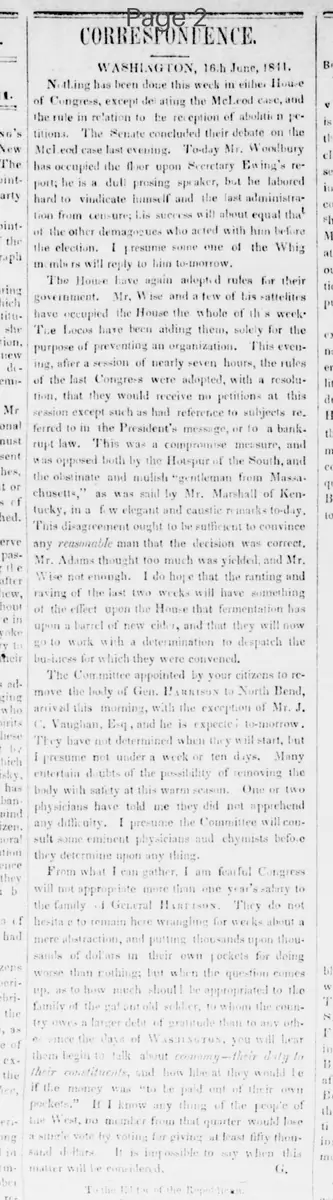
WASHINGTON, 16th June, 1841.
Nothing has been done this week in either House of Congress, except debating the McLeod case, and the rule in relation to the reception of abolition petitions. The Senate concluded their debate on the McLeod case last evening. To-day Mr. Woodbury has occupied the floor upon Secretary Ewing's report; he is a dull prosing speaker, but he labored hard to vindicate himself and the last administration from censure; his success will about equal that of the other demagogues who acted with him before the election. I presume some one of the Whig members will reply to him to-morrow.
The House have again adopted rules for their government. Mr. Wise and a few of his satellites have occupied the House the whole of this week. The Locos have been aiding them, solely for the purpose of preventing an organization. This evening, after a session of nearly seven hours, the rules of the last Congress were adopted, with a resolution, that they would receive no petitions at this session except such as had reference to subjects referred to in the President's message, or to a bankrupt law. This was a compromise measure, and was opposed both by the Hotspur of the South, and the obstinate and mulish 'gentleman from Massachusetts,' as was said by Mr. Marshall of Kentucky, in a few elegant and caustic remarks to-day.
This disagreement ought to be sufficient to convince any reasonable man that the decision was correct. Mr. Adams thought too much was yielded, and Mr. Wise not enough. I do hope that the ranting and raving of the last two weeks will have something of the effect upon the House that fermentation has upon a barrel of new cider, and that they will now go to work with a determination to dispatch the business for which they were convened.
The Committee appointed by your citizens to remove the body of Gen. Harrison to North Bend, arrived this morning, with the exception of Mr. J. Vaughan, Esq., and he is expected to-morrow. They have not determined when they will start, but I presume not under a week or ten days. Many entertain doubts of the possibility of removing the body with safety at this warm season. One or two physicians have told me they did not apprehend any difficulty. I presume the Committee will consult some eminent physicians and chemists before they determine upon any thing.
From what I can gather, I am fearful Congress will not appropriate more than one year's salary to the family of General Harrison. They do not hesitate to remain here wrangling for weeks about a mere abstraction, and pocketing thousands upon thousands of dollars in their own pockets for doing worse than nothing; but when the question comes up, as to how much shall be appropriated to the family of the gallant old soldier, whom the country owes a larger debt of gratitude than to any other since the days of Washington, you will hear them begin to talk about economy—their duty to their constituents, and how liberal they would be if the money was 'to be paid out of their own pockets.' If I know anything of the people of the West, no niggler from that quarter would lose a single vote by voting for giving at least fifty thousand dollars. It is impossible to say when this matter will be ended.
What sub-type of article is it?
What themes does it cover?
What keywords are associated?
What entities or persons were involved?
Where did it happen?
Story Details
Key Persons
Location
Washington
Event Date
16th June, 1841
Story Details
Congressional debates on McLeod case and abolition petitions stall progress; House adopts rules limiting petitions after compromise opposed by Wise and Adams; committee arrives to transport Harrison's body to North Bend amid safety concerns; fears of stingy appropriation to Harrison's family despite his service.