Thank you for visiting SNEWPapers!
Sign up free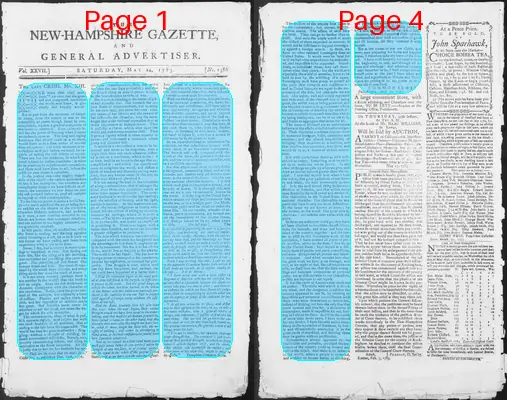
The New Hampshire Gazette And General Advertiser
Portsmouth, Exeter, Rockingham County, New Hampshire
What is this article about?
Thomas Paine's final 'Crisis' essay reflects on the American Revolution's triumphant end, urging the nation to preserve its unity, reputation, and virtuous character in peace, emphasizing the vital role of the states' union for future prosperity and sovereignty.
Merged-components note: This is the continuation of Thomas Paine's 'The Last Crisis' essay from page 1 to page 4, as indicated by the '[See last page]' at the end of the first part.
Clippings
1 of 2
OCR Quality
Full Text
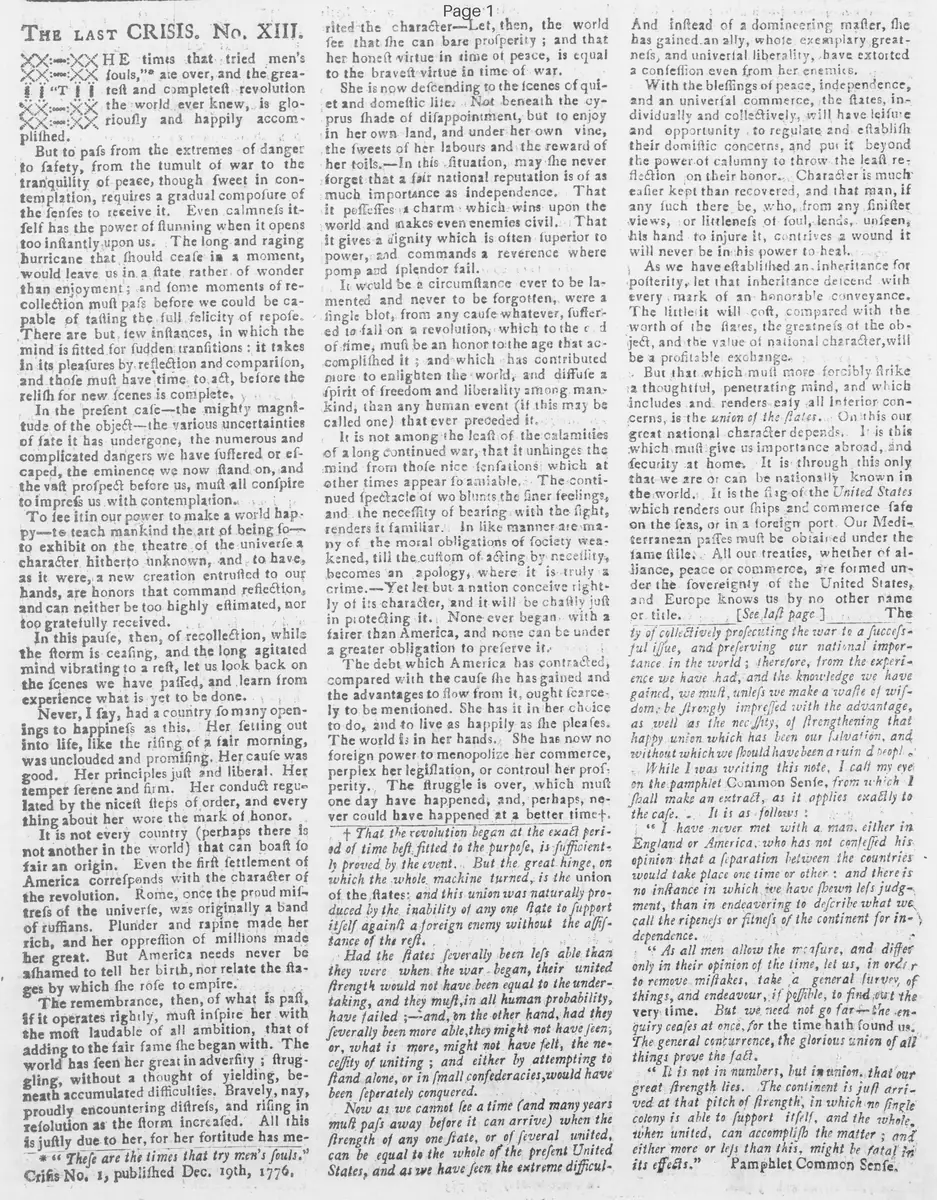
THE times that tried men's souls,* are over, and the greatest and completest revolution the world ever knew, is gloriously and happily accomplished.
But to pass from the extremes of danger to safety, from the tumult of war to the tranquility of peace, though sweet in contemplation, requires a gradual composure of the senses to receive it. Even calmness itself has the power of stunning when it opens too instantly upon us. The long and raging hurricane that should cease in a moment, would leave us in a state rather of wonder than enjoyment; and some moments of recollection must pass before we could be capable of tasting the full felicity of repose.
There are but few instances in which the mind is fitted for sudden transitions: it takes in its pleasures by reflection and comparison, and those must have time to act before the relish for new scenes is complete.
In the present case—the mighty magnitude of the object—the various uncertainties of fate it has undergone, the numerous and complicated dangers we have suffered or escaped, the eminence we now stand on, and the vast prospect before us, must all conspire to impress us with contemplations.
To see it in our power to make a world happy—to teach mankind the art of being so—to exhibit on the theatre of the universe a character hitherto unknown, and—to have, as it were, a new creation entrusted to our hands, are honors that command reflection, and can neither be too highly estimated, nor too gratefully received.
In this pause then, of recollection, while the storm is ceasing, and the long agitated mind vibrating to a rest, let us look back on the scenes we have passed, and learn from experience what is yet to be done.
Never, I say, had a country so many openings to happiness as this. Her setting out into life, like the rising of a fair morning, was unclouded and promising. Her cause was good. Her principles just and liberal. Her temper serene and firm. Her conduct regulated by the nicest steps of order, and everything about her wore the mark of honor.
It is not every country (perhaps there is not another in the world) that can boast so fair an origin. Even the first settlement of America corresponds with the character of the revolution. Rome, once the proud mistress of the universe, was originally a band of ruffians. Plunder and rapine made her rich, and her oppression of millions made her great. But America needs never be ashamed to tell her birth, nor relate the stages by which she rose to empire.
The remembrance, then, of what is past, if it operates rightly, must inspire her with the most laudable of all ambition, that of adding to the fair fame she began with. The world has seen her great in adversity; struggling, without a thought of yielding, beneath accumulated difficulties. Bravely, nay, proudly encountering distress, and rising in resolution as the storm increased. All this is justly due to her, for her fortitude has merited the character—Let, then, the world see that she can bear prosperity: and that her honest virtue in time of peace, is equal to the bravest virtue in time of war.
She is now descending to the scenes of quiet and domestic life. Not beneath the cypress shade of disappointment, but to enjoy in her own land, and under her own vine, the sweets of her labours and the reward of her toils.—In this situation, may she never forget that a fair national reputation is of as much importance as independence. That it possesses a charm which wins upon the world and makes even enemies civil. That it gives a dignity which is often superior to power, and commands a reverence where pomp and splendor fail.
It would be a circumstance ever to be lamented and never to be forgotten, were a single blot, from any cause whatever, suffered to fall on a revolution, which to the end of time, must be an honor to the age that accomplished it; and which has contributed more to enlighten the world, and diffuse a spirit of freedom and liberality among mankind, than any human event (if this may be called one) that ever preceded it.
It is not among the least of the calamities of a long continued war, that it unhinges the mind from those nice sensations which at other times appear so amiable. The continued spectacle of woe blunts the finer feelings, and the necessity of bearing with the sight, renders it familiar. In like manner are many of the moral obligations of society weakened, till the custom of acting by necessity becomes an apology, where it is truly a crime.—Yet let but a nation conceive rightly of its character, and it will be chastely just in protecting it. None ever began with a fairer than America, and none can be under a greater obligation to preserve it.
The debt which America has contracted, compared with the cause she has gained and the advantages to flow from it, ought scarcely to be mentioned. She has it in her choice to do, and to live as happily as she pleases. The world is in her hands. She has now no foreign power to monopolize her commerce, perplex her legislation, or control her prosperity. The struggle is over, which must one day have happened, and, perhaps, never could have happened at a better time.† That the revolution began at the exact period of time best fitted to the purpose, is sufficiently proved by the event. But the great hinge on which the whole machine turned, is the union of the states: and this union was naturally produced by the inability of any one state to support itself against a foreign enemy without the assistance of the rest.
Had the states severally been less able than they were when the war began, their united strength would not have been equal to the undertaking, and they must in all human probability, have failed: and, on the other hand, had they severally been more able, they might not have seen, or, what is more, might not have felt, the necessity of uniting; and either by attempting to stand alone, or in small confederacies, would have been separately conquered.
Now as we cannot see a time (and many years must pass away before it can arrive) when the strength of any one state, or of several united, can be equal to the whole of the present United States, and as we have seen the extreme difficulty of collectively prosecuting the war to a successful issue, and preserving our national importance in the world: therefore, from the experience we have had, and the knowledge we have gained, we must, unless we make a waste of wisdom; be strongly impressed with the advantage, as well as the necessity, of strengthening that happy union which has been our salvation, and without which we should have been a ruined people.
While I was writing this note, I cast my eye on the pamphlet Common Sense, from which I shall make an extract, as it applies exactly to the case. It is as follows:
“I have never met with a man, either in England or America, who has not confessed his opinion that a separation between the countries would take place one time or other: and there is no instance in which we have shewn less judgment, than in endeavoring to describe what we call the ripeness or fitness of the continent for independence.
“As all men allow the measure, and differ only in their opinion of the time, let us, in order to remove mistakes, take a general survey of things, and endeavour, if possible, to find out the very time. But we need not go far—the enquiry ceases at once, for the time hath found us. The general concurrence, the glorious union of all things prove the fact.
“It is not in numbers, but in union, that our great strength lies. The continent is just arrived at that pitch of strength, in which no single colony is able to support itself, and the whole, when united, can accomplish the matter; and either more or less than this, might be fatal in its effects.”
Pamphlet Common Sense.
* These are the times that try men's souls. Crisis No. 1, published Dec. 19th, 1776.
† That the revolution began at the exact period of time best fitted to the purpose, is sufficiently proved by the event. But the great hinge on which the whole machine turned, is the union of the states: and this union was naturally produced by the inability of any one state to support itself against a foreign enemy without the assistance of the rest.
[See last page]
The division of the empire into states is for our convenience: but abroad, this distinction ceases. The affairs of each state are local. They can go no farther than to itself. And were the whole worth of even the richest of them expended in revenue, it would not be sufficient to support sovereignty against a foreign attack. In short, we have no other national sovereignty than as United States. It would even be fatal for us if we had [one] too expensive to be maintained, and impossible to be supported. Individuals, or individual states, may call themselves what they please: but the world, and especially the world of enemies, is not to be held in awe by the whistling of a name.
Sovereignty must have power to protect all the parts that compose and constitute it: and as United States, we are equal to the importance of the title, but otherwise we are not. Our union, well and wisely regulated and cemented, is the cheapest way of being great, the easiest way of being powerful, and the happiest invention in government which the circumstances of America can admit of: because it collects from each state that which, by being inadequate, can be of no use to it, and forms an aggregate that serves for all.
The states of Holland are an unfortunate instance of the effects of individual sovereignty. Their disjointed condition exposes them to numerous intrigues, loss, calamities and enemies; and the almost impossibility of bringing their measures to a decision, and that decision into execution, is to them, and would be to us, a source of endless misfortune.
It is with confederate states as with individuals in society. Something must be yielded up to make the whole secure. In this view of things we gain by what we give, and draw an annual interest greater than the capital. I ever feel myself hurt when I hear the union, that great palladium of our liberty and safety, the least irreverently spoken of. It is the most sacred thing in the constitution of America, and that which every man should be the most proud and tender of.
Our citizenship in the United States is our national character. Our citizenship in any particular state is only our local distinction. By the latter we are known at home; by the former, to the world. Our great title is, Americans; our inferior ones vary with the place.
So far as my endeavors could go, they have all been directed to conciliate the affections, unite the interests, and draw and keep the mind of the country together: and the better to assist in this foundation work of the revolution, I have avoided all places of profit or office, either in the state I live in, or in the United States; kept myself at a distance from all parties and party connections, and even disregarded all private and inferior concerns. And when we take into view the great work we have gone through, and feel, as we ought to feel, the just importance of it, we shall then see, that the little wranglings and indecent contentions of personal party, are as dishonorable to our characters, as they are injurious to our repose.
It was the cause of America that made me an author. The force with which it struck my mind, and the dangerous condition the country appeared to me in; by courting an impossible and unnatural reconciliation with those who were determined to reduce her, instead of striking out into the only line that could cement and save her, a declaration of independence, made it impossible for me, feeling as I did, to be silent. And if in the course of more than seven years, I have rendered her any service, I have likewise added something to the reputation of literature, by freely and disinterestedly employing it in the great cause of mankind, and showing there may be genius without prostitution.
Independence always appeared to me practicable and probable, provided the sentiment of the country could be formed and held to the object. And there is no instance in the world, where a people so extended, and wedded to former habits of thinking, and under such a variety of circumstances, were so instantly and effectually pervaded, by a turn in politics, as in the case of independence, and who supported their opinion, undiminished, thro' such a succession of good and ill fortune, till they crowned it with success.
But as the scenes of war are closed, and every man preparing for home and happier times, I therefore take my leave of the subject. I have most sincerely followed it from the beginning to end, and through all its turns and windings: and whatever country I may hereafter be in, I shall always feel an honest pride at the part I have taken and acted, and a gratitude to Nature and Providence for putting it in my power to be of some use to mankind.
COMMON SENSE.
Philadelphia, April 19, 1783.
What sub-type of article is it?
What keywords are associated?
What entities or persons were involved?
Editorial Details
Primary Topic
Reflection On The Revolution's Success And The Necessity Of National Union In Peace
Stance / Tone
Optimistic Exhortation To Preserve Unity And Virtue
Key Figures
Key Arguments