Thank you for visiting SNEWPapers!
Sign up free
Gazette Of The United States
New York, New York County, New York
What is this article about?
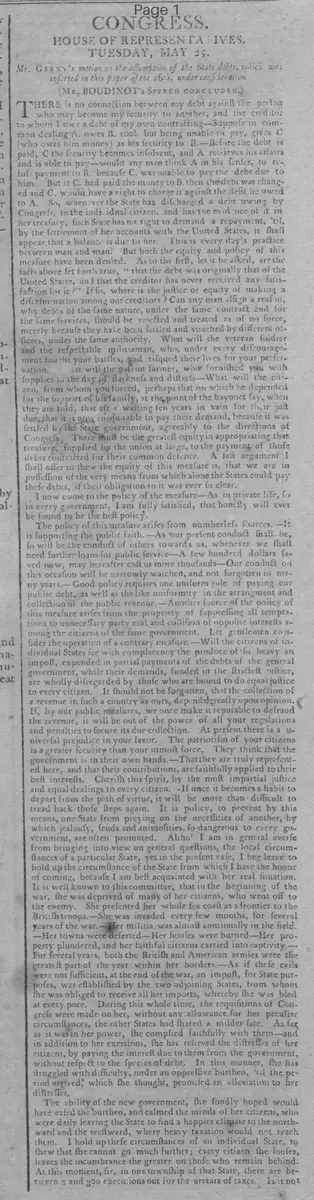
On Tuesday, May 25, in the U.S. House of Representatives, Mr. Boudinot concluded his speech advocating for the federal assumption of state debts. He argued for equity toward creditors, especially veterans and suppliers, and the policy benefits of upholding public faith and uniform debt payment to prevent state conflicts and ensure revenue collection.
Merged-components note: This is a continuation of the report on congressional proceedings (Mr. Boudinot's speech) across pages, so merge into a single domestic_news component.
Clippings
1 of 2
OCR Quality
Full Text
HOUSE OF REPRESENTATIVES.
TUESDAY, MAY 25.
Mr. Gerry's motion on the assumption of the State debts, which was
inserted in this paper of the 26th, under consideration
(MR. BOUDINOT's SPEECH CONCLUDED.)
There is no connection between my debt against the person
who may become my security to another, and the creditor
to whom I owe a debt of my own contracting—Suppose in common
dealing A. owes B. 100l. but being unable to pay, gives C
(who owes him money) as his security to B.—Before the debt is
paid, C the security becomes insolvent, and A retrieves his affairs
and is able to pay—would any man think A in his senses, to refuse
payment to B. because C. was unable to pay the debt due to
him. But if C. had paid the money to B. then the debt was changed
and C. would have a right to charge it against the debt he owed
to A. So, whenever the State has discharged a debt owing by
Congress, to the individual citizen, and has the evidence of it in
her treasury, such State has no right to demand a repayment, 'til,
by the settlement of her accounts with the United States, it shall
appear that a balance is due to her. This is every day's practice
between man and man. But both the equity and policy of this
measure have been denied. As to the first, let it be asked, are the
facts above set forth true, "that the debt was originally that of the
United States, and that the creditor has never received any satisfaction
for it?" If so, where is the justice or equity of making a discrimination
among our creditors? Can any man assign a reason,
why debts of the same nature, under the same contract and for
the same services, should be rejected and treated as of no force,
merely because they have been settled and vouched by different officers,
under the same authority. What will the veteran soldier
and the respectable militiaman, who, under every discouragement
fought your battles, and risked their lives for your preservation.
What will the patriot farmer, who furnished you with
supplies in the day of darkness and distress—What will the citizen,
from whom you forced, perhaps that on which he depended
for the support of his family, at the point of the bayonet say, when
they are told, that after waiting ten years in vain for their just
due, that it is now inequitable to pay their demand, because it was
settled by the State government, agreeably to the directions of
Congress. There must be the greatest equity in appropriating that
treasure, supplied by the union at large, to the payment of those
debts contracted for their common defence. A last argument I
shall offer to shew the equity of this measure is, that we are in
possession of the very means from which alone the States could pay
these debts, if their obligation to it was ever so clear.
I now come to the policy of the measure—As in private life, so
in every government, I am fully satisfied, that honesty will ever
be found to be the best policy.
The policy of this measure arises from numberless sources.—It
is supporting the public faith.—As our present conduct shall be,
so will be the conduct of others towards us, whenever we shall
need further loans for public service—A few hundred dollars saved
now, may hereafter cost us more thousands—Our conduct on
this occasion will be narrowly watched, and not forgotten in many
years.—Good policy requires one uniform rule of paying our
public debt, as well as the like uniformity in the arrangement and
collection of the public revenue.—Another source of the policy of
this measure arises from the propriety of suppressing all temptations
to unnecessary party zeal and collision of opposite interests among
the citizens of the same government. Let gentlemen consider
the operation of a contrary measure.—Will the citizens of individual
States see with complacency the produce of so heavy an
impost, expended in partial payments of the debts of the general
government, while their demands, founded in the strictest justice,
are wholly disregarded by those who are bound to do equal justice
to every citizen. It should not be forgotten, that the collection of
a revenue in such a country as ours, depends greatly upon opinion.
If, by our public measures, we once make it reputable to defraud
the revenue, it will be out of the power of all your regulations
and penalties to secure its due collection. At present there is a universal
prejudice in your favor. The patriotism of your citizens
is a greater security than your utmost force. They think that the
government is in their own hands.—That they are truly represented
here, and that their contributions, are faithfully applied to their
best interests. Cherish this spirit, by the most impartial justice
and equal dealings to every citizen.—If once it becomes a habit to
depart from the path of virtue, it will be more than difficult to
tread back those steps again. It is policy, to prevent by this
means, one State from preying on the necessities of another, by
which jealousy, feuds and animosities, so dangerous to every government,
are often promoted. Altho' I am in general averse
from bringing into view on general questions, the local circumstances
of a particular State, yet in the present case, I beg leave to
hold up the circumstance of the State from which I have the honor
of coming, because I am best acquainted with her real situation.
It is well known to this committee, that in the beginning of the
war, she was deprived of many of her citizens, who went off to
the enemy. She presented her whole sea coast as a frontier to the
British troops.—She was invaded every few months, for several
years of the war.—Her militia was almost continually in the field.
—Her towns were deserted—Her houses were burned—Her property
plundered, and her faithful citizens carried into captivity.—
For several years, both the British and American armies were the
greatest part of the year within her borders.—As if these evils
were not sufficient, at the end of the war, an impost, for State purposes,
was established by the two adjoining States, from whom
she was obliged to receive all her imports, whereby she was bled
at every pore. During this whole time, the requisitions of Congress
were made on her, without any allowance for her peculiar
circumstances, the other States had shared a milder fate. As far
as it was in her power, she complied faithfully with them—and
in addition to her exertions, she has relieved the distresses of her
citizens, by paying the interest due to them from the government,
without respect to the species of debt. In this manner, she has
struggled with difficulty, under an oppressive burthen, 'til the period
arrived, which she thought, promised an alleviation to her
distresses.
The ability of the new government, she fondly hoped would
have eased the burthen, and calmed the minds of her citizens, who
were daily leaving the State to find a happier climate to the northward
and the westward, where heavy taxation would not reach
them. I hold up these circumstances of an individual State, to
shew that she cannot go much further; every citizen she loses,
leaves the incumbrance the greater on those who remain behind.
At this moment, sir, in one township of that State, there are between
200 and 300 executions out for the arrears of taxes. Is it not
It is the best of policy to equalize the burdens of so arduous a struggle as was brought upon us by the late war, and prevent a sister State from sinking after getting through so far?—Is there any reason that after exerting herself to the utmost, and aiding you in the day of distress, that now you are in possession of the resources of the country, and she is deprived of the only means she had of helping herself (I mean by her paper money) that she should still be left to struggle on without relief?—But, sir, if you refuse this measure and do not resume these debts, it is not contemplated by any one, to embrace the excise, but to leave that to the individual States. What then must be the situation of New-Jersey, if New-York and Pennsylvania should establish a general excise for the payment of their particular citizens? Would not New-Jersey pay her full proportion, as she did formerly under their imposts? It never can be consistent with good policy, thus to leave your citizens to such different measures of public justice.
The last evidence of the policy of this measure arises from the impossibility of otherwise funding the domestic debt with certainty, while the States are necessitated to claim particular sources of revenue. This must produce a clashing of jurisdiction, and a continual jarring of interests.
I should now close my argument sir, was it not for an objection which I confess when I first heard it struck me with some conviction, but on a closer examination, I found not to bear a scrutiny. It was, that if the measure could be carried by a very small majority, it would be highly impolitic, because if a right measure and now rejected, it could easily be adopted hereafter; but if a wrong measure and now adopted, it could not easily be remedied when the evil was acknowledged.
Sir, if the debt is a just one against the United States, and we are able to pay it, I cannot admit the idea of a longer refusal—the delay of justice is a denial of justice. What would be the consequence of paying this debt and afterwards being convinced of the injustice of it? You would charge it to the individual State, and the only loss would be the interest of the interest you might pay—But, sir, if you refuse it and find you are wrong, you are doing an act of palpable injustice by which you may ruin thousands of your citizens and depopulate your States by driving the most valuable of them to seek an asylum in the wilds of the Ohio and Lake Erie.
It will be a very insufficient excuse to our suffering host of creditors, that from local principles and private motives, there could only be obtained a small majority to do them justice, and if we were wrong in the refusal, we could set all right when we were convinced of it. I believe this will scarcely justify us in our own eyes. But will not this delay impede the operation of the general system—and if this once takes place, who can foresee where it will end. An attempt to do justice, can do us no essential injury even if we should be wrong, but a refusal in our present circumstances may raise a spirit, that cannot easily be laid.
Although the question, sir, before you is on the assumption of the State debts, so called for sake of distinction, yet as an objection had been made in the House yesterday, and an endeavor used to separate this part of the domestic debt from that which is founded on certificates given by the immediate officers of Congress, supposing this to be a subject essentially different from the one referred to the committee, I thought it my duty to show that having been contracted by the United States in Congress assembled, for the general defence of the union, there remained no foundation in reason or justice for the objection, although the settlements of the accounts, and the balances due, were certified by the individual States. And I think that it must as clearly appear that no solid reason can be assigned, why the individual States should not now be delivered from the burden of them, since you have delivered her from the means of payment.
These arguments address themselves to the understanding and the judgment.—It is under their impression, and from a thorough conviction of their force and propriety under every view of the subject, that I have heretofore and shall still give my vote for the resumption of these debts, and of course, in favor of the amendment now before the committee.
What sub-type of article is it?
What keywords are associated?
What entities or persons were involved?
Domestic News Details
Event Date
Tuesday, May 25
Key Persons
Event Details
Mr. Boudinot's speech in support of Mr. Gerry's motion for the federal assumption of state debts, emphasizing equity for creditors like veterans and farmers, policy benefits including public faith, uniform debt payment, and preventing state conflicts, with specific reference to New Jersey's wartime hardships.